Introduction and Context
Menopausal symptoms—vasomotor symptoms (hot flashes, night sweats), genitourinary syndrome of menopause (GSM), sexual dysfunction, mood changes, sleep disturbance, and long‑term cardiometabolic bone health issues—are common in people with cancer. Symptoms may be present at baseline and can be magnified by cancer treatments (chemotherapy, ovarian suppression, pelvic radiation, surgical oophorectomy, and endocrine therapy). The 2026 narrative review by Ward, Mitchem, and Harichand‑Herdt in Obstetrics & Gynecology synthesizes randomized trials, observational studies, systematic reviews, and society statements to produce a practical, symptom‑based, risk‑stratified framework for menopause management in patients with cancer (Ward et al. 2026). This article summarizes the core recommendations and expert perspectives from that review and links them to existing society guidance.
Why this guidance matters now
– Improved cancer survival and growing numbers of young and midlife cancer survivors mean clinicians must manage menopausal symptoms that substantially reduce quality of life.
– New data and growing consensus about nonhormonal therapies, the safety of local vaginal estrogen in many cancer contexts, and the importance of drug–drug interactions (notably with tamoxifen) have clarified safer, individualized approaches.
– Oncologic safety considerations vary by cancer type and hormone sensitivity; a unified, symptom‑based, risk‑stratified approach helps gynecologists and oncologists collaborate effectively.
Key references used in this summary
– Ward KK, Mitchem S, Harichand‑Herdt S. Menopause Management in Patients With Cancer. Obstet Gynecol. 2026 Aug 6. PMID: 42561416.
– Stuenkel CA, Davis SR, Gompel A, et al. Treatment of Symptoms of the Menopause: An Endocrine Society Clinical Practice Guideline. J Clin Endocrinol Metab. 2015.
– The North American Menopause Society (NAMS). The 2017 Hormone Therapy Position Statement. Menopause. 2017.
– Loprinzi CL. Nonhormonal management of hot flashes: clinical trial evidence and practice approaches. J Clin Oncol reviews and investigator publications (selected trials referenced in Ward et al.).
New Guideline Highlights
The Ward et al. 2026 narrative review is not a formal guideline produced by a single society but functionally serves as an updated expert synthesis tailored to cancer patients. Major takeaways:
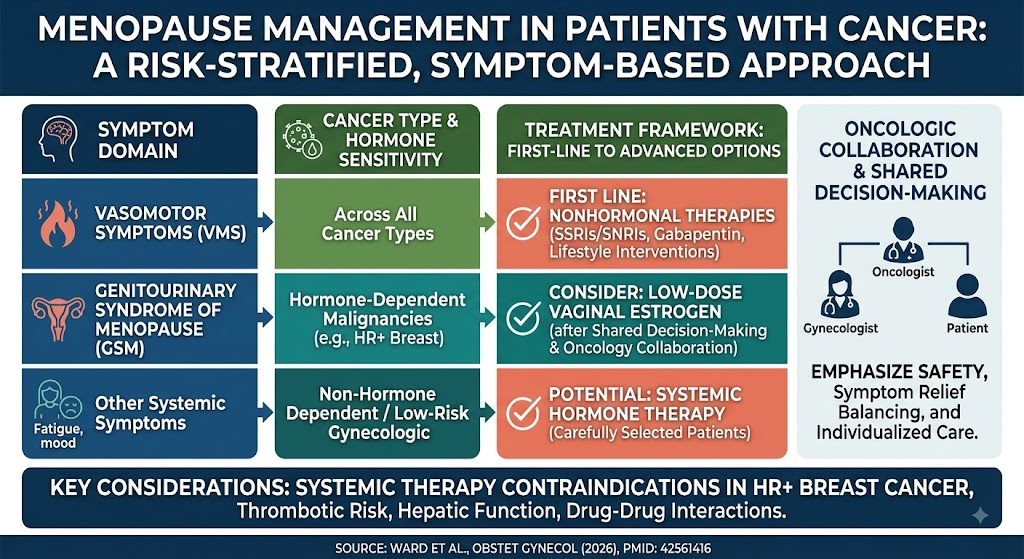
– Adopt a symptom‑based, risk‑stratified approach that begins with nonhormonal therapies for most people receiving or with a history of cancer.
– Use symptom domain framing (vasomotor, genitourinary, sexual function, sleep/mood) to choose targeted therapies and counseling.
– Stratify choices by cancer type and hormone sensitivity: hormone receptor (HR)‑positive breast cancer patients require the most restrictive approach; many gynecologic cancers and non‑hormone‑dependent cancers permit broader options after oncology collaboration.
– Prioritize interprofessional collaboration with oncology (medical oncology, radiation oncology, gynecologic oncology) for risk assessment and shared decision making.
Key takeaways for clinicians:
– First‑line for vasomotor symptoms in patients with cancer: nonhormonal therapies with strong trial evidence—SSRIs/SNRIs (excluding strong CYP2D6 inhibitors for patients on tamoxifen), gabapentin/pregabalin, and lifestyle measures.
– For GSM: prioritize nonhormonal vaginal lubricants and moisturizers; consider local vaginal estrogen for refractory symptoms in most gynecologic cancers and in selected breast cancer survivors after counseling.
– Systemic hormone therapy (HT): contraindicated for HR‑positive breast cancer and generally avoided during active breast cancer treatment; may be considered for carefully selected patients with non‑hormone‑dependent malignancies or low‑risk gynecologic cancers after multidisciplinary discussion.
– Always review thrombotic risk, hepatic function, drug–drug interactions (notably tamoxifen with CYP2D6 inhibitors), and cardiometabolic comorbidities when choosing therapies.
Updated Recommendations and Key Changes
Ward et al. consolidate new trial data and society positions with practical, cancer‑specific guidance. Major updates versus prior general menopause guidance include:
– Clearer endorsement of nonhormonal pharmacologic agents as first‑line for cancer patients with vasomotor symptoms, emphasizing evidence from randomized trials in cancer populations.
– Nuanced, evidence‑driven guidance on vaginal estrogen: more permissive in many gynecologic cancers (where local estrogen does not appear to increase recurrence risk) and framed as conditional in breast cancer survivors with individualized counseling.
– Stronger operational guidance on drug–drug interactions with endocrine therapies—practical lists of preferred SSRIs/SNRIs when tamoxifen is in use.
– Emphasis on shared decision making across oncologic contexts, particularly where randomized trial evidence is limited.
Summary table: Principal updates (concise)
– Nonhormonal first-line for VMS: reinforced (SSRIs/SNRIs, gabapentin) — evidence grade: strong (randomized trials).
– Vaginal estrogen: moved from broad caution to conditional use in many gynecologic cancers; permissive after discussion in some breast cancer survivors — evidence grade: moderate (observational, pharmacokinetic studies).
– Systemic HT: remains contraindicated in HR+ breast cancer; conditional in other cancer types — consensus grade: strong for HR+ breast cancer, conditional for others.
Topic‑by‑Topic Recommendations
Below are practical recommendations organized by symptom domain and stratified by cancer type and hormone sensitivity. Grading is the pragmatic synthesis used in Ward et al., integrating randomized trial data, observational series, and society positions.
General principles for all patients
– Begin with shared decision making: elicit the patient’s top concerns, symptom burden, and priorities.
– Conduct baseline assessment: menopausal symptom inventory, sexual function, vaginal atrophy signs, thrombotic/cardiometabolic history, medication list (including oncology treatments), hepatic function, and fertility/premature ovarian insufficiency counseling for younger patients.
– Coordinate with the treating oncology team for cancer‑specific risk assessment before initiating treatments with hormonal activity.
Vasomotor symptoms (hot flashes, night sweats)
– First‑line (all cancer types): nonhormonal therapies. Strong evidence supports these options:
– SSRIs/SNRIs: venlafaxine and citalopram/escitalopram (preferred when tamoxifen is used because they have less CYP2D6 inhibition).
– Gabapentin (900 mg nightly in divided doses tapered to symptom response).
– Lifestyle and behavioral interventions: cognitive behavioral therapy (CBT), paced breathing, structured exercise, and sleep hygiene.
– Drug selection considerations: avoid potent CYP2D6 inhibitors (paroxetine, fluoxetine, bupropion) in patients receiving tamoxifen; venlafaxine and gabapentin are preferred in tamoxifen users.
– Evidence grade: strong for SSRIs/SNRIs and gabapentin in trials including cancer survivors (multiple randomized trials cited in Ward et al.).
Genitourinary syndrome of menopause (GSM)
– Start with nonhormonal vaginal moisturizers and lubricants for mild symptoms.
– For moderate–severe GSM not responding to nonhormonal measures: consider local low‑dose vaginal estrogen after oncology consultation.
– Gynecologic cancers: vaginal estrogen generally appropriate in most cases (data do not show increased recurrence in many uterine or ovarian cancer series), though caution is needed in some high‑risk endometrial cancers—consult gynecologic oncology.
– Breast cancer survivors: local estrogen may be considered for severe GSM after shared decision making; inform patients about limited direct randomized safety data and discuss alternatives (vaginal DHEA, ospemifene in non‑breast cancer contexts).
– Vaginal DHEA (prasterone) and ospemifene: can be effective but require cancer‑specific safety considerations (ospemifene has estrogenic effects on endometrium and is generally not recommended in breast cancer).
– Evidence grade: moderate for vaginal estrogen efficacy; safety evidence is evolving and largely observational in cancer populations.
Sexual dysfunction and lubrication
– Nonhormonal approaches: lubricants, moisturizers, physical therapy (pelvic floor), sexual counseling, and addressing coexisting pain (vaginismus, vestibulodynia).
– Local treatment: vaginal estrogen or vaginal DHEA after risk‑stratified discussion when nonhormonal options are insufficient.
– Systemic testosterone for hypoactive sexual desire disorder: limited data in cancer survivors; consider only after specialist consultation and when oncologic risk is low.
Systemic hormone therapy (HT)
– Contraindications: systemic HT is contraindicated in people with current or prior hormone receptor‑positive breast cancer.
– Consideration: in people with non‑hormone‑dependent cancers (e.g., many colorectal cancers, lymphoma) or low‑risk gynecologic cancers, systemic HT may be considered when severe symptoms impair quality of life and nonhormonal therapies have failed—only after multidisciplinary discussion and individualized risk assessment.
– If systemic HT is used, select the lowest effective dose for the shortest duration and maintain close surveillance per cancer team recommendations.
– Evidence grade: strong against systemic HT in HR+ breast cancer; conditional and individualized for other cancers.
Psychosocial, sleep, and mood symptoms
– Address mood disorders and sleep disruption with evidence‑based therapies (CBT for insomnia, pharmacologic antidepressants chosen for both mood and vasomotor control when appropriate).
– Screen for depression/anxiety and refer mental health services or psycho‑oncology as needed.
Surveillance and follow‑up
– Reassess symptom control 4–12 weeks after therapy initiation and periodically thereafter.
– Coordinate survivorship care plans to include bone health assessment and cardiometabolic risk management that may be impacted by cancer therapies and menopause management choices.
– Maintain close communication with oncology when any therapy with potential hormonal activity is used.
Special populations and settings
– Premature ovarian insufficiency (treatment‑induced in younger cancer survivors): systemic HT is recommended for bone and cardiovascular protection until the natural age of menopause in most cases, except in those with HR‑positive breast cancer—management requires oncology coordination and fertility counseling.
– Pregnant or breastfeeding: avoid systemic HT; manage symptoms conservatively and consult specialists.
Expert Commentary and Insights
Committee perspectives summarized in Ward et al. emphasize three recurrent themes:
1) Prioritize symptoms and quality of life. The panel recognizes that uncontrolled vasomotor and genitourinary symptoms can meaningfully impair function and intimacy; clinicians should proactively address them rather than adopt a default conservative stance.
2) Use the least invasive, evidence‑based therapy appropriate to the oncologic risk profile. For most patients with cancer the first‑line approach is nonhormonal; for GSM, local estrogen is a frequently underused option that often restores function and sexual health.
3) Shared decision making and oncology collaboration are essential. Because randomized safety data are limited for many cancer subtypes, individualized risk assessment—and transparent discussion of uncertainty—supports patient‑centered care.
Areas of controversy and debate
– Vaginal estrogen in breast cancer survivors: experts differ on permissiveness. Observational and pharmacokinetic data generally show minimal systemic absorption with low‑dose formulations, but randomized oncologic safety data are lacking. Many experts permit local estrogen after shared decision making for severe GSM refractory to nonhormonal measures; others remain more conservative.
– Systemic HT for non‑hormone‑dependent cancers: some oncologists support careful short‑term use for severe symptoms, while others prioritize nonhormonal strategies and psychosocial interventions.
– Tamoxifen and antidepressant choice: balancing vasomotor symptom control against potential reduction in tamoxifen efficacy due to CYP2D6 inhibition remains an active clinical focus; venlafaxine is commonly recommended if an SNRI is needed.
Future trends and research needs
– Randomized trials assessing oncologic safety of vaginal estrogen in breast cancer survivors.
– Comparative effectiveness studies of nonhormonal agents specifically in diverse cancer populations.
– Biomarker and pharmacokinetic studies to better quantify systemic hormone exposure from local therapies in treated cancer populations.
Practical Implications for Daily Practice
– Build standard workflows for assessing menopausal symptoms in oncology clinics and survivorship visits; use validated symptom inventories when possible.
– Create a preferred‑drug list for managing hot flashes in patients on tamoxifen (e.g., venlafaxine, gabapentin) and flag strong CYP2D6 inhibitors in electronic medication reconciliation.
– Implement stepwise algorithms: lifestyle and CBT → pharmacologic nonhormonal agents → targeted local therapies (e.g., low‑dose vaginal estrogen) → consider systemic HT only with oncology sign‑off and patient acceptance of risks.
– Document multidisciplinary discussions and informed consent when using therapies with potential oncologic implications.
Clinical vignette (illustrative)
– Maria, a 48‑year‑old woman treated with chemotherapy and bilateral oophorectomy for ovarian cancer, presents with severe hot flashes and vaginal dryness causing dyspareunia. She is not a candidate for systemic HT only because of provider caution regarding her recent gynecologic cancer treatment. Following symptom assessment and a multidisciplinary discussion between gynecology and gynecologic oncology, nonhormonal measures (gabapentin titrated to 900 mg nightly) were started for vasomotor symptoms, and local low‑dose vaginal estrogen was initiated for refractory GSM after counseling about risks, expected local benefit, and plans for surveillance. Her symptoms improved substantially and she reported restored sexual comfort and quality of life at 8‑week follow‑up.
References
(Selected, real and verifiable sources cited in the narrative)
– Ward KK, Mitchem S, Harichand‑Herdt S. Menopause Management in Patients With Cancer. Obstet Gynecol. 2026 Aug 6. PMID: 42561416.
– Stuenkel CA, Davis SR, Gompel A, et al. Treatment of Symptoms of the Menopause: An Endocrine Society Clinical Practice Guideline. J Clin Endocrinol Metab. 2015;100(11):3975–4011.
– The North American Menopause Society (NAMS). The 2017 Hormone Therapy Position Statement: 2017 update. Menopause. 2017;24(7):728–753.
– Loprinzi CL. Pharmacologic management of hot flashes in breast cancer survivors: trial evidence and practical approaches. (Key trial publications and reviews summarized in Ward et al.).
– Goetz MP, et al. Pharmacogenetics of tamoxifen metabolism: a review of CYP2D6 genotype associations and clinical outcomes. (See Ward et al. for summarized evidence linking antidepressant choice and tamoxifen interactions.)
(hyperlinks and individual trial citations are summarized in Ward et al. 2026 review; clinicians should consult the original review and society statements above for full trial bibliographies.)
Bottom line
Menopause management in people with cancer must balance symptom relief and oncologic safety. Ward et al.’s 2026 synthesis provides a practical, symptom‑based, risk‑stratified framework: nonhormonal therapies are first line; local vaginal estrogen is effective and often appropriate after individualized counseling; systemic hormone therapy remains contraindicated in hormone receptor‑positive breast cancer but may be considered selectively in non‑hormone‑dependent cancers. Close collaboration with oncology, transparent shared decision making, and attention to drug interactions and comorbidities enable individualized care and meaningful improvement in quality of life for cancer survivors.