Highlight
- PMOS affects 17.1% of pregnant women at risk for hyperglycemia and is associated with younger maternal age and higher baseline BMI.
- PMOS independently increases the odds of early gestational diabetes mellitus (GDM) and adverse neonatal outcomes, including higher neonatal intensive care admissions.
- No modifying effects of maternal BMI or ethnicity on PMOS-associated risks were observed, suggesting intrinsic disease-related pregnancy complications.
- Findings emphasize the clinical importance of early screening and tailored management for pregnant women with PMOS.
Study Background
Polyendocrine metabolic ovarian syndrome (PMOS), commonly overlapping with polycystic ovary syndrome (PCOS), is a complex endocrine disorder frequently associated with metabolic derangements such as insulin resistance, obesity, and hyperandrogenism. Women with PMOS have heightened reproductive challenges and metabolic risks, which may exacerbate pregnancy complications. Given the global rise in metabolic diseases and increasing pregnancy rates in women with PMOS, understanding the impact of PMOS on maternal and neonatal outcomes is important for optimizing pregnancy management and reducing perinatal morbidity. Despite prior studies indicating links between PCOS and gestational diabetes mellitus, adverse pregnancy outcomes remain variably characterized, with limited large prospective datasets and unclear interactions with factors such as BMI and ethnicity. This nested prospective cohort study within an international randomized trial aimed to clarify these associations.
Study Design
The study was conducted as a prospective nested cohort within the multinational Treatment of Booking Gestational Diabetes Mellitus (TOBOGM) randomized controlled trial, which enrolled pregnant women identified as at risk for hyperglycemia. A total of 3,645 participants were included, with 17.1% (n≈623) meeting diagnostic criteria for PMOS. Baseline demographic and clinical variables including maternal age, BMI, ethnicity, parity, smoking status, and educational level were recorded at the booking visit.
Maternal outcomes assessed included the development and timing of gestational diabetes, as well as adverse pregnancy complications. Neonatal outcomes encompassed a composite measure of adverse conditions and rates of neonatal intensive care or special care nursery admission. Multivariable logistic and linear regression models were used to determine adjusted odds ratios (aORs) and effect sizes, controlling for confounding factors and exploring potential interactions with BMI and ethnicity.
Key Findings
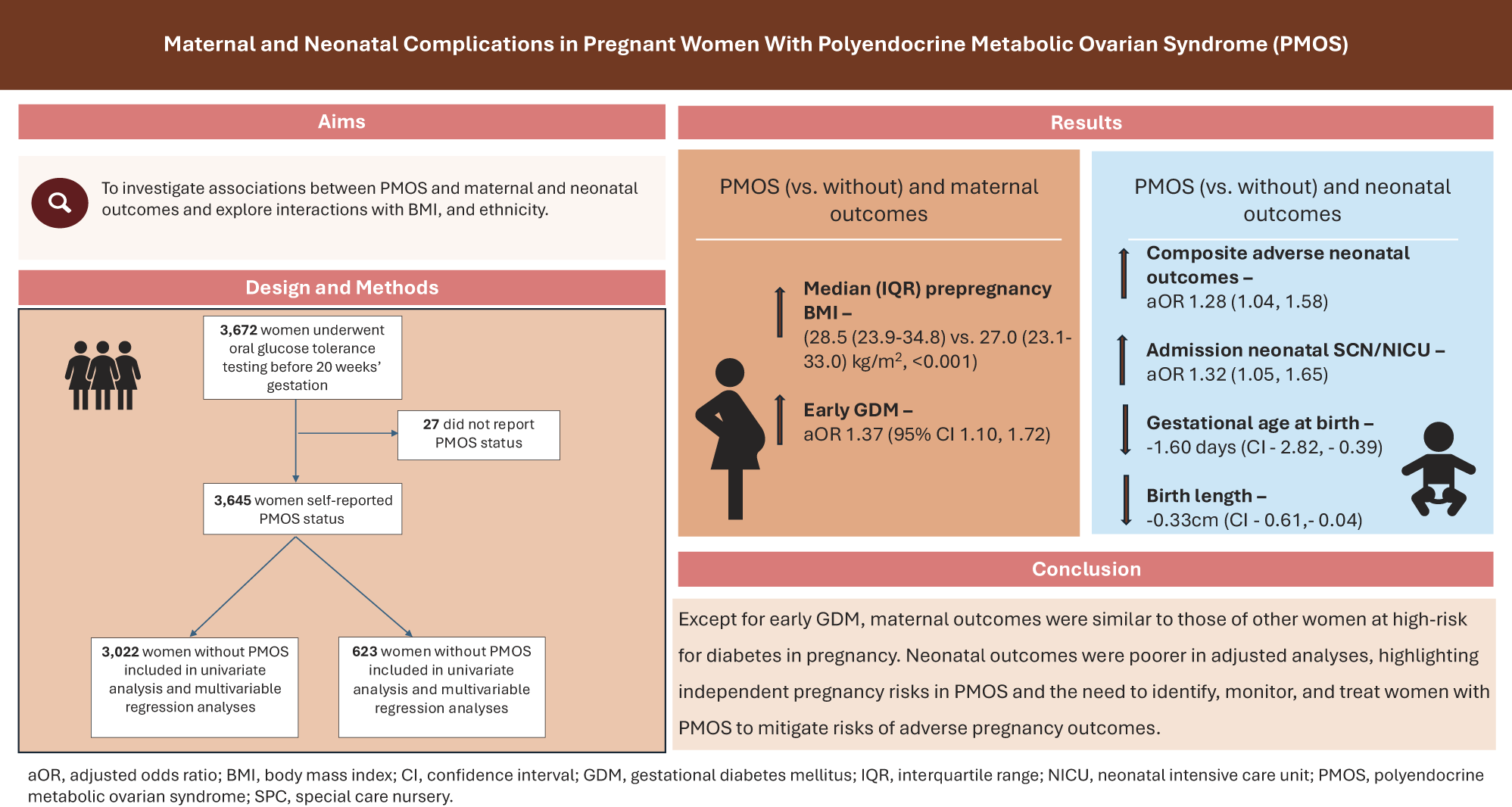
Women with PMOS were on average younger (mean age 30.6 vs. 31.3 years; P<0.001), had higher baseline BMI (median 29.8 kg/m2 vs. 28.1 kg/m2; P<0.001), and were more likely to be primigravid (30.2% vs. 25.7%; P=0.022) compared to those without PMOS.
Among major outcomes, PMOS was associated with a significantly increased risk of early gestational diabetes, with an adjusted odds ratio of 1.37 (95% CI 1.10–1.72), indicating an approximately 37% higher risk after controlling for confounders. Neonatal adverse outcomes, including various morbidity markers, showed an aOR of 1.28 (95% CI 1.04–1.58), and admissions to neonatal intensive or special care units were increased (aOR 1.32, 95% CI 1.05–1.65).
Additionally, PMOS was linked to slightly earlier delivery (mean reduction in gestational age of 1.6 days; 95% CI -2.82 to -0.39) and shorter birth length (-0.33 cm; 95% CI -0.61 to -0.04). There was no evidence of interaction effects between PMOS and baseline BMI or ethnicity, suggesting that PMOS independently contributes to these pregnancy risks irrespective of these factors.
Expert Commentary
This well-powered, rigorously conducted prospective nested cohort provides compelling evidence that PMOS independently amplifies the risk of early-onset gestational diabetes and worse neonatal outcomes. The absence of modifying effects from BMI or ethnicity is notable, as it underscores intrinsic pathophysiological mechanisms of PMOS impacting pregnancy beyond general obesity or ethnic predispositions. Insulin resistance and endocrine dysregulation in PMOS likely contribute to placental dysfunction and fetal growth disturbance, warranting further mechanistic studies.
While the study’s strengths include comprehensive adjustment for confounders and multicenter international representation, limitations include reliance on clinical diagnostic criteria of PMOS which may have variability, and the observational design precluding causality. The findings align with existing literature emphasizing heightened metabolic risk in PMOS but expand understanding to neonatal outcomes and the independence from BMI effects.
Clinically, this study supports early identification and intensified surveillance for women with PMOS during pregnancy, including timely screening for GDM and close fetal monitoring. Interventions targeting metabolic optimization prior to and during pregnancy may mitigate these risks but require further clinical trials.
Conclusion
Maternal polyendocrine metabolic ovarian syndrome is significantly associated with increased risks of early gestational diabetes, adverse neonatal outcomes, and subtle alterations in birth parameters independent of BMI and ethnicity. These findings highlight the necessity of recognizing PMOS as a distinct pregnancy risk factor to guide tailored prenatal care. Future research should elucidate underlying mechanisms and evaluate intervention strategies to improve both maternal and neonatal health outcomes in this vulnerable population.
Funding and ClinicalTrials.gov Identifier
The study was performed within the framework of the TOBOGM randomized controlled trial. Detailed funding information and trial registration details were reported in the primary publication.
References
– Neven ACH, et al. Maternal and Neonatal Complications in Pregnant Women With Polyendocrine Metabolic Ovarian Syndrome: A Nested Prospective Cohort Study. Diabetes Care. 2026 Sep 16. PMID: 42747940.
– Teede HJ, et al. Polycystic ovary syndrome: a complex condition with psychological, reproductive and metabolic manifestations that impacts health across the lifespan. BMC Med. 2010;8:41.
– Bozdag G, et al. The prevalence and phenotypic features of polycystic ovary syndrome: a systematic review and meta-analysis. Hum Reprod. 2016 Dec;31(12):2841-2855.
– Ding T, et al. Increased risk of pregnancy complications in women with polycystic ovary syndrome: a systematic review and meta-analysis. Hum Reprod. 2011 May;26(5):1412-21.