Highlight
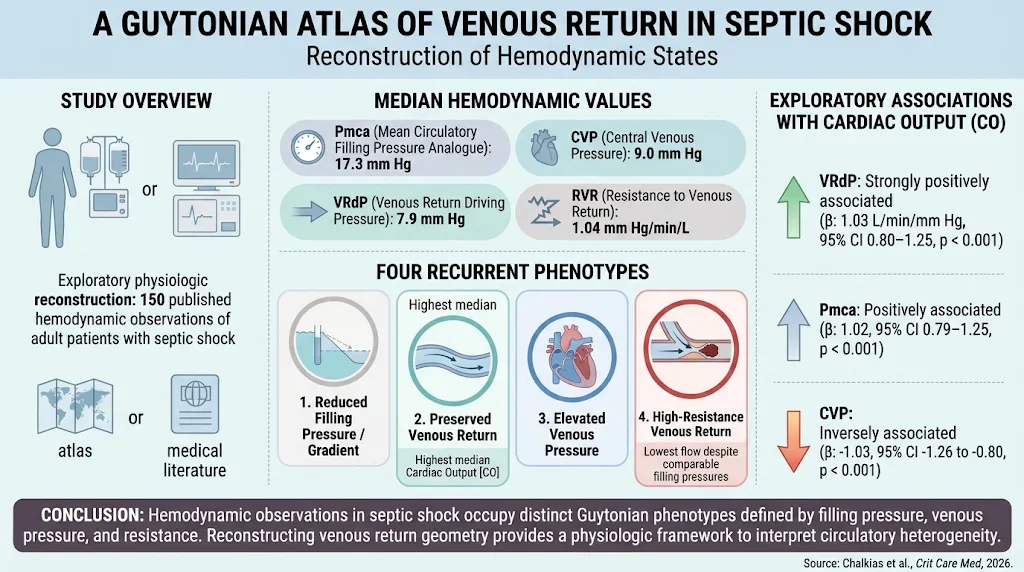
– Analysis of 150 hemodynamic observations in septic shock reveals four distinct circulatory phenotypes based on venous return parameters.
– Mean circulatory filling pressure analog (Pmca), central venous pressure (CVP), venous return driving pressure (VRdP), and resistance to venous return (RVR) are key metrics for phenotyping.
– Preserved venous return phenotype is associated with highest median cardiac output, while high-resistance phenotype shows lowest flow despite comparable pressures.
– VRdP shows a strong positive correlation with cardiac output, validating its physiological relevance even after adjusting for vasopressor and fluid therapy context.
Study Background
Septic shock is a complex and life-threatening condition characterized by circulatory failure and profound hemodynamic disturbances. Accurate assessment of venous return and its determinants is critical for guiding resuscitation strategies. Yet, heterogeneity in the hemodynamic profiles among septic patients complicates clinical interpretation and management. The Guytonian model of venous return physiology, which mathematically relates mean circulatory filling pressure, central venous pressure, and vascular resistance to cardiac output, offers a physiologic blueprint to understand these circulatory states. However, comprehensive application of this framework in septic shock has been limited by lack of integrated data and phenotypic categorization. This study aims to reconstruct venous return parameters across multiple published studies to delineate common circulatory phenotypes, enhancing physiological understanding and potentially informing personalized hemodynamic resuscitation in septic shock.
Study Design
This exploratory physiologic reconstruction study conducted a secondary analysis of published hemodynamic observations from adult patients diagnosed with septic shock. Inclusion required sufficient data to reconstruct mean circulatory filling pressure analogue (Pmca), venous return driving pressure (VRdP), and resistance to venous return (RVR).
No interventions were applied as this is a data synthesis and modeling study.
Endpoints focused on characterizing venous return parameters and their relation to cardiac output and the identification of circulatory phenotypes.
Key Findings
The dataset comprised 150 observations pooled from various published studies on hemodynamics in septic shock patients. Median (interquartile ranges) values were: Pmca 17.3 mm Hg (approximate range), central venous pressure (CVP) 9.0 mm Hg, VRdP 7.9 mm Hg, and RVR 1.04 mm Hg/min/L.
Circulatory Phenotypes
Using empirical quartiles of these variables, four recurrent phenotypes emerged:
- Reduced filling pressure/gradient phenotype: characterized by low Pmca and VRdP, indicating decreased venous return capacity.
- Preserved venous return phenotype: typical Pmca and CVP values with adequate VRdP and low to moderate resistance, correlated with the highest median cardiac output.
- Elevated venous pressure phenotype: increased CVP with somewhat preserved Pmca, suggesting venous congestion and pressure overload.
- High-resistance venous return phenotype: marked by elevated RVR and lower cardiac output despite similar filling pressures as the preserved phenotype, indicating impaired flow due to resistance.
Associations with Cardiac Output
VRdP was the strongest independent correlate of cardiac output (β = 1.03 L/min/mm Hg; 95% CI, 0.80-1.25; p < 0.001), even after adjusting for confounders such as vasopressor use and fluid therapy context. Separately, higher Pmca positively associated with increased cardiac output, while higher CVP negatively associated, reflecting the physiological gradient driving venous return to the right heart.
Expert Commentary
This study innovatively leverages Guyton’s model to practically dissect the heterogeneity of septic shock hemodynamics at the venous return level. The identification of four physiologically distinct patterns could help clinicians better understand the pathophysiology underlying apparently similar clinical presentations. The strong relation of VRdP with cardiac output reinforces the importance of maintaining an adequate venous return pressure gradient during resuscitation.
However, limitations include reliance on secondary published data which may have variability in measurement standards and patient selection. Prospective validation and real-time bedside assessment of these phenotypes may improve translation. Additionally, dynamic changes over the septic shock course were not evaluated here but are critical in clinical decision-making.
Conclusion
This physiologic reconstruction study establishes a Guytonian framework to categorize septic shock patients into distinct hemodynamic phenotypes based on venous return parameters. Recognition of these phenotypes enables a more nuanced interpretation of circulatory heterogeneity, offering potential to guide tailored hemodynamic interventions. Further prospective studies are warranted to validate the clinical utility of this atlas in guiding resuscitation and improving outcomes in septic shock.
Funding and ClinicalTrials.gov
No funding was reported for this exploratory secondary analysis. This retrospective reconstruction study is not registered on ClinicalTrials.gov.
References
Chalkias A, Mavridis T, Papagiannakis N, et al. A Guytonian Atlas of Venous Return in Septic Shock: Reconstruction of Hemodynamic States. Crit Care Med. 2026 Nov 13. PMID: 43024946.
Guyton AC. Circulatory Physiology III: The Venous Return. Annu Rev Physiol. 1961;23:323-56.
Monge Garcia MI, Walley KR. Hemodynamic assessment and monitoring of septic shock. Crit Care Clin. 2017;33(1):57-70.
Specialty calculators
For clinical reference; use professional judgment.