Introduction
Type 2 diabetes is a growing health concern globally, with distinct pathophysiological characteristics observed among East Asian populations, including Japanese patients. These differences necessitate tailored evaluations of new treatments. Orforglipron, an oral glucagon-like peptide-1 (GLP-1) receptor agonist, has emerged as a promising therapeutic agent for glucose control. GLP-1 receptor agonists aid in regulating blood sugar by enhancing insulin secretion, reducing glucagon release, and promoting satiety, leading to weight loss. However, there is a need for comprehensive, long-term safety data of orforglipron in Japanese individuals due to their unique metabolic profiles and treatment responses.
Study Objectives
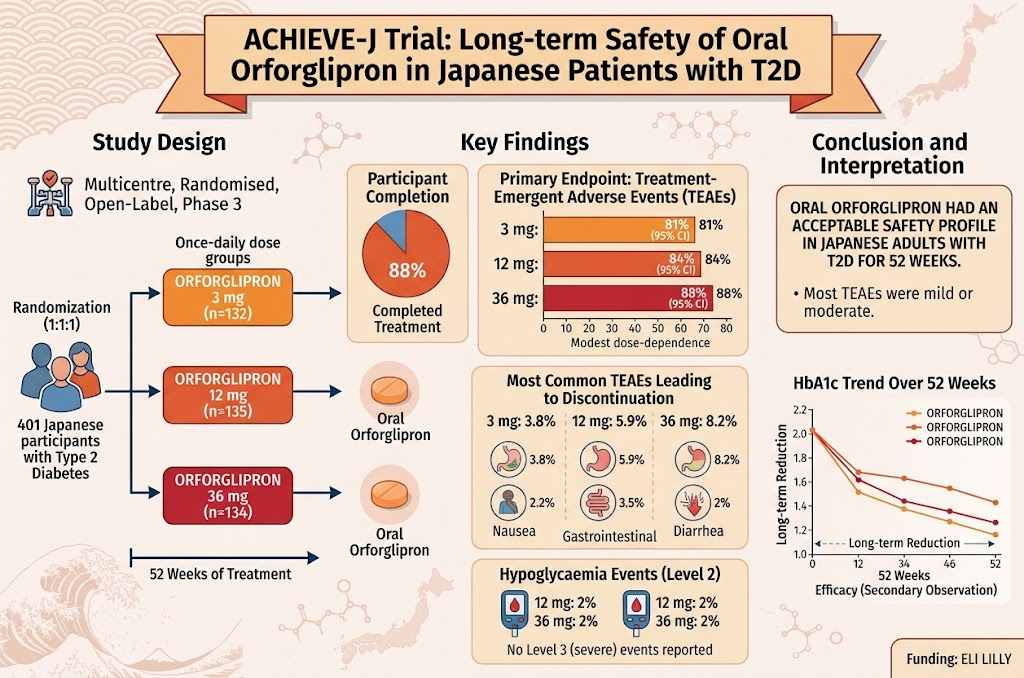
This multicenter, randomized, open-label phase 3 trial (ACHIEVE-J) investigated the long-term safety—over a 52-week period—of oral orforglipron in Japanese adults with type 2 diabetes. The participants were either managing their diabetes through diet and exercise alone or in combination with one or two oral antihyperglycemic medications. The study aimed also to evaluate the tolerability and occurrence of adverse events linked to orforglipron at various dosages, administered as add-on therapy.
Methods
The study was conducted at 40 medical research centers and hospitals across Japan, enrolling adult patients diagnosed with type 2 diabetes exhibiting elevated blood glucose levels. Eligible participants were randomized in equal proportions (1:1:1) into three treatment groups receiving once-daily oral doses of orforglipron at 3 mg, 12 mg, or 36 mg. Randomization was carefully stratified according to baseline background therapy, initial HbA1c level (≤8.5% or >8.5%), and metformin usage (applied when combined with α-glucosidase inhibitors, thiazolidinediones, or glinides).
The study was open-label, meaning both investigators and participants were aware of the assigned treatments. Safety was the primary endpoint, with all participants receiving at least one dose of the drug included in the safety analysis. Safety was monitored via reported adverse events, clinical laboratory evaluations, vital signs, and other standard assessments throughout the 52-week treatment period.
Results
Between September 28, 2023, and June 5, 2025, 450 participants were screened, and 401 were randomized: 132 to the 3 mg group, 135 to the 12 mg group, and 134 to the 36 mg group. Of these, 352 participants (88%) completed the treatment regimen.
Treatment-emergent adverse events (TEAEs) were common, reported in 85% of participants overall. The incidence was highest in the 36 mg group (88%), followed by the 12 mg (84%) and 3 mg (81%) groups. Most TEAEs were mild or moderate in severity. Treatment discontinuation due to adverse events was more frequent at the highest dose (14% in the 36 mg group) compared to the 3 mg (5%) and 12 mg (8%) groups.
Gastrointestinal symptoms—such as nausea, vomiting, diarrhea, or abdominal discomfort—were the most frequent reasons for treatment discontinuation and were reported more prominently with higher doses. Hypoglycemic events were rare and mild, with no severe (level 3) hypoglycemia documented.
The safety profile was consistent regardless of whether participants were on diet and exercise alone or combined with oral antihyperglycemic agents. This suggests orforglipron’s tolerability across common diabetes treatment regimens in the Japanese population.
Discussion
This 52-week study establishes that orforglipron, administered orally once daily, has an acceptable long-term safety profile when added to conventional diabetes management in Japanese adults with type 2 diabetes. The manageable side effect profile, predominated by mild to moderate gastrointestinal issues and low hypoglycemia risk, aligns with the class effects of GLP-1 receptor agonists.
Of clinical importance, the findings support orforglipron’s versatility as an add-on therapy to both lifestyle intervention and oral antihyperglycemic medications, providing a convenient oral alternative to injectable GLP-1 receptor agonists—a factor that potentially improves adherence and quality of life.
This study also contributes to the growing evidence base supporting personalized diabetes management in East Asian populations, acknowledging their specific metabolic characteristics that can impact pharmacodynamics and responses to treatment.
Limitations and Future Directions
While this trial offers valuable long-term safety data, it was limited to Japanese adults and may not extrapolate fully to other ethnic groups. Additionally, the open-label design may introduce bias in reporting of subjective adverse events. Future studies might explore comparative efficacy, real-world adherence, cardiovascular outcomes, and quality-of-life metrics, including head-to-head comparisons with other GLP-1 receptor agonists or antidiabetic agents.
Conclusion
Orforglipron administered once daily in doses ranging from 3 mg to 36 mg as an adjunct to diet, exercise, and up to two oral antihyperglycemic agents is safe and generally well tolerated over 52 weeks in Japanese adults with type 2 diabetes. The predictable adverse event profile, with predominantly gastrointestinal symptoms and low hypoglycemia risk, and the high study completion rate, underscore its potential as a practical therapeutic option tailored to this population.
Funding and Acknowledgments
This study was funded by Eli Lilly, which manufactures orforglipron. The authors acknowledge the participants and clinical staff at the 40 Japanese medical centers that contributed to conducting this robust phase 3 investigation.
References
Yabe D, Shiraiwa T, Ugai H, Takeuchi M, Suzuki R. Long-term safety of oral orforglipron in Japanese participants with type 2 diabetes (ACHIEVE-J): a multicentre, randomised, open-label, parallel-group phase 3 trial. The Lancet Diabetes & Endocrinology. Published 2026 Aug 17. PMID: 42607698.