Highlights
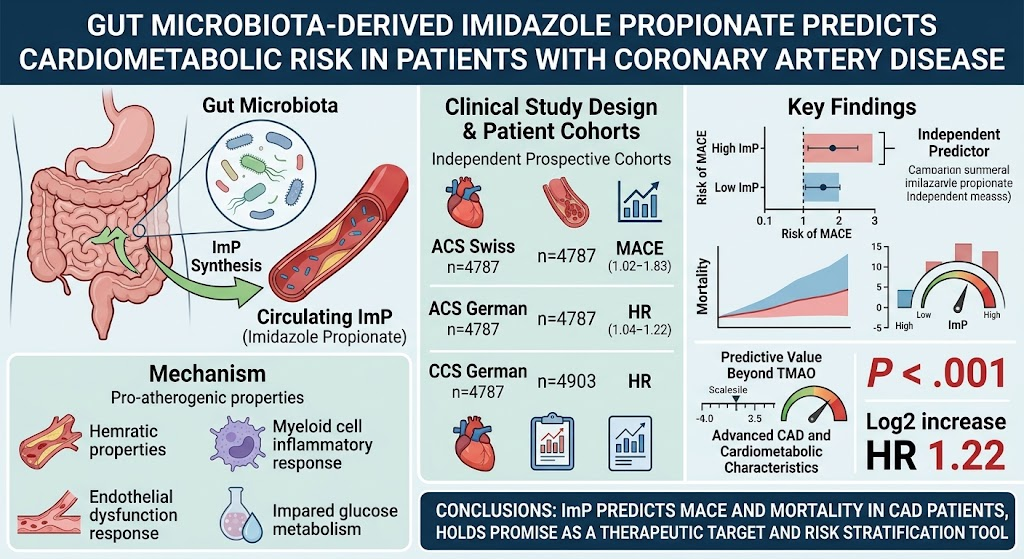
- Imidazole propionate (ImP), a metabolite produced by gut microbiota, independently predicts major adverse cardiovascular events (MACE) in patients with both acute and chronic coronary artery disease (CAD).
- ImP correlates with cardiometabolic risk features such as diabetes, systemic inflammation (hs-CRP), and advanced CAD severity, suggesting a multifaceted pathophysiological role.
- Prognostic value of ImP extends beyond classical risk factors and the established gut-derived marker trimethylamine N-oxide (TMAO), indicating its potential utility for refined risk stratification.
- Targeting ImP and its metabolic pathways may offer novel therapeutic approaches for secondary prevention in CAD.
Background
Coronary artery disease remains the leading cause of morbidity and mortality worldwide, with considerable residual risk despite advances in treatment. The gut microbiota has emerged as a key modulator of cardiometabolic health, influencing systemic inflammation, endothelial function, and metabolic homeostasis via bioactive metabolites. Among these, imidazole propionate (ImP), derived from histidine metabolism by gut bacteria, has recently gained attention for its proatherogenic properties and impact on glucose metabolism and immune cell activation. Understanding ImP’s role as a prognostic biomarker and therapeutic target offers potential for enhanced management of patients with CAD, especially in tailoring secondary prevention strategies beyond traditional risk assessments.
Key Content
Chronological Development of Evidence on Imidazole Propionate in Cardiometabolic Disease
Initial preclinical studies identified ImP as a microbiota-derived metabolite influencing insulin signaling and inflammatory pathways. Subsequent exploratory human studies linked elevated ImP levels to metabolic disturbances and cardiovascular risk profiles. The pivotal 2026 study by Wenzl et al. represents the first large-scale clinical evidence elucidating ImP’s prognostic importance across heterogeneous cohorts of patients with acute coronary syndrome (ACS) and chronic coronary syndrome (CCS).
Study Cohorts and Methodology
The investigation utilized three independent, prospectively enrolled cohorts:
- Swiss ACS cohort (n=4787) with comprehensive baseline characteristics and longitudinal MACE follow-up.
- Smaller Swiss cardiac magnetic resonance imaging cohort (n=150), providing mechanistic linking of ImP with cardiac phenotype.
- German cohorts including ACS patients (n=1428) and CCS patients (n=701), enabling validation across different clinical spectrums and healthcare settings.
Measurement of circulating ImP employed advanced mass spectrometry techniques, with statistical analyses incorporating Cox proportional hazards models adjusting for traditional risk factors and gut-derived metabolites like trimethylamine N-oxide (TMAO).
Associations Between ImP Levels and Cardiometabolic Characteristics
Elevated ImP was consistently associated with:
- More advanced angiographic CAD severity.
- Higher prevalence of diabetes mellitus.
- Increased systemic inflammation as reflected by high-sensitivity C-reactive protein (hs-CRP).
- Impaired glucose metabolism and endothelial dysfunction (derived from mechanistic imaging and biomarker data).
These correlations underscore ImP’s role in the pathophysiology bridging metabolic disease and atherosclerosis progression.
ImP as an Independent Predictor of Major Adverse Cardiovascular Events
High baseline ImP conferred significantly increased risk of MACE:
- Swiss ACS cohort: Adjusted HR per log2 increase: 1.22 (95% CI 1.10–1.35, P<0.001).
- German ACS cohort: Adjusted HR 2.34 (95% CI 1.46–3.76, P<0.001).
- German CCS cohort: Adjusted HR 1.32 (95% CI 1.13–1.53, P<0.001).
Mortality risk was similarly elevated:
- Swiss ACS cohort: Adjusted HR 1.34 (95% CI 1.17–1.54, P<0.001).
- German ACS cohort: Adjusted HR 2.38 (95% CI 1.48–3.82, P<0.001).
- German CCS cohort: Adjusted HR 1.50 (95% CI 1.14–1.98, P=0.004).
Crucially, ImP retained prognostic significance even when accounting for TMAO, a well-described gut-derived cardiovascular risk factor (Swiss ACS cohort HR 1.30, German CCS cohort HR 1.31), signifying an additive predictive role.
Mechanistic Insights and Translational Implications
Preclinical data implicate ImP in:
- Activation of inflammatory signaling in myeloid cells, promoting atherosclerotic plaque instability.
- Dysregulation of endothelial nitric oxide synthesis, impairing vascular homeostasis.
- Interference with insulin signaling pathways, exacerbating metabolic derangements common in CAD patients.
These multifactorial effects position ImP as both a biomarker and a candidate for therapeutic intervention aimed at modulating gut microbiota-host interactions.
Expert Commentary
The 2026 comprehensive study robustly expands understanding beyond associative observations to demonstrate ImP’s independent prognostic value in large, well-characterized CAD cohorts. Its additive predictive capacity relative to TMAO highlights the complexity of microbial metabolite contributions to cardiovascular risk.
However, limitations include:
- Observational cohort design precluding causal inference.
- Potential confounding by diet, medications, and microbial diversity not fully accounted for.
- Need for standardized assays and validated clinical thresholds for ImP quantification.
Current clinical guidelines do not yet incorporate gut microbiota-derived metabolite profiling, but this study advocates for integration of such biomarkers in future risk stratification models. Therapeutic modulation of ImP through targeted microbiota interventions (e.g., prebiotics, probiotics, metabolite inhibitors) remains an attractive research frontier.
Conclusion
Accumulating evidence positions circulating imidazole propionate as a novel, independent predictor of cardiovascular events and mortality in CAD patients, adding depth to the gut-heart axis paradigm. The incorporation of ImP measurement could refine personalized risk assessment and guide secondary prevention beyond traditional models. Clinical translation will necessitate further validation in randomized intervention trials and mechanistic exploration to harness ImP-targeted therapies.
References
- Wenzl FA, Wang P, Kahles F, et al. Gut microbiota-derived imidazole propionate predicts cardiometabolic risk in patients with coronary artery disease. Eur Heart J. 2026;47(31):4259-4273. PMID: 40884168.
- Koh A, Molinaro A, Ståhlman M, et al. Microbial Imidazole Propionate Impairs Insulin Signaling through mTORC1. Cell. 2018;175(4):947-961.e17. PMID: 30397319.
- Witkowski M, Weeks TL, Hazen SL. Gut microbiota and cardiovascular disease. Circ Res. 2020;127(4):553-570. PMID: 32667223.
- Jie Z, Xia H, Zhong SL, et al. The gut microbiome in atherosclerotic cardiovascular disease. Nat Commun. 2017;8:845. PMID: 29069397.
- Tabibian JH, et al. Gut Microbial Metabolites and Cardiovascular Disease: Molecular Mechanisms and Therapeutic Perspectives. Annu Rev Pathol. 2022;17:315-336. PMID: 35003701.