Highlight
- Ruxolitinib cream, a selective JAK1/JAK2 inhibitor, shows excellent long-term safety over 52 weeks in children aged 2 to 11 with mild-to-moderate atopic dermatitis (AD).
- Disease control was maintained with as-needed twice-daily use, with over 70% achieving clear or almost clear skin (IGA 0/1) at one year.
- Application site reactions were rare, and no serious treatment-related adverse events were observed, supporting a favorable tolerability profile in this pediatric population.
- Findings align with similar safety and efficacy profiles previously demonstrated in adolescents and adults, expanding treatment options for younger children.
Study Background and Disease Burden
Atopic dermatitis (AD) is a common chronic inflammatory skin disease that frequently manifests in early childhood. It is characterized by intense pruritus, eczematous lesions, and a relapsing course which substantially impact quality of life for patients and families. In children aged 2 to 11 years, AD prevalence remains high, and therapeutic options are limited by safety concerns, especially for long-term use. The disease burden includes sleep disruption, psychological distress, and risk for skin infections due to barrier dysfunction.
Conventional topical treatments such as corticosteroids and calcineurin inhibitors raise concerns regarding adverse effects with chronic application, including skin atrophy and systemic absorption. Hence, new targeted therapies with improved safety profiles are urgently needed. Janus kinase (JAK) inhibitors, which modulate inflammatory signaling pathways implicated in AD pathogenesis, have emerged as promising agents. Ruxolitinib cream, a selective JAK1/JAK2 inhibitor, has demonstrated rapid efficacy and good short-term safety in pediatric AD, but long-term data in younger children had been lacking.
Study Design
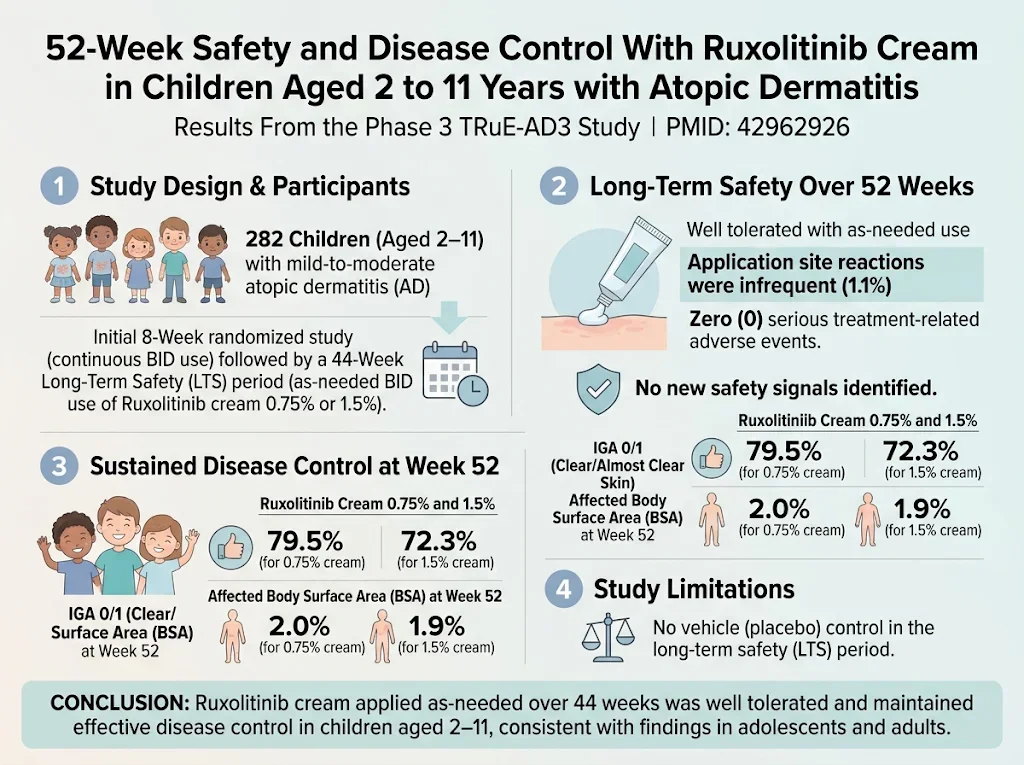
The TRuE-AD3 trial is a phase 3, multicenter, randomized study evaluating the long-term safety (LTS) and disease control efficacy of ruxolitinib cream in children aged 2 to 11 years with mild-to-moderate AD. Initially, participants were randomized to twice-daily application of either 0.75% or 1.5% ruxolitinib cream or vehicle for 8 weeks.
In the subsequent 44-week extension period, those originally assigned to ruxolitinib continued the same dose but shifted to an as-needed twice-daily application regimen. Participants initially on vehicle were re-randomized to either strength of ruxolitinib cream, also applied as needed. The primary endpoints focused on safety outcomes, including the incidence of adverse events, particularly application site reactions and serious treatment-related adverse events. Secondary endpoints assessed maintenance of disease control measured by Investigator’s Global Assessment (IGA) scores and affected body surface area (BSA).
Key Findings
The long-term safety data demonstrated that ruxolitinib cream was well tolerated over 52 weeks in 282 children. Application site reactions occurred infrequently (1.1%), and no new safety signals emerged beyond those observed in the initial 8-week period. Importantly, no serious adverse events attributed to treatment were reported, underscoring the favorable risk profile of ruxolitinib cream for chronic intermittent use in this young population.
Disease control was effectively maintained throughout the extended period among children treated with ruxolitinib (both 0.75% and 1.5% concentrations). At Week 52, 79.5% of children treated with 0.75% and 72.3% treated with 1.5% cream achieved IGA scores of 0 or 1, indicating clear or almost clear skin. Correspondingly, affected BSA remained low at a mean of 2.0% and 1.9%, respectively, demonstrating sustained suppression of the inflammatory process.
These results affirm that intermittent, as-needed application of ruxolitinib cream can provide prolonged control of AD symptoms in children, reducing the need for continuous or systemic therapies. The absence of a vehicle control during the extension phase is a limitation; however, consistent maintenance of disease control and safety outcomes comparable to earlier study phases mitigate this concern.
Expert Commentary
These findings support the role of topical JAK inhibition as a safe and effective long-term management strategy for pediatric AD, complementing current guidelines that recommend non-steroidal topical agents for maintenance therapy where possible. The selective inhibition of JAK1/JAK2 pathways targets key cytokines involved in AD pathophysiology, such as interleukins 4 and 13, offering a mechanistically rational approach with potentially fewer systemic side effects than oral JAK inhibitors.
Dr. Amy S. Paller, lead investigator, emphasizes that “these safety and efficacy results provide reassurance for clinicians and caregivers managing young children with AD, who require sustained control without compromising safety.” Furthermore, the low frequency of application site reactions and absence of serious adverse events underline the tolerability suitable for chronic intermittent use in a vulnerable pediatric population.
Future studies could explore the comparative effectiveness of ruxolitinib cream against other topical therapies and assess its impact on quality of life and long-term disease modification. Additionally, real-world evidence would further validate these clinical trial findings.
Conclusion
This 52-week phase 3 TRuE-AD3 study establishes that ruxolitinib cream, administered as needed twice daily, is a well-tolerated and effective intervention for maintaining disease control in children aged 2 to 11 years with mild-to-moderate atopic dermatitis. The favorable long-term safety profile and sustained clinical benefits support its use as a valuable addition to pediatric AD therapeutic options, potentially improving outcomes and quality of life for affected children and families.
Funding and ClinicalTrials.gov
The study was funded by Incyte Corporation, the developer of ruxolitinib cream. Clinical trial registration number is not provided in the abstract but can be located on ClinicalTrials.gov with details corresponding to the TRuE-AD3 study.
References
- Paller AS, Stein Gold LF, Simpson EL, et al. 52-Week Safety and Disease Control With Ruxolitinib Cream in Children Aged 2 to 11 Years With Atopic Dermatitis: Results From the Phase 3 TRuE-AD3 Study. J Am Acad Dermatol. 2026 Oct 30. PMID: 42962926.
- Silverberg JI. Adult and Pediatric Atopic Dermatitis. J Allergy Clin Immunol Pract. 2019;7(1):28-38.
- Wollenberg A, Oranje AP, Deleuran M. Personalized medicine in atopic dermatitis: Treating the patient, not the disease. Allergy. 2020;75(9):2174-2187.
Specialty calculators
For clinical reference; use professional judgment.