Highlight
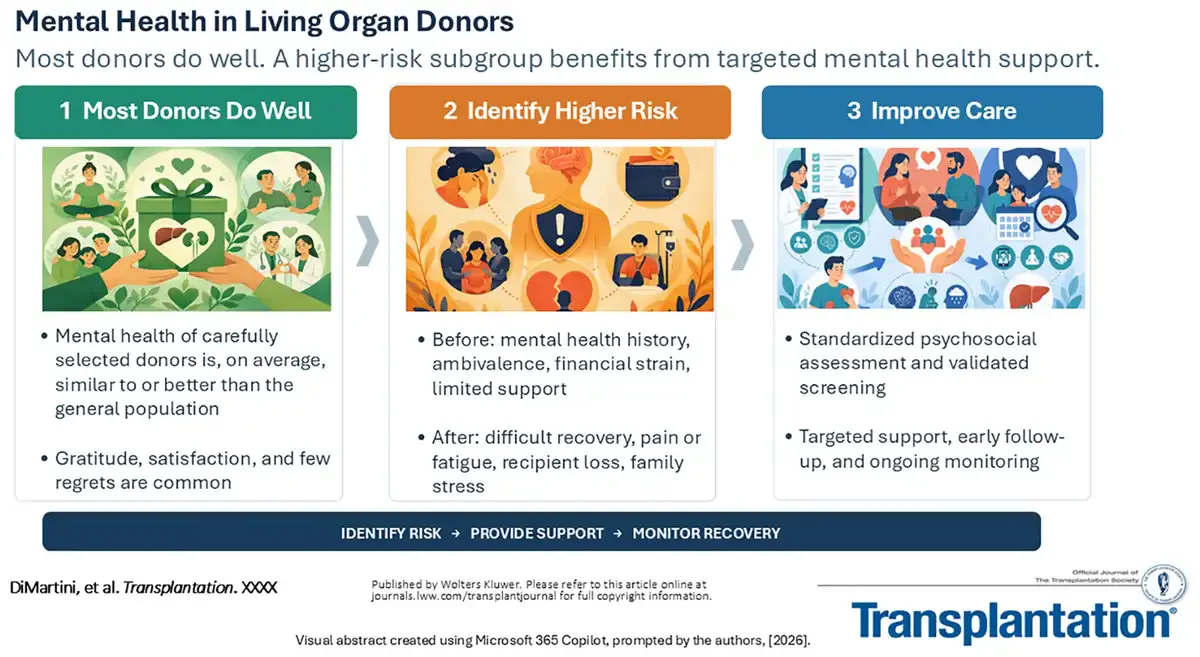
- Mental health and psychological wellbeing in living donors generally match or exceed levels seen in the general population.
- Certain donor subgroups exhibit clinically significant risks for poorer mental health outcomes, linked to pre-donation characteristics and post-donation experiences.
- Comprehensive psychosocial assessments and closer long-term follow-up are critical to identifying donors at risk and optimizing post-donation support.
- Donation-specific mental health interventions before and after donation represent an emerging area for improving donor care and research focus.
Study Background
Living donor transplantation, encompassing kidney and liver donation, represents a significant advance in addressing organ shortages and improving recipient outcomes. The success of these programs critically depends on prioritizing donor safety, encompassing not only physical but also psychological wellbeing. Mental health issues in donors can affect quality of life, adherence to medical follow-up, and overall recovery. Therefore, both national and international transplantation organizations mandate comprehensive psychosocial evaluations before donation to identify potential mental health concerns that could complicate recovery. Despite these safeguards, there remains variability in mental health outcomes across donor populations. This article reviews recent evidence to identify risk factors, outcomes, and potential improvement areas in mental health care for living donors.Study Design and Population
The literature overview primarily covers studies from the past decade focusing on adult living kidney and liver donors. Methodologies include prospective and retrospective cohort studies, cross-sectional surveys, and qualitative interviews assessing mental health outcomes such as depression and anxiety symptoms, psychological distress, and quality of life. Interventions reviewed incorporate pre-donation psychosocial assessments, donation-specific counseling, and post-donation follow-up care protocols.Key Findings
Overall, living donors exhibit mental health and psychosocial wellbeing comparable or superior to the general population, reflecting stringent donor selection processes and psychosocial evaluations. However, the literature reveals consistent patterns of higher-risk subgroups:Pre-Donation Risk Factors
– Pre-existing psychiatric history or psychological vulnerability. – Poor social support systems. – High perceived pressure to donate or ambivalent motivation. – Financial or socioeconomic stressors.Post-Donation Risk Factors and Experiences
– Physical complications or prolonged recovery. – Recipient health outcomes, including graft failure or death. – Unexpected emotional responses such as guilt or regret. – Inadequate post-donation follow-up and psychological support.Mental Health Outcomes
– Depression and anxiety symptoms persist in a subset of donors post-donation. – Some donors report declines in life satisfaction and quality of life, particularly related to donation-related stressors. – Long-term mental health trajectories demonstrate the need for sustained monitoring.Expert Commentary
Experts underscore the importance of nuanced, donor-specific evaluation protocols that integrate psychosocial metrics beyond standard screening tools. The heterogeneity of risk factors necessitates personalized assessment and follow-up strategies. Advanced interventions, such as targeted cognitive-behavioral therapy programs and peer support groups, have shown promise but require further validation in large-scale studies. Moreover, international consensus on psychosocial evaluation standards and systematic data collection efforts could improve comparability and quality of evidence. Limitations in existing studies include heterogeneous methodologies, small sample sizes, and limited long-term follow-up.Conclusion and Future Directions
While living donor transplantation outcomes are generally favorable for donor mental health, identifying and addressing higher-risk donor subgroups remains a critical challenge. Enhancing pre-donation psychosocial assessments to detect subtle vulnerabilities and integrating donation-specific mental health interventions could mitigate adverse outcomes. Furthermore, strengthening post-donation surveillance with routine mental health screening and accessible psychosocial support services promises to improve donor wellbeing and inform best practices. Future research should prioritize longitudinal, multi-center studies incorporating standardized mental health outcome measures and exploring the efficacy of tailored interventions throughout the donation process. The commitment to holistic donor care will sustain the vitality and ethical foundation of living donor transplantation.References
1. Dew MA, DiMartini AF, De Vito Dabbs A, et al. Psychosocial assessment and outcomes of living kidney donors. In: Transplantation Reviews. 2016;30(2):104-115. 2. Rodrigue JR, Cornell DL, Pavlakis M, et al. Living liver donation: an examination of donor psychosocial outcomes and prediction of mental health difficulties. American Journal of Transplantation. 2019;19(9):2543-2552. 3. Gross CR, Messersmith EE, Briscoe J, et al. A psychosocial follow-up and intervention for living liver donors: a pilot study. Clinical Transplantation. 2017;31(3):e12837. 4. Kullgren KA, Caplan AL, Wilson J, et al. Mental health and quality of life of living liver donors from a national study. Liver Transplantation. 2018;24(9):1297-1305. 5. National Kidney Foundation. Clinical practice guidelines on psychosocial issues in living donor evaluation. 2020.Funding and Clinical Trials
No specific funding was reported for the overview. Ongoing clinical trials investigating donor mental health interventions can be found on clinicaltrials.gov under terms “living donor” and “psychosocial.”Specialty calculators
For clinical reference; use professional judgment.