Highlights
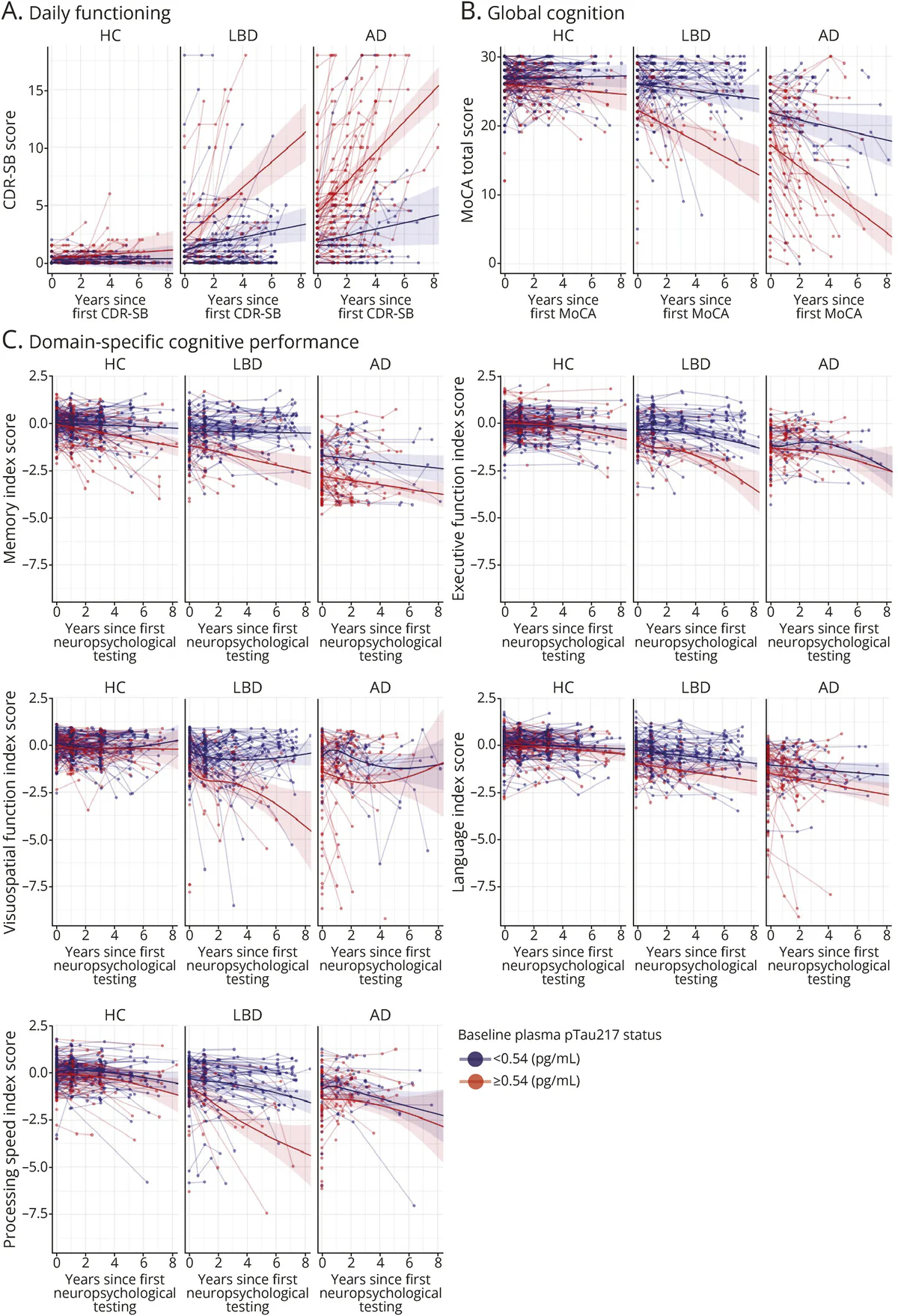
- Plasma phosphorylated tau-217 (pTau217) robustly predicts clinical progression in Lewy body disease (LBD), correlating with faster cognitive and functional decline.
- Baseline plasma pTau217 stratifies risk of diagnostic progression to mild cognitive impairment or dementia, enabling targeted clinical decision-making.
- Longitudinal increases in plasma pTau217 closely mirror worsening clinical outcomes, supporting its utility as a dynamic monitoring biomarker.
- Integration of plasma pTau217 with amyloid PET-derived cut-points enhances specificity for LBD-related Alzheimer neuropathology, refining prognostication in mixed pathology cases.
Background
Lewy body disease (LBD) encompasses a spectrum characterized by alpha-synuclein aggregates leading to parkinsonism, cognitive impairment, and dementia. Co-pathology with Alzheimer disease (AD), particularly amyloid plaques and tau neurofibrillary tangles, is common and critically modifies clinical progression. Biomarkers that accurately detect and monitor these overlapping pathologies are essential to elucidate prognosis, stratify patient risk, and assess therapeutic responses in this heterogeneous disease context. Plasma phosphorylated tau at threonine 217 (pTau217) has emerged as a sensitive and specific indicator of AD neuropathologic change. However, its longitudinal clinical significance within LBD populations remained unclear prior to recent investigations.Key Content
Chronological Development of Plasma pTau217 as a Biomarker in Neurodegenerative Disorders
Initial studies identified pTau217 in cerebrospinal fluid (CSF) and later plasma as a sensitive AD biomarker, with superior accuracy over other tau phosphorylation sites (pTau181, pTau231). Advancements in immunoassay ultrasensitive detection facilitated plasma measurements, with pivotal studies demonstrating plasma pTau217 levels correlate with amyloid PET and tau PET imaging, predicting cognitive decline in AD spectrum individuals. Subsequent research extended these findings to mixed neuropathology cohorts, including LBD, highlighting plasma pTau217’s potential to detect co-occurring AD-related tauopathy.Evidence of Plasma pTau217 in Lewy Body Disease Subtypes and Clinical Progression
The prospective longitudinal study by Lorkiewicz et al. (2026) involving 131 LBD participants showed that elevated baseline plasma pTau217 predicted faster progression of cognitive impairment and functional decline measured via CDR-SB and MoCA over 2–8 years. The association extended across specific cognitive domains, including memory, executive function, and visuospatial abilities, underscoring plasma pTau217’s broad relevance to clinical manifestations in LBD. Importantly, the study utilized an amyloid PET-derived LBD-specific pTau217 cut-point to classify abnormal levels, enhancing risk stratification precision. Participants with abnormal baseline plasma pTau217 exhibited nearly threefold increased risk of transitioning to mild cognitive impairment or dementia compared to those with normal levels, highlighting its prognostic importance. Moreover, longitudinal increases in plasma pTau217 tracked with worsening clinical scores, establishing its role as a biomarker for ongoing disease monitoring.Comparisons with Other Biomarkers and Clinical Implications
Though alpha-synuclein assays and amyloid biomarkers provide crucial information on LBD pathology, pTau217 complements these by specifically quantifying tau-related neurodegeneration. Its use addresses the unmet need for accessible, minimally invasive markers that reflect mixed pathology contributions—a common challenge in LBD clinical management. The study’s integration of plasma pTau217 with amyloid PET cut-points refined diagnostic accuracy and disease staging, offering a model for multimodal biomarker approaches. These findings also suggest potential utility in enriching clinical trial populations for tau-targeting therapeutics and monitoring treatment effects.Expert Commentary
The work by Lorkiewicz et al. represents a significant advance in biomarker-guided LBD management. The demonstrated associations between plasma pTau217 and multidimensional clinical decline provide a compelling rationale to incorporate this biomarker into routine clinical assessment to enhance prognostication and personalize care. However, the heterogeneity of LBD and overlap with AD requires careful interpretation. While plasma pTau217 indicates AD-related tau pathology, it does not capture alpha-synuclein directly, necessitating complementary biomarkers for a full pathological picture. Future research should focus on harmonizing assays, standardizing cut-points across populations, and validating pTau217 utility in diverse clinical settings and ethnicities. The prognostic value of plasma pTau217 supports its integration alongside neuroimaging, clinical assessments, and other fluid biomarkers to create composite risk models. Such an approach could optimize patient enrollment in clinical trials, monitor disease-modifying therapies, and guide personalized therapeutic strategies targeting mixed pathology.Conclusion
Plasma pTau217 is a promising, minimally invasive biomarker for prognostication, monitoring, and risk stratification of clinical progression in Lewy body disease, particularly in patients exhibiting co-pathology with Alzheimer disease. Its ability to predict faster cognitive and functional decline and increased risk of diagnostic progression positions it as a valuable tool for clinicians and researchers. Future longitudinal and interventional studies should validate and refine its clinical applications, ultimately contributing to improved patient outcomes in this complex neurodegenerative disorder.References
- Lorkiewicz SA, Abdelnour C, Bolen ML, et al. Plasma P-Tau217 as a Prognostic, Monitoring, and Risk-Stratification Biomarker of Clinical Progression in Lewy Body Disease. Neurology. 2026 Nov 11;107(11):e218686. doi:10.1212/WNL.0000000000018686. PMID: 43013788.
- Petersen RC, et al. Advances in Biomarkers for Alzheimer’s Disease: A Review. Neurology. 2020;95(11):491–504. doi:10.1212/WNL.0000000000009509.
- Karikari TK, et al. Blood phosphorylated tau 181 as a biomarker for Alzheimer’s disease: a diagnostic performance and prediction of progression meta-analysis. Nat Med. 2020;26(3):379–386. doi:10.1038/s41591-020-0755-1.
- Blennow K, Zetterberg H. Biomarkers for Alzheimer’s disease: current status and prospects for the future. J Intern Med. 2018;284(6):643-663. doi:10.1111/joim.12816.
Specialty calculators
For clinical reference; use professional judgment.