Highlight
- Left bundle-branch pacing (LBBP) preserves ventricular synchrony better than right ventricular pacing (RVP).
- In patients with atrioventricular (AV) block, LBBP significantly reduced a composite endpoint of death, heart failure hospitalization, or pacing-induced cardiomyopathy over about three years.
- The nearly 60% risk reduction with LBBP suggests a compelling clinical advantage in this population.
- Serious adverse events were similar between LBBP and RVP, indicating comparable safety profiles.
Study Background
Atrioventricular block is a conduction disorder often managed by permanent pacemaker implantation, predominantly utilizing right ventricular pacing. Despite its widespread use, RVP is associated with adverse consequences, including cardiac dyssynchrony, left ventricular (LV) systolic dysfunction, and pacing-induced cardiomyopathy, leading to increased morbidity and mortality. Preserving physiological ventricular activation and mechanical synchrony is critical to improving clinical outcomes in pacing-dependent patients.
Left bundle-branch pacing has emerged as a novel pacing strategy aiming to directly stimulate the native His-Purkinje conduction system distal to the AV node, thereby maintaining synchronous ventricular depolarization and contraction. Prior observational and small-scale studies have suggested that LBBP may attenuate the deleterious effects of dyssynchronous pacing seen with RVP, but robust randomized trial data comparing clinical outcomes have been lacking.
Study Design
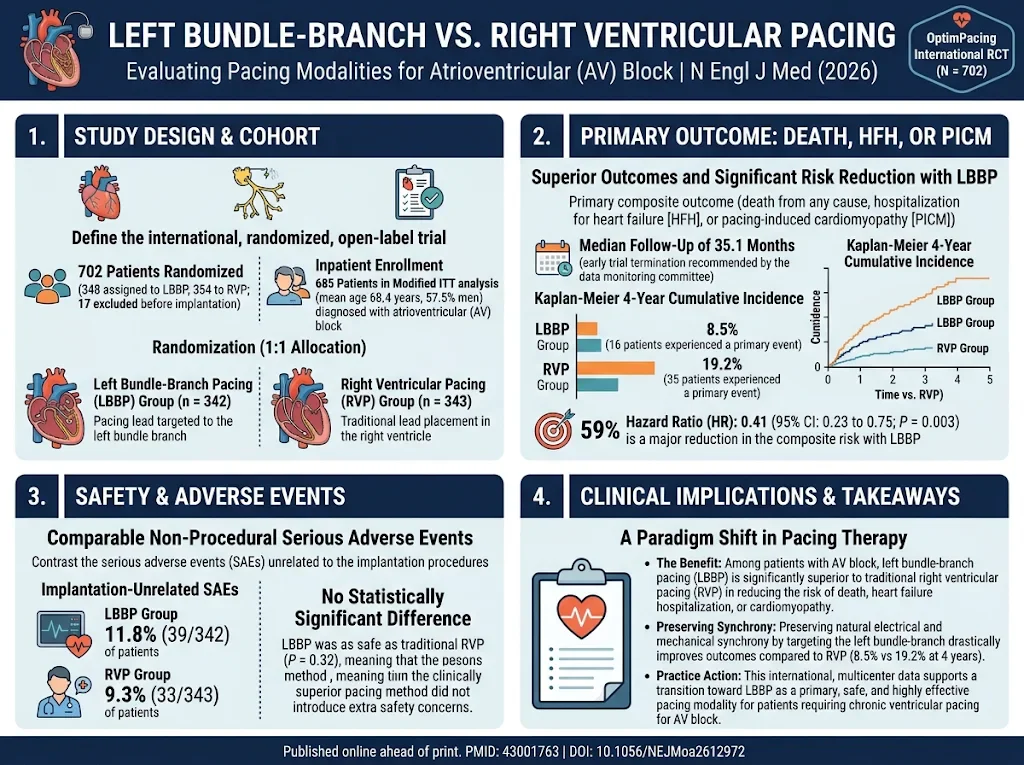
This investigation was an international, open-label, randomized controlled trial involving 702 patients with AV block, allocated 1:1 to receive either LBBP or RVP. Following exclusions of patients prior to device implantation, 685 individuals (342 receiving LBBP and 343 receiving RVP) were analyzed under a modified intention-to-treat approach.
The primary composite outcome was death from any cause, hospitalization for heart failure, or development of pacing-induced cardiomyopathy, evaluated over a median follow-up of 35.1 months. The trial was prematurely terminated after a prespecified interim analysis demonstrated significant efficacy in favor of LBBP.
Key Findings
At study conclusion, the primary composite outcome occurred in 16 patients (8.5% cumulative incidence at 4 years) within the LBBP group versus 35 patients (19.2%) in the RVP cohort. This equates to a hazard ratio of 0.41 (95% confidence interval, 0.23 to 0.75; P=0.003), indicating a 59% relative risk reduction with LBBP.
The superiority of LBBP was consistent across all components of the composite endpoint: mortality, heart failure hospitalizations, and pacing-induced cardiomyopathy events were all less frequent relative to RVP.
Importantly, rates of serious adverse events unrelated to device implantation were comparable between groups (11.8% vs. 9.3%; P=0.32), supporting the safety of the novel pacing approach.
The mean age of patients was 68.4 years, and 57.5% were men. The study population reflects a typical AV block demographic, enhancing the external validity of results.
Expert Commentary
This landmark randomized trial provides compelling level 1 evidence affirming that left bundle-branch pacing is superior to conventional right ventricular pacing in terms of clinically meaningful endpoints in patients with AV block.
Biologically, the benefits are explained by preservation of ventricular electrical and mechanical synchrony with LBBP, preventing adverse remodeling and progressive LV dysfunction commonly triggered by RVP-induced dyssynchrony.
While previous studies hinted at the promise of conduction system pacing, this rigorous trial clarifies its efficacy and safety profile, offering a strong rationale for reconsidering standard pacing paradigms in this population.
Limitations include the open-label design, which is inherently challenging to blind given the nature of pacing interventions. However, objective endpoints and blinded adjudication mitigate bias risk.
Future studies should explore long-term durability beyond 4 years, cost-effectiveness, patient quality of life, and applicability in broader pacing indications.
Conclusion
The OptimPacing trial establishes left bundle-branch pacing as a superior alternative to right ventricular pacing for patients with atrioventricular block, significantly reducing the risk of death, heart failure hospitalization, and pacing-induced cardiomyopathy over approximately 3 years of follow-up without increased adverse events.
These findings support a paradigm shift in pacemaker implantation strategy towards physiologic pacing to enhance clinical outcomes in this growing patient population. Incorporation of LBBP into guideline recommendations and clinical practice should be anticipated as more centers adopt this feasible technique.
Funding and Registration
The trial was funded by the Project on New Technology of Jiangsu Province and other sponsors. It is registered at ClinicalTrials.gov under the identifier NCT04624763.
References
Qian Z, Jiang L, Hou X, et al. Left Bundle-Branch Pacing versus Right Ventricular Pacing for Atrioventricular Block. N Engl J Med. 2026 Nov 8; PMID: 43001763.
Specialty calculators
For clinical reference; use professional judgment.