Highlight
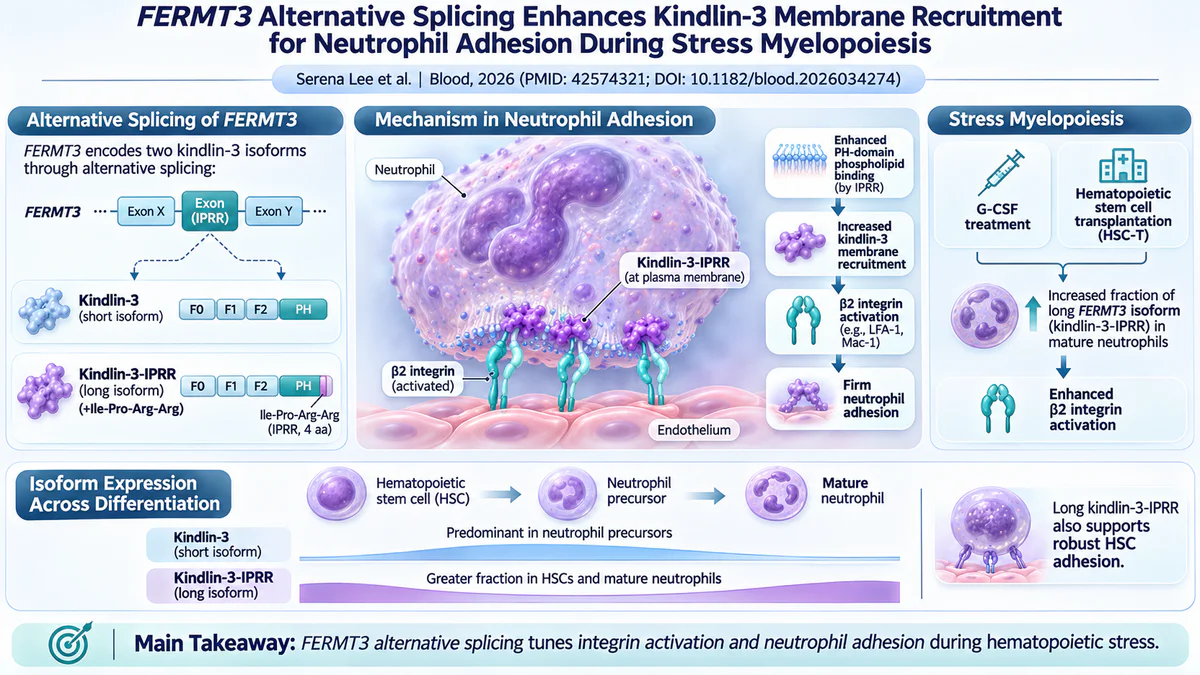
– Alternative splicing of FERMT3 produces two kindlin-3 isoforms differing by a 4-amino acid (IPRR) insertion within the PH domain.
– The longer kindlin-3-IPRR isoform enhances phospholipid binding, promoting membrane recruitment and β2 integrin activation essential for neutrophil adhesion.
– Expression of these isoforms differs during neutropoiesis: the short isoform predominates in precursors, while the long isoform is enriched in hematopoietic stem cells (HSCs) and mature neutrophils.
– During stress myelopoiesis induced by granulocyte colony-stimulating factor (G-CSF) or hematopoietic stem cell transplantation (HSCT), the long isoform is upregulated, augmenting neutrophil integrin activation and adhesion capacity.
Study Background
Leukocyte adhesion deficiency type III (LAD-III) is a rare immunodeficiency characterized by recurrent infections, caused by mutations in FERMT3, the gene encoding kindlin-3. Kindlin-3 critically regulates β2 integrin activation, enabling leukocyte adhesion and migration. Despite prior suggestions that the longer kindlin-3 isoform containing an IPRR insertion is dysfunctional, new findings imply a pivotal role for this variant in adhesion dynamics, particularly under hematopoietic stress. Understanding splicing regulation and functional distinctions between FERMT3 isoforms may improve insight into immune cell mobilization and adhesion deficiencies, with broader implications in stress myelopoiesis, HSCT recovery, and infectious susceptibility.
Study Design
The study employed a combination of molecular and cellular assays, phospholipid binding analyses, and RNA sequencing datasets to characterize the functional differences and expression patterns of FERMT3 splicing isoforms during neutrophil development and stress conditions. Neutrophil adhesion assays evaluated β2 integrin activation capability of the kindlin-3 isoforms. Expression profiling across hematopoietic stages was assessed using RNA-sequencing data from normal hematopoiesis and patients undergoing G-CSF treatment or HSCT. The study combined in vitro biochemistry with patient-derived sample analyses to delineate the clinical relevance of FERMT3 splicing dynamics.
Key Findings
The investigation revealed that the kindlin-3 long isoform incorporating the IPRR insertion within the pleckstrin homology (PH) domain is fully capable of β2 integrin activation, contrary to previous assumptions about its dysfunction. This insertion enhances phospholipid binding affinity, facilitating increased plasma membrane association of kindlin-3, a critical step for integrin activation during neutrophil adhesion.
Expression analysis revealed a developmental regulation of FERMT3 splice variants: the short kindlin-3 isoform without IPRR predominates in neutrophil precursors, whereas the long isoform is abundant in hematopoietic stem cells and mature neutrophils. Functional adhesion assays showed that the long isoform supports robust adhesion of HSCs, highlighting its importance beyond mature neutrophils.
Importantly, under stress conditions such as G-CSF–induced stress myelopoiesis or after HSCT, the long kindlin-3 isoform is selectively upregulated in mature neutrophils, correlating with enhanced β2-integrin activation and adhesion capacity. This dynamic splicing appears to fine-tune leukocyte adhesion to meet the heightened demands for neutrophil mobilization and vascular recruitment during hematopoietic stress.
Expert Commentary
These findings challenge earlier conceptions that the kindlin-3-IQRR isoform is dysfunctional. Instead, they reveal that alternative splicing of FERMT3 is a crucial regulatory mechanism in immune cell adhesion, dynamically adapting integrin activation during physiological stress. The molecular insight that a small four-residue insert can modulate phospholipid binding and membrane recruitment mechanistically links alternative splicing with functional modulation of cell adhesion.
Given the central role of neutrophils in innate immunity and microbial defense, these observations have significant clinical relevance. They suggest that monitoring FERMT3 splicing patterns could serve as a biomarker of hematopoietic recovery after HSCT and reflect bone marrow stress responses. Moreover, therapeutic strategies modulating splicing or enhancing kindlin-3 membrane recruitment might improve neutrophil function in LAD-III and other adhesion-related immune disorders.
Limitations include that the precise signaling pathways upstream of splice variant regulation during stress remain undefined, and patient cohorts for clinical correlation are limited. Further larger longitudinal and mechanistic studies would strengthen translational application.
Conclusion
The study fundamentally advances the understanding of neutrophil adhesion regulation by demonstrating that FERMT3 alternative splicing generates kindlin-3 isoforms with differential membrane recruitment capacities, fine-tuning β2 integrin activation during steady-state and stress myelopoiesis. This molecular adaptation likely facilitates rapid neutrophil mobilization under hematopoietic stress, such as during G-CSF therapy or HSCT recovery. These insights pave the way for novel biomarker development and potential therapeutic targeting of splicing mechanisms to improve immune cell functionality in leukocyte adhesion deficiencies and hematopoietic disorders.
Funding and Clinical Trials
Details regarding funding sources and clinical trial registrations were not specified in the source article.
References
Lee S, Halimu G, Vidal M, Song X, Ball NJ, Ley K, Goult BT, Wen L. FERMT3 alternative splicing enhances kindlin-3 membrane recruitment for neutrophil adhesion during stress myelopoiesis. Blood. 2026 Nov 5;148(19):2399-2410. PMID: 42574321. https://pubmed.ncbi.nlm.nih.gov/42574321/
Additional relevant literature:
1. Moser M, Nieswandt B, Ussar S, Pozgajova M, Fässler R. Kindlin-3 is essential for integrin activation and platelet aggregation. Nat Med. 2008 Mar;14(3):325-30. doi: 10.1038/nm1723.
2. Kuijpers TW, van de Vijver E, Weterman MA, et al. LAD-III, a novel leukocyte adhesion deficiency syndrome, is caused by mutations in KINDLIN3 affecting integrin activation. Nat Med. 2009 Mar;15(3):306-12. doi: 10.1038/nm.1911.
3. Lefort CT, Rossaint J, Moser M. Kindlin-3 signaling in leukocytes. Cell Mol Life Sci. 2012 Feb;69(22):3497-507. doi: 10.1007/s00018-012-1005-8.
Specialty calculators
For clinical reference; use professional judgment.