Highlights
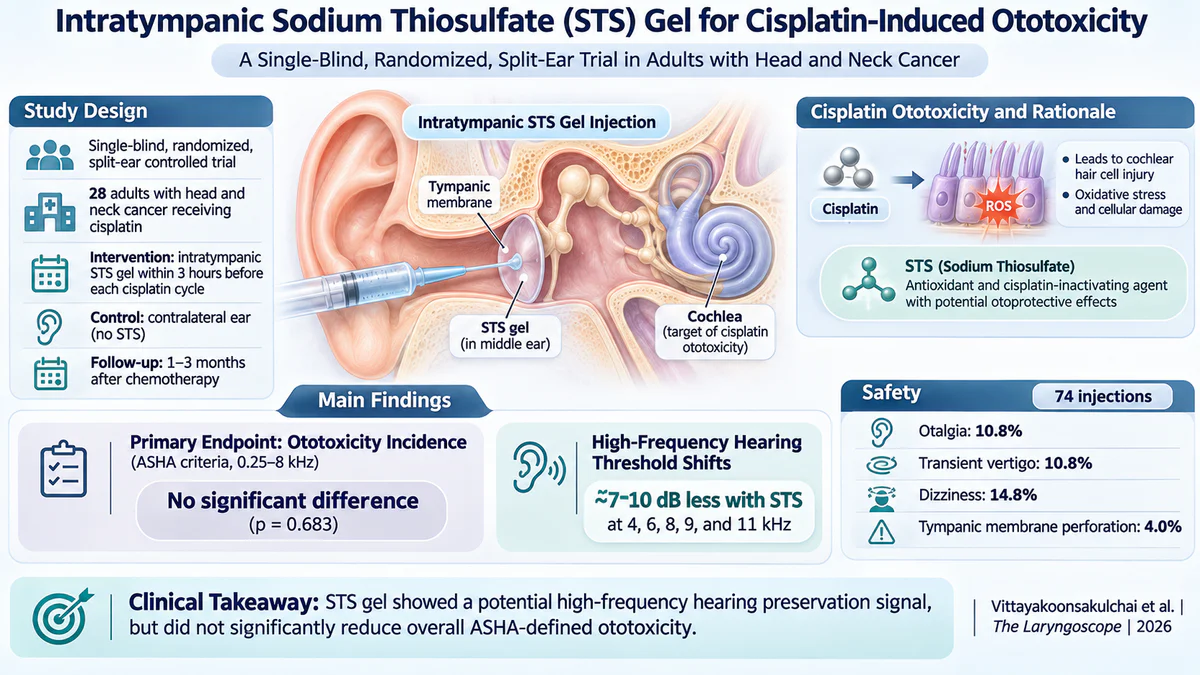
- Intratympanic sodium thiosulfate (STS) gel administration prior to cisplatin chemotherapy may protect hearing at high and extended-high frequencies.
- Randomized controlled trials (RCTs) demonstrate safety and feasibility without systemic interference with cisplatin efficacy.
- Despite no significant reduction in overall ototoxicity incidence defined by ASHA criteria, threshold shifts at frequencies above 4 kHz show meaningful preservation.
- Adverse events related to intratympanic STS injections are generally minor and manageable, supporting procedural tolerability.
Background
Cisplatin is a platinum-based chemotherapeutic agent widely employed in the treatment of various solid tumors, including head and neck, lung, and testicular cancers. Its clinical utility is often limited by dose-dependent ototoxicity, leading to irreversible sensorineural hearing loss that affects patient quality of life significantly. High-frequency cochlear hair cells are particularly vulnerable, resulting in progressive audiometric threshold shifts, especially in frequencies above 4 kHz. Despite extensive research, effective strategies to mitigate cisplatin-induced ototoxicity (CIHL) without compromising its antitumor efficacy remain elusive. Sodium thiosulfate (STS) is a potent cisplatin inactivator via covalent platinum binding and has shown otoprotective properties in preclinical models. Systemic administration, however, raises concerns about reducing cisplatin’s oncologic effectiveness. Thus, intratympanic (transtympanic) delivery of STS directly to the middle ear has garnered interest for local cochlear protection by enabling high local drug concentrations with limited systemic absorption.Key Content
Chronological Development of Evidence on Intratympanic STS for CIHL Prevention
Preclinical Foundation and Administration Modalities: Early animal studies, such as the 2004 investigation by Fernandez et al., demonstrated that continuous infusion of STS into the middle ear space of Hartley albino guinea pigs offered superior protection against cisplatin ototoxicity compared to single daily doses, notably preserving hearing thresholds at key frequencies (2, 8, 16 kHz). These findings underscored the importance of pharmacokinetic and delivery strategies to optimize otoprotection. Phase 1 Clinical Studies: Transitioning to human subjects, a 2020 Phase 1 trial assessed DB-020, a novel formulation of sodium thiosulfate pentahydrate in hyaluronic acid gel for intratympanic injection. This study established the safety and tolerability of DB-020 administered unilaterally or bilaterally in healthy volunteers, demonstrating only nominal systemic thiosulfate increases that would unlikely interfere with cisplatin’s antitumor action. Mild to moderate transient auditory-related adverse events were attributed largely to the injection procedure rather than the drug itself, paving the way for efficacy trials. Preliminary Efficacy Trials: In a 2021 randomized controlled trial involving 12 adults receiving high-dose cisplatin (≥ 75 mg/m2), transtympanic STS gel injection into one ear was compared with placebo or untreated ears in the contralateral side. Although the primary outcome focused on safety and feasibility, secondary audiometric endpoints suggested a trend toward reduced hearing threshold shifts at extended high frequencies (8–12.5 kHz) in treated ears, with a subset of patients demonstrating a clinically relevant effect (≥ 10 dB threshold shift reduction), though statistical significance was not reached (p=0.068). Pharmacokinetic analyses supported the absence of systemic interaction with cisplatin. Recent Randomized Controlled Trials: The 2026 single-blinded RCT by Vittayakoonsakulchai et al., enrolling 28 adults with head and neck cancer undergoing cisplatin chemotherapy, administered intratympanic STS gel within 3 hours before each cisplatin cycle to one ear; the contralateral ear served as control. Audiometric evaluation spanned standard (0.25–8 kHz) to extended high frequencies (up to 11 kHz). Findings revealed no statistically significant difference in the overall incidence of ototoxicity per ASHA criteria within 0.25–8 kHz (p=0.683). However, treated ears had significantly attenuated threshold shifts in 4, 6, 8, 9, and 11 kHz frequencies by approximately 7–10 dB compared to controls, indicating meaningful preservation of high-frequency hearing critical for speech discrimination and quality of life. The safety profile was favorable, with adverse events limited to mild otalgia (10.8%), transient vertigo (10.8%), dizziness (14.8%), and 4% incidence of tympanic membrane perforation, all manageable.Mechanistic and Translational Insights
The localized delivery of STS achieves cochlear concentrations sufficient to neutralize cisplatin-induced reactive platinum species, minimizing cochlear outer hair cell apoptosis and stria vascularis disruption. The intratympanic gel formulation, often incorporating sodium hyaluronate, facilitates sustained cochlear exposure while limiting systemic thiosulfate absorption, thereby preserving cisplatin systemic antitumor efficacy. This pharmacokinetic compartmentalization is supported by clinical data showing negligible interference with cisplatin plasma levels.Expert Commentary
Intratympanic STS represents a promising otoprotective approach addressing an unmet clinical need in oncology. The recent 2026 RCT advances the evidence base by demonstrating significant preservation of hearing thresholds at critical high frequencies, despite the lack of impact on overall ASHA ototoxicity incidence, which focuses largely on standard audiometric ranges. This highlights the importance of incorporating extended high-frequency audiometry in ototoxicity trials to detect clinically relevant benefits. Limitations include relatively small sample sizes, single-blinded design, and short-term follow-up (1–3 months post-chemotherapy). Longitudinal studies with larger cohorts and functional hearing assessments (speech discrimination, patient-reported outcomes) are necessary to fully characterize clinical benefits. Safety remains acceptable with minor procedural adverse events; however, refinement in injection techniques and patient selection could reduce complications such as tympanic membrane perforation. Furthermore, intratympanic delivery should be contextualized within multidisciplinary oncologic care to optimize timing vis-à-vis cisplatin dosing. Current oncology guidelines do not yet endorse intratympanic STS due to limited high-level evidence, but the emerging data supports pursuing definitive phase 3 trials. Mechanistically, STS’s ability to covalently inactivate cisplatin locally without systemic compromise aligns with precision medicine principles, offering targeted otoprotection.Conclusion
Intratympanic sodium thiosulfate gel injections exhibit encouraging potential to preserve high and extended-high frequency hearing during cisplatin chemotherapy with an acceptable safety profile. Although not significantly reducing overall ototoxicity incidence per standard criteria, the approach addresses functionally important cochlear frequencies and advances protective strategies. Continued clinical development including larger trials and longer follow-up is warranted to validate efficacy and facilitate integration into oncology supportive care paradigms.References
- Vittayakoonsakulchai K, Pitathawatchai P, Plodpai Y, et al. Efficacy of Intratympanic Sodium Thiosulfate Gel Injection to Prevent Cisplatin-Induced Ototoxicity. Laryngoscope. 2026 Nov 2. doi:10.1002/lary.71028. PMID: 42971568.
- Keppler H, Drees D, Kammerer B, et al. Transtympanic Sodium Thiosulfate for Prevention of Cisplatin-Induced Ototoxicity: A Randomized Clinical Trial. Otol Neurotol. 2021 Jun;42(5):678-685. doi:10.1097/MAO.0000000000003069. PMID: 33710154.
- Lajiness J, Gildersleeve DL, et al. Phase 1 study of intratympanic sodium thiosulfate to prevent cisplatin-induced hearing loss. Invest New Drugs. 2020 Oct;38(5):1463-1471. doi:10.1007/s10637-020-00918-1. PMID: 32157599.
- Fernandez C, Hallworth R, Ernst SL, et al. Ototoxic protection of sodium thiosulfate: daily vs constant infusion. Otolaryngol Head Neck Surg. 2004 Jul;131(1):115-9. doi:10.1016/j.otohns.2004.02.022. PMID: 15243567.
Specialty calculators
For clinical reference; use professional judgment.