Highlight
This randomized clinical trial demonstrates that clinician-guided digital cognitive behavioral therapy for insomnia (D-CBT-I) substantially improves insomnia severity, subjective sleep quality, and apnea-hypopnea index in patients suffering from concurrent insomnia and obstructive sleep apnea (COMISA). These benefits extend to daytime sleepiness reduction and enhanced cognitive executive functions, with a good safety profile and no serious adverse events reported.
Study Background
Insomnia and obstructive sleep apnea (OSA) are highly prevalent sleep disorders that frequently coexist, a condition termed co-morbid insomnia and OSA (COMISA). COMISA is associated with greater health burden, worse daytime functioning, and diminished quality of life compared to either disorder alone. Cognitive behavioral therapy for insomnia (CBT-I) is the gold standard first-line treatment for chronic insomnia. However, its accessibility is limited by availability of trained therapists, and concerns remain about the safety and effectiveness of CBT-I in COMISA patients given the interplay between insomnia and respiratory events.
Digital CBT-I (D-CBT-I) guided by clinicians represents an innovative approach that can expand treatment reach while preserving personalized therapeutic support. Prior studies have established CBT-I efficacy in isolated insomnia but robust clinical trial evidence evaluating clinician-guided D-CBT-I specifically in COMISA, including effects on OSA severity, has been lacking. This trial addressed the unmet need to determine whether digitally delivered CBT-I can simultaneously improve insomnia and OSA outcomes safely in this complex population.
Study Design
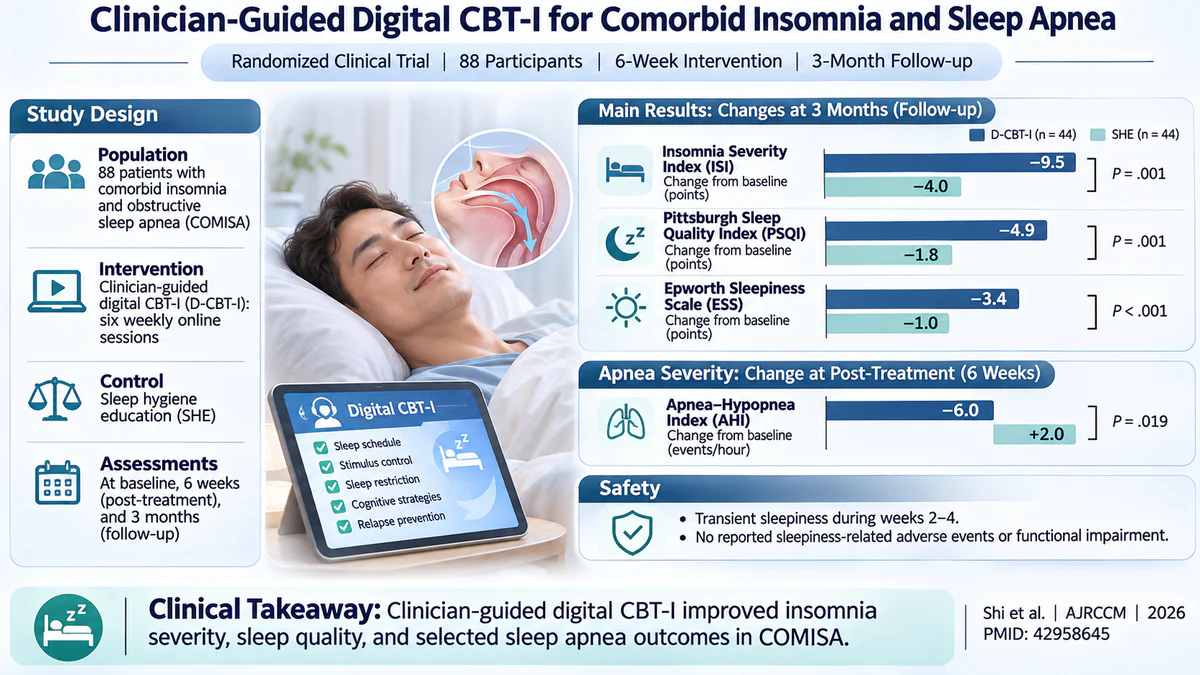
This double-blind, randomized clinical trial enrolled 88 adult patients diagnosed with COMISA. Participants were allocated to receive either clinician-guided digital CBT-I or sleep hygiene education (SHE) alone over six weeks. The D-CBT-I intervention comprised six weekly online sessions involving sleep restriction, stimulus control, cognitive restructuring, sleep hygiene, and relapse prevention strategies. SHE served as an active comparator focusing solely on general sleep health advice.
Outcomes were assessed at baseline, immediately post-intervention (6 weeks), and at a 3-month follow-up. The primary endpoints were changes in Insomnia Severity Index (ISI) and Pittsburgh Sleep Quality Index (PSQI) scores. Secondary measures included daytime sleepiness (Epworth Sleepiness Scale, ESS), objective polysomnographic apnea-hypopnea index (AHI), neurocognitive functioning, and adverse event monitoring. Assessors were blinded to treatment allocation to mitigate bias.
Key Findings
At the 3-month follow-up, intention-to-treat analyses demonstrated that clinician-guided D-CBT-I yielded significantly greater improvements in insomnia severity and sleep quality compared to SHE. The mean ISI score reduction was 9.5 points for D-CBT-I versus 4.0 points for SHE (effect size d = -1.18, P = 0.001). PSQI likewise improved by 4.9 points compared to 1.8 points in SHE (d = -0.87, P = 0.001). These changes indicate meaningful clinical benefits aligning with established thresholds for insomnia remission.
Regarding daytime functioning, subjective sleepiness measured by ESS decreased by 3.4 points in the D-CBT-I group versus 1.0 point with SHE (d = -0.68, P < 0.001). Notably, the apnea-hypopnea index (AHI), assessed by attended polysomnography, showed a significant reduction of 6 events per hour posttreatment in the D-CBT-I arm, whereas AHI increased by 2 events per hour in the SHE group (d = -0.64, P = 0.019). This is clinically impactful, suggesting that D-CBT-I not only improves insomnia but also moderates OSA severity.
Transient increases in daytime sleepiness were observed during weeks 2-4 of therapy, consistent with sleep restriction components of CBT-I. However, these did not translate into functional impairment or sleepiness-related adverse events, affirming the safety of the approach. Cognitive assessments revealed enhanced metacognition and executive function among D-CBT-I recipients, indicating broader neuropsychological benefits beyond sleep improvements.
Expert Commentary
This trial fills a critical evidence gap in managing COMISA by confirming that clinician-guided digital CBT-I is an effective and safe intervention. The dual improvement in both insomnia and OSA severity challenges the traditional belief that treating insomnia alone may exacerbate sleep apnea events. Instead, carefully supervised digital CBT-I may promote more consolidated and restorative sleep, reducing respiratory disruptions.
Strengths of this study include its rigorous double-blind design, objective sleep measurement via polysomnography, and comprehensive cognitive assessments. Limitations include a modest sample size and a relatively short follow-up period of three months. Additional research is needed to confirm long-term sustainability of benefits and to generalize findings to diverse subpopulations with differing OSA severity or comorbidities.
From a mechanistic perspective, improved sleep architecture and reduced arousal from sleep due to cognitive restructuring and stimulus control may mitigate upper airway collapsibility and oxidative stress associated with apneas. Furthermore, digital platforms facilitate greater accessibility and adherence potential, crucial for scaling behavioral interventions addressing high unmet need in COMISA.
Conclusion
Clinician-guided digital CBT-I represents a promising, scalable therapeutic modality that not only ameliorates insomnia symptoms but also significantly reduces obstructive sleep apnea severity and improves daytime functioning in patients with COMISA. This innovative approach may transform clinical management by integrating behavioral sleep medicine with OSA care, ultimately enhancing patient outcomes and quality of life.
Future research should focus on long-term outcomes, cost-effectiveness, and integration of digital CBT-I platforms with conventional OSA therapies such as positive airway pressure devices. Multidisciplinary collaboration among sleep specialists, behavioral therapists, and digital health experts will be essential to optimize care for this challenging patient population.
Funding and Trial Registration
This investigator-initiated trial was registered with the Chinese Clinical Trial Registry (No.: ChiCTR2500099854). The full trial protocol and results are accessible at https://www.chictr.org.cn/showproj.html?proj=267457. Funding sources were not explicitly disclosed in the primary publication.
References
- Shi Y, Feng X, Chen Z, et al. Clinician-guided digital CBT-I improves sleep quality and apnea severity in patients with co-morbid insomnia and OSA: A Double-Blind, Randomized Clinical Trial. Am J Respir Crit Care Med. 2026 Oct 29. PMID: 42958645.
- Roth T. Comorbid insomnia and obstructive sleep apnea: Challenges and treatment approaches. Sleep. 2020;43(4):zsaa018.
- Trauer JM, Qian MY, Doyle JS, Rajaratnam SM, Cunnington D. Cognitive Behavioral Therapy for Chronic Insomnia: A Systematic Review and Meta-analysis. Ann Intern Med. 2015;163(3):191–204.
- Kimoff RJ, Mokhlesi B, Morgenthaler TI. Management of Obstructive Sleep Apnea in Patients with Comorbid Insomnia. Chest. 2021;159(6):2355–2369.
Specialty calculators
For clinical reference; use professional judgment.