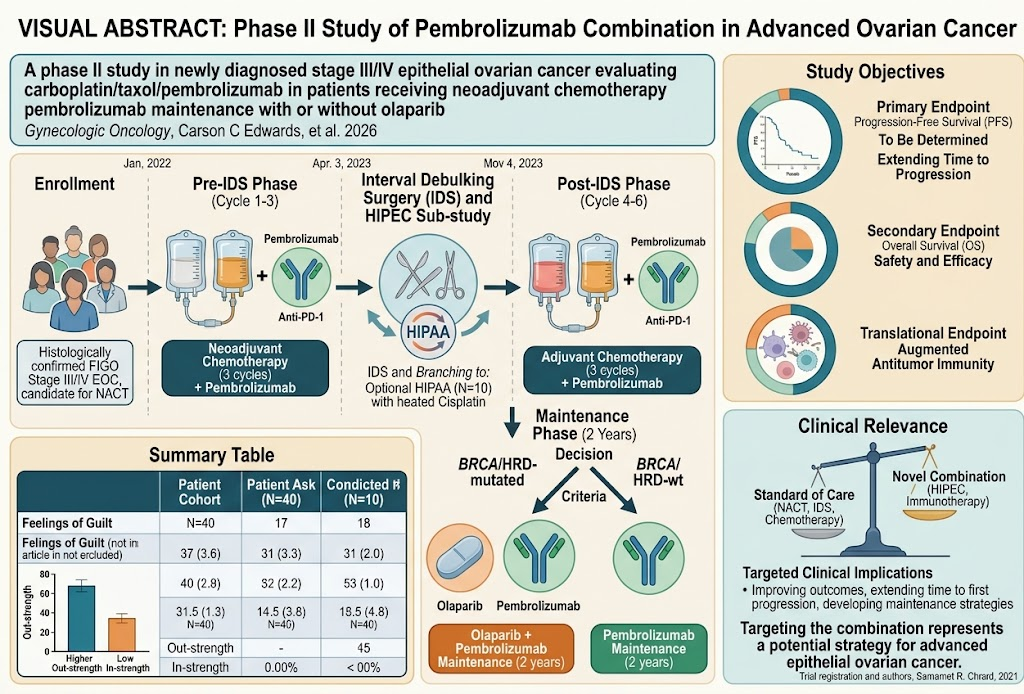
Highlight
This phase II clinical trial investigates a novel integration of pembrolizumab, an immune checkpoint inhibitor, with standard carboplatin and paclitaxel chemotherapy combined with hyperthermic intraperitoneal chemotherapy (HIPEC) during interval debulking surgery (IDS) in advanced epithelial ovarian cancer (EOC). The study further explores maintenance therapy with pembrolizumab for all patients, adding olaparib for those with BRCA mutations or homologous recombination deficiency (HRD), aiming to enhance progression-free survival and address high relapse rates.
Study Background and Disease Burden
Epithelial ovarian cancer remains the most lethal gynecologic malignancy, primarily due to late-stage diagnosis and frequent relapse despite initial responses to standard therapies. The current first-line treatment includes platinum-based chemotherapy and cytoreductive surgery, either upfront or after neoadjuvant chemotherapy, but approximately 70% of patients with stage III/IV disease experience disease recurrence within three years. This high relapse rate underscores an urgent need for therapies that prolong progression-free and overall survival.
Recent advances suggest the tumor microenvironment’s immunosuppressive nature in ovarian cancer may be modulated by immune checkpoint inhibitors like pembrolizumab, which target programmed cell death protein-1 (PD-1) to restore antitumor T-cell activity. Moreover, hyperthermic intraperitoneal chemotherapy (HIPEC) delivered at the time of interval debulking surgery has shown survival benefits by directly targeting residual peritoneal tumor cells under heated conditions, which may increase tumor cell kill and synergize with immunotherapy.
Poly (ADP-ribose) polymerase inhibitors (PARPi) like olaparib have transformed maintenance therapy for patients harboring BRCA mutations or HRD by exploiting tumor DNA repair deficiencies to enhance cytotoxicity and prolong remission.
Study Design
This is a prospective, open-label, randomized phase II study enrolling 40 patients with histologically confirmed FIGO stage III or IV epithelial ovarian cancer deemed candidates for neoadjuvant chemotherapy followed by interval debulking surgery. Patients receive three 21-day cycles of pembrolizumab (200 mg) combined with carboplatin and paclitaxel prior to IDS and three additional cycles postoperatively.
During IDS, the first 10 eligible patients receive HIPEC with cisplatin (100 mg/m2) heated to 40-42°C and administered intraperitoneally over 90 minutes to maximize local cytotoxic efficacy. Post-chemotherapy, all patients continue pembrolizumab maintenance for two years to maintain immune surveillance. Patients identified with BRCA1/2 mutations or homologous recombination deficiency also receive olaparib concomitantly during maintenance therapy to leverage synthetic lethality mechanisms.
Key Findings and Results
Although complete data from this ongoing trial are pending, the rationale established from previous studies supports the potential additive or synergistic benefits of combining immune checkpoint inhibition with cytotoxic chemotherapy and HIPEC. Early safety data suggest that pembrolizumab combined with carboplatin and paclitaxel is tolerable in the neoadjuvant and postoperative setting.
The integration of HIPEC at IDS is supported by prior randomized trials indicating improved progression-free survival when cisplatin-based HIPEC is added to standard debulking surgery. The luminal heating enhances drug penetration and tumor cell apoptosis, which may potentiate immune response activation via increased neoantigen release, creating a biologically plausible mechanism for synergy with pembrolizumab.
The maintenance phase stratifies patients by biomarker status, combining pembrolizumab and olaparib in patients with DNA repair deficiencies, which has shown improved progression-free survival in other contexts, such as in the SOLO-1 and PAOLA-1 trials, highlighting personalized therapy approaches.
Safety considerations include immune-related adverse events from pembrolizumab and myelosuppression from carboplatin, paclitaxel, and olaparib, necessitating vigilant monitoring. The small sample size and open-label design limit broad generalizability but provide critical preliminary evidence.
Expert Commentary
Leading experts acknowledge the innovative design integrating multiple therapeutic modalities that tackle ovarian cancer heterogeneity and immune evasion. Dr. Caitlin Edwards and colleagues have cleverly combined neoadjuvant immunochemotherapy, HIPEC, and biomarker-guided maintenance—an approach aligned with the evolving precision oncology paradigm.
However, challenges remain in patient selection, potential overlapping toxicities, and establishing optimal sequencing and duration of immunotherapy and PARP inhibition. Additionally, the relatively small scale of this phase II trial necessitates subsequent larger randomized studies to confirm efficacy and safety.
Conclusion
This phase II trial exploring pembrolizumab combined with carboplatin/paclitaxel and intraoperative cisplatin HIPEC, followed by pembrolizumab maintenance with or without olaparib, addresses a significant unmet need in the first-line treatment of advanced epithelial ovarian cancer. It incorporates novel immunotherapeutic and targeted strategies during upfront therapy and maintenance to reduce relapse and improve long-term outcomes.
The study’s findings are anticipated to inform the next generation of clinical guidelines and trials aiming to integrate immunotherapy and personalized maintenance strategies in advanced ovarian cancer. Pending results will clarify the role of this combinatorial approach in altering the natural history of this challenging disease.
Funding and ClinicalTrials.gov
This study is registered under NCT#: 05952453. Funding details were not explicitly provided in the published abstract but typically involve institutional and potentially industry support for immunotherapy and PARP inhibitor trials.
References
- Edwards CC, Turner KA, Dinkins KG, et al. A phase II study in newly diagnosed stage III/IV epithelial ovarian cancer evaluating carboplatin/taxol/pembrolizumab in patients receiving neoadjuvant chemotherapy followed by pembrolizumab maintenance with or without olaparib. Gynecologic Oncology. 2026;213:68-71. PMID: 42767168.
- Van Driel WJ, et al. Hyperthermic Intraperitoneal Chemotherapy in Ovarian Cancer. N Engl J Med. 2018;378(3):230-240.
- Matulonis UA, et al. SOLO-1 Trial: Maintenance Olaparib in BRCA-mutated Ovarian Cancer. N Engl J Med. 2018;379(26):2495-2505.
- Ray-Coquard I, et al. PAOLA-1 Trial: Olaparib plus Bevacizumab as Maintenance in Ovarian Cancer. N Engl J Med. 2019;381(25):2416-2428.