Highlights
1. The prevalence of gestational diabetes mellitus (GDM) and pregestational type 2 diabetes increased in U.S. delivery hospitalizations from 2016 to 2022.
2. Severe maternal morbidity (SMM) concurrently rose, with an increasing trend in both overall and nontransfusion SMM.
3. Pregestational type 1 diabetes was associated with the highest risk for SMM, followed by type 2 diabetes and GDM.
4. The findings stress the necessity for comprehensive cardiometabolic risk management and multidisciplinary care during pregnancy.
Study Background
Maternal diabetes, encompassing both gestational diabetes mellitus (GDM) and pregestational diabetes (type 1 and type 2), presents significant challenges in obstetric care. These conditions are associated with adverse pregnancy outcomes, including increased risk for severe maternal morbidity (SMM), which encompasses life-threatening complications during delivery. Over recent years, broader sociodemographic changes and increasing rates of obesity and metabolic syndrome have contributed to the rising prevalence of diabetes in pregnant women.
Understanding how these diabetes subtypes contribute to maternal health risks at the population level is critical for shaping preventive strategies, obstetric management, and resource allocation in healthcare.
Study Design
This retrospective observational study analyzed data from the Healthcare Cost and Utilization Project (HCUP) National Inpatient Sample, covering delivery hospitalizations in the United States from 2016 through 2022. The study population included women aged 12 to 55 years with documented delivery admissions.
Diabetes status was categorized as gestational diabetes mellitus (GDM), pregestational type 1 diabetes, and pregestational type 2 diabetes, identified through diagnostic codes. The outcomes assessed were the prevalence of these diabetes conditions and their association with severe maternal morbidity (SMM). SMM was defined using established criteria, including a subset excluding blood transfusions (“nontransfusion SMM”) to address potential documentation biases.
Modified Poisson regression models estimated relative risks (RRs) for SMM associated with diabetes status, adjusting for important sociodemographic variables (such as age, race/ethnicity, and insurance type) and clinical characteristics.
Key Findings
Among 25,138,817 delivery hospitalizations analyzed:
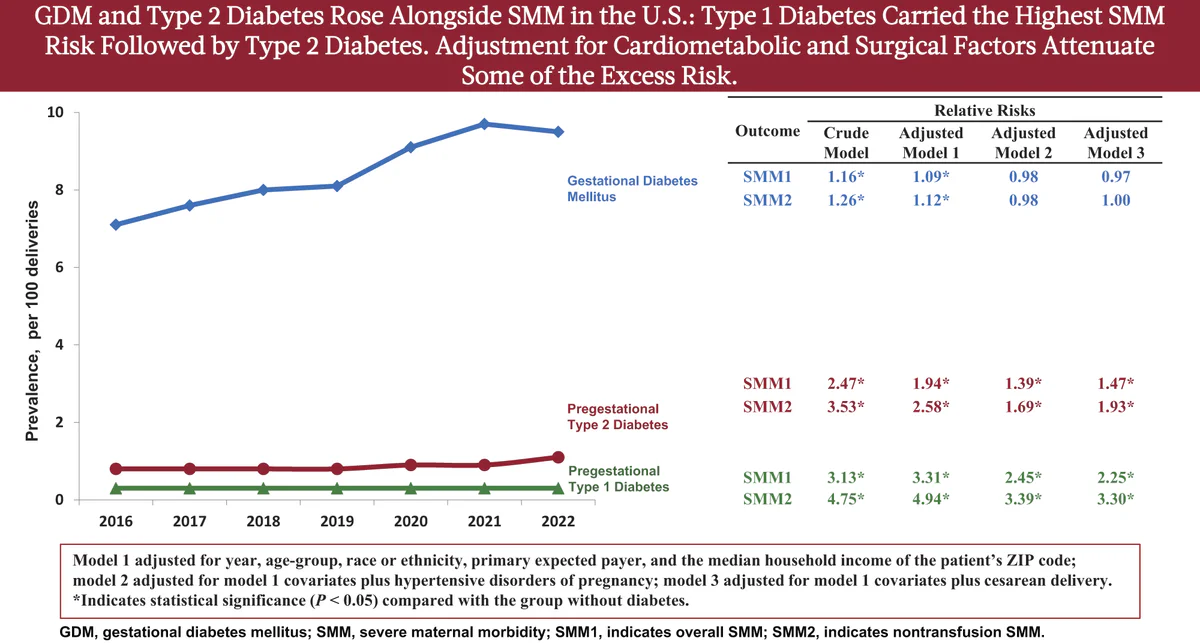
- Prevalence Trends: GDM prevalence increased from 7.1 to 9.5 per 100 deliveries between 2016 and 2022. Pregestational type 2 diabetes rose from 0.8 to 1.1 per 100 deliveries, whereas pregestational type 1 diabetes remained stable at approximately 0.3 per 100 deliveries.
- Severe Maternal Morbidity Trends: Overall SMM rates increased from 160.0 to 220.3 per 10,000 deliveries. Nontransfusion SMM also exhibited an increase, rising from 72.0 to 93.0 per 10,000 deliveries.
- Risk Associations: After adjusting for sociodemographic factors, women with pregestational type 1 diabetes exhibited the highest risk of nontransfusion SMM (RR 4.94; 95% CI 4.55–5.35) compared to women without diabetes. Pregestational type 2 diabetes was associated with a 2.58-fold increased risk (95% CI 2.43–2.74), and GDM was associated with a modest but statistically significant 12% increased risk (RR 1.12; 95% CI 1.08–1.15).
These data illustrate a parallel increase in diabetes during pregnancy and SMM, emphasizing the gradient of risk by diabetes subtype.
Expert Commentary
The observed stable prevalence of type 1 diabetes contrasts with rising type 2 diabetes and GDM, reflecting broader epidemiological trends of metabolic disease burden in reproductive-aged women. The markedly higher risk of SMM with type 1 diabetes aligns with known challenges in managing this group, who often have longer diabetes duration and more complications.
Importantly, the modest increased risk associated with GDM, despite its high prevalence, suggests that while GDM alone may confer a lower individual risk compared to pregestational diabetes, its population-level impact on maternal health morbidity is significant.
This study underscores the critical need for preconception and prenatal strategies focusing on cardiometabolic risk optimization. Multidisciplinary approaches involving endocrinologists, obstetricians, diabetes educators, and nutritionists are necessary to mitigate risks.
One limitation includes reliance on administrative coding, which can be subject to misclassification. Moreover, residual confounding from unmeasured clinical factors cannot be excluded. Despite this, the large sample size and national representation provide robust evidence for policy and clinical interventions.
Conclusion
Between 2016 and 2022, gestational diabetes and pregestational type 2 diabetes increased among U.S. delivery hospitalizations, concomitant with an upward trend in severe maternal morbidity. Women with pregestational diabetes, particularly type 1, face notably higher risks of serious complications during delivery.
These findings highlight an urgent need for integrated diabetes care pathways before and during pregnancy to improve maternal health outcomes. Future research should explore mechanistic drivers of increased SMM risk and evaluate interventions tailored to diabetes type and severity in pregnancy.
Funding and ClinicalTrials.gov
The study was supported by the Healthcare Cost and Utilization Project and published in Diabetes Care (2026). ClinicalTrials.gov registration is not applicable as this was a retrospective observational analysis.
References
- Fwu CW, Casagrande SS, Lawrence JM. Trends in Pregestational Diabetes and Gestational Diabetes Mellitus and Associations With Severe Maternal Morbidity in U.S. Delivery Hospitalizations, 2016-2022. Diabetes Care. 2026 Nov;49(11):1955-1964. PMID: 42319764.
- American Diabetes Association. Management of Diabetes in Pregnancy: Standards of Medical Care in Diabetes—2024. Diabetes Care. 2024 Jan;47(Supplement_1):S183-S192.
- Metzger BE. Long-term outcomes in mothers diagnosed with gestational diabetes mellitus and their offspring. Clin Obstet Gynecol. 2007;50(4):972-979.
- Kuklina EV, Ayala C, Callaghan WM. Severe obstetric morbidity in the United States: 1998–2005. Obstet Gynecol. 2009 Apr;113(2 Pt 1):293-299.
Specialty calculators
For clinical reference; use professional judgment.