Highlights
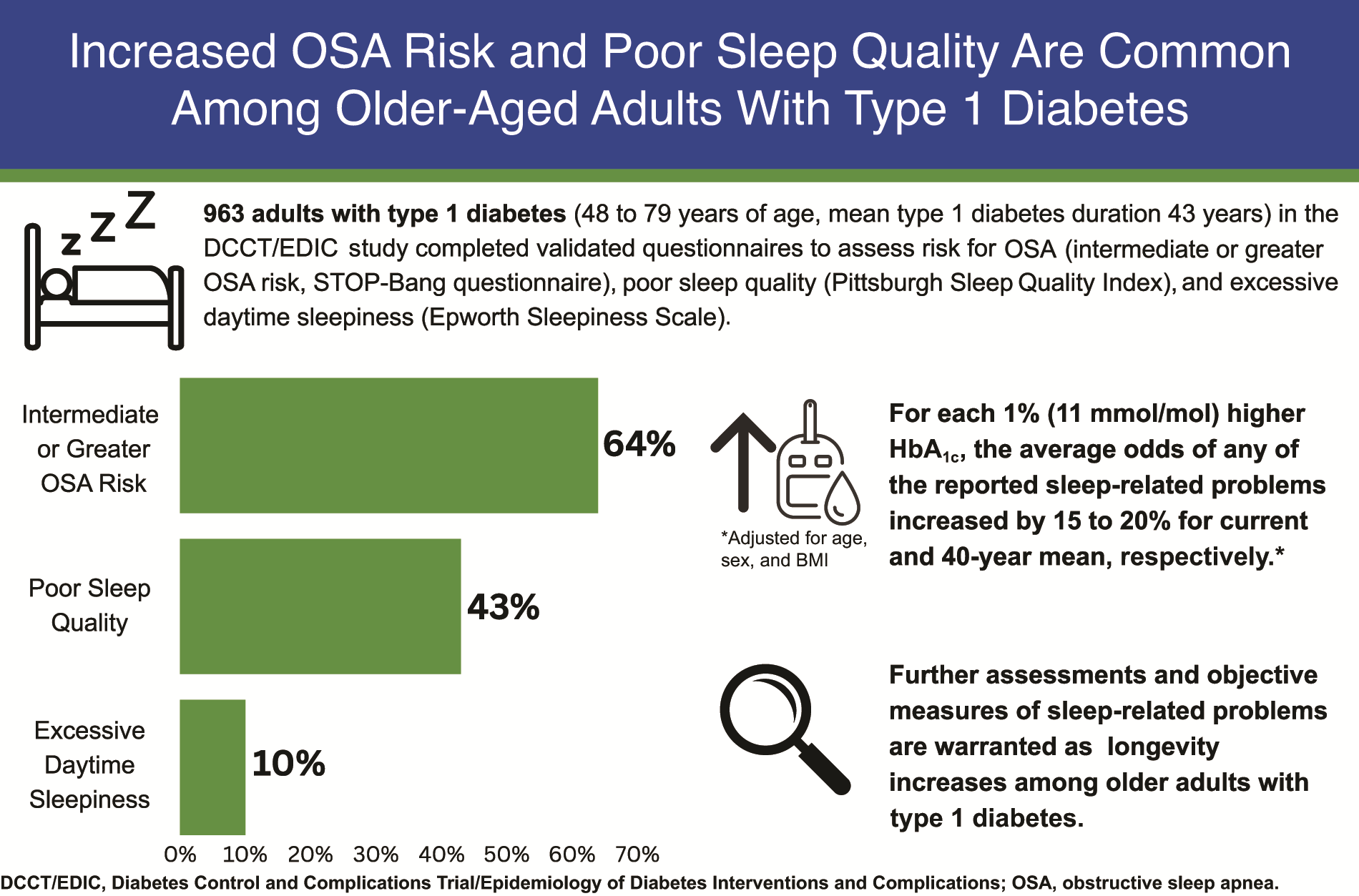
- Older adults with type 1 diabetes exhibit a markedly increased risk of obstructive sleep apnea (OSA), with 64% demonstrating intermediate to high risk by STOP-Bang criteria.
- Poor sleep quality affects nearly half (43%) of this population, with significant overlaps between glycemic control, diabetes complications, and sleep disturbances.
- Glycemic parameters (current and mean HbA1c) correlate with 15-20% increased odds of sleep problems per 1% HbA1c increment, underscoring a dose-response relationship.
- Cardiovascular autonomic neuropathy and markers of diabetic kidney disease (albuminuria) along with hypoglycemia severity are independently associated with OSA risk and poor sleep quality, implicating complex pathophysiological links.
Background
Type 1 diabetes mellitus (T1DM) is a chronic autoimmune disease characterized by absolute insulin deficiency, necessitating lifelong management to prevent microvascular and macrovascular complications. As patients with T1DM age, the cumulative burden of diabetes-related comorbidities increases, potentially impacting sleep architecture and quality. Sleep disorders, particularly obstructive sleep apnea (OSA), are well-recognized risk factors for cardiovascular morbidity and mortality in the general population, yet their prevalence and determinants in older adults with T1DM have been under-investigated.
Understanding sleep disturbances is crucial as they may exacerbate glycemic variability, insulin resistance, and diabetic complications, thereby creating a vicious cycle adversely affecting diabetes outcomes and quality of life. The Diabetes Control and Complications Trial (DCCT) and its observational follow-up, the Epidemiology of Diabetes Interventions and Complications (EDIC) study, provide a well-characterized cohort to investigate these associations in a long-term prospective framework.
Key Content
Prevalence and Assessment of Sleep Disorders in Older Adults with T1DM
The 2026 DCCT/EDIC analysis involved 963 participants (mean age 64 years, mean diabetes duration 43 years) who completed validated sleep questionnaires: the STOP-Bang for OSA risk, the Pittsburgh Sleep Quality Index (PSQI) for sleep quality, and the Epworth Sleepiness Scale (ESS) for daytime sleepiness.
Reported diagnosed OSA prevalence reached 29%, and 19% of participants were on positive airway pressure (PAP) therapy, consistent with underdiagnosis and under-treatment. The STOP-Bang identified 64% at intermediate/high risk for OSA, a prevalence substantially exceeding that in the general older adult population. Poor sleep quality (PSQI >5) was present in 43%, and excessive daytime sleepiness (ESS >10) in 10%.
Association of Glycemia and Diabetes Complications with Sleep Impairment
Multivariate logistic regression revealed that each 1% increase in current or mean HbA1c conferred a 15-20% increased odds of any sleep disturbance, highlighting hyperglycemia as a modifiable risk factor. Cardiovascular autonomic neuropathy (CAN) independently increased the odds of intermediate/high OSA risk after adjustment for confounders including age, sex, BMI, and glycemia.
Albuminuria, a marker of diabetic nephropathy, and history of severe hypoglycemia were significantly associated with poor sleep quality, suggesting that microvascular complications and glycemic instability contribute to sleep disruption mechanisms.
Potential Mechanisms Linking T1DM and Sleep Disorders
The interplay between autonomic dysfunction and upper airway control may predispose to OSA in T1DM patients. CAN can impair ventilatory control and upper airway muscle tone, facilitating apneic events. Hypoglycemia episodes disrupt sleep continuity and architecture, contributing to subjective poor sleep quality.
Furthermore, chronic hyperglycemia contributes to systemic inflammation and oxidative stress, possibly affecting central nervous system pathways regulating sleep-wake cycles. Renal impairment may lead to uremic toxin accumulation and metabolic imbalances that negatively impact sleep.
Comparative and Complementary Literature
While OSA prevalence in type 2 diabetes has been extensively studied, evidence in T1DM has been limited. Previous smaller cross-sectional studies have suggested elevated OSA risk in T1DM; however, the DCCT/EDIC study provides robust prospective data with comprehensive phenotyping. Meta-analyses of T2DM populations report OSA prevalence rates between 50-70%, aligning with findings herein and supporting the clinical relevance across diabetes subtypes.
Expert Commentary
The DCCT/EDIC findings underscore the need for routine sleep assessments in older adults with long-standing T1DM. Sleep disturbances are not merely comorbid conditions but integral components of diabetes morbidity that may exacerbate metabolic and vascular complications.
Clinical guidelines for diabetes management should consider incorporating screening tools like STOP-Bang and PSQI to identify patients at risk who may benefit from polysomnography and targeted interventions.
Mechanistic insights invite further research into autonomic neuropathy’s role in OSA pathogenesis within T1DM, emphasizing the importance of neuropathy prevention. Moreover, interventions to optimize glycemic control and minimize hypoglycemia may improve sleep outcomes, although causality and intervention efficacy require rigorous testing.
Limitations of current evidence include reliance on questionnaire-based assessment rather than objective sleep studies for all participants, and potential residual confounding by comorbidities. Nonetheless, the longitudinal characterization of the DCCT/EDIC cohort strengthens the validity of observed associations.
Conclusion
Older adults with type 1 diabetes exhibit a high burden of obstructive sleep apnea risk and poor sleep quality, intricately linked with glycemic control and diabetes complications. Incorporation of standardized sleep assessments into routine care may facilitate early identification and management of sleep disorders, potentially mitigating adverse metabolic and cardiovascular sequelae.
Future research should focus on interventional trials assessing the impact of OSA treatment and improved glycemic strategies on sleep outcomes and overall morbidity in T1DM. Additionally, mechanistic studies deciphering neural and vascular pathways will enhance understanding and therapeutic targeting.
References
- Martin CL, Bott M, Herman WH, Braffett BH, Trapani VR, Bebu I, et al. Increased Risk of Obstructive Sleep Apnea and Poor Sleep Quality Among Older Adults With Type 1 Diabetes: The DCCT/EDIC Study. Diabetes Care. 2026 Sep 29; PMID: 42809017.
- Punjabi NM. The epidemiology of adult obstructive sleep apnea. Proc Am Thorac Soc. 2008;5(2):136-43. PMID: 18250224.
- Littleton SW. Impact of sleep disturbance on glycemic control in persons with type 1 diabetes: a systematic review. Behav Sleep Med. 2012;10(4):265-75. PMID: 22890494.
- Pamidi S, Tasali E. Obstructive sleep apnea and type 2 diabetes: is there a link? Front Neurol. 2012;3:126. PMID: 22919627.
- Martyn-Nemeth P, Lores-Arnaiz S, et al. Autonomic dysfunction and sleep disorders in type 1 diabetes. Front Endocrinol (Lausanne). 2020;11:411. PMID: 32753637.