Highlight
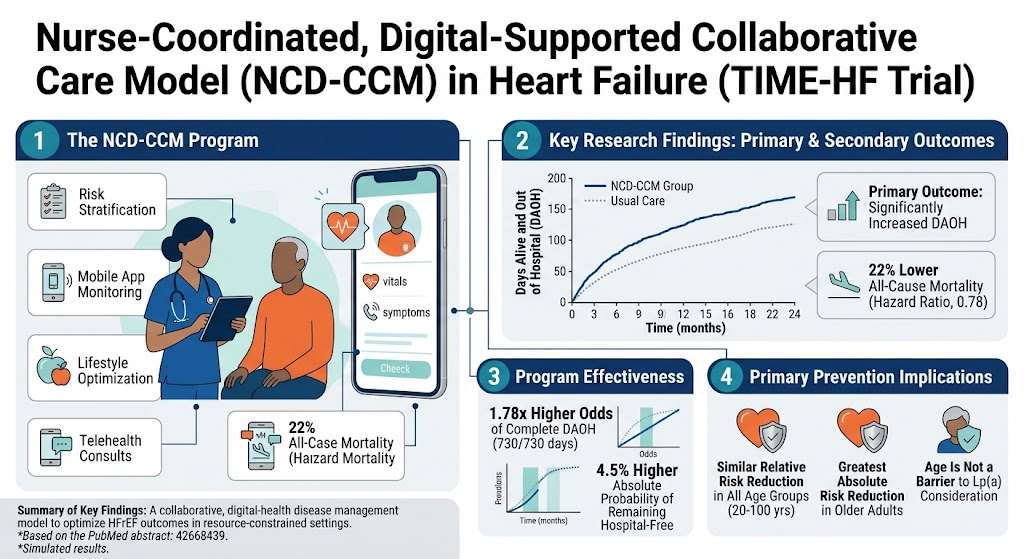
- The TIME-HF cluster RCT demonstrated that a nurse-coordinated, digital-supported collaborative care model significantly increased days alive and out of hospital among patients with heart failure with reduced ejection fraction (HFrEF) in India.
- The intervention led to a 22% reduction in all-cause mortality compared with usual care over a 2-year follow-up period.
- The study underscores the feasibility and effectiveness of integrating mobile health technology with nurse-led care for chronic heart failure management in resource-constrained, predominantly rural Indian contexts.
- This model may serve as a scalable strategy to improve clinical outcomes and reduce disease burden among heart failure patients in India and similar low- to middle-income settings.
Study Background
Heart failure with reduced ejection fraction (HFrEF) is a leading cause of morbidity and mortality in India, a country facing increasing cardiovascular disease burden due to demographic transition and lifestyle changes. Patients with HFrEF experience recurrent hospitalizations and high mortality rates, imposing substantial healthcare costs and social hardships, especially in rural and low-resource areas. Despite established therapies, gaps remain in optimizing management, particularly regarding adherence to guideline-directed medical therapy and patient self-care. Nurse-coordinated care models supported by digital health tools have emerged internationally as promising interventions for chronic disease management but lacked robust evidence from large pragmatic trials in India. The TIME-HF trial aimed to fill this gap by evaluating whether a comprehensive nurse-led, mobile health-supported collaborative care approach could improve clinical outcomes among Indian patients with HFrEF.
Study Design
The TIME-HF trial was a parallel-group, cluster-randomized controlled trial conducted across 22 centers in India, enrolling 1507 adult patients with established HFrEF. Centers were randomized 1:1 to either the intervention or usual care arm. The intervention incorporated several components:
- Systematic risk stratification of patients.
- Optimization of pharmacological treatment according to guidelines.
- Structured lifestyle counseling and self-care education.
- Nurse-coordinated follow-up facilitated by mobile health technology enabling active monitoring and communication between healthcare providers and patients.
Participants were followed for a duration of 24 months. The primary outcome was days alive and out of hospital, analyzed via a one-inflated beta regression model. Secondary outcome included all-cause mortality, assessed using Cox proportional hazards models adjusting for cluster randomization.
Key Findings
The trial enrolled 1507 participants (755 intervention; 752 usual care) with a mean age of approximately 62 years. The majority were men (77.6%), many had low educational attainment (70%), and more than half (57.3%) lived in rural areas. Ischemic heart disease was the leading cause of heart failure (77.4%). Baseline characteristics were balanced between groups.
Over 24 months, adherence to follow-up was excellent, with all but one participant completing the full duration. Analysis revealed:
– The probability of survival without hospitalization for the full 730 days was higher in the intervention group (84.0%) than usual care (79.4%), indicating improved patient stability.
– The odds of having 100% days alive and out of hospital were 78% higher in the intervention arm (OR 1.78; 95% CI, 1.42-2.23), demonstrating meaningful clinical benefit beyond standard care.
– Mortality was significantly reduced: 21.59% of intervention patients died by 2 years compared to 26.73% in usual care, yielding a risk ratio of 0.80 (95% CI, 0.67-0.97).
– Cox regression confirmed a 22% relative risk reduction in death with intervention (HR 0.78; P=0.028) after adjusting for cluster effects.
These findings translate to a 4.5 percentage point absolute increase in the probability of remaining out of hospital alive over 2 years.
Expert Commentary
The TIME-HF trial provides compelling evidence supporting nurse-coordinated, digital-assisted collaborative care as a pragmatic and scalable strategy to improve outcomes in HFrEF patients in India. Previous trials globally have demonstrated benefits with multidisciplinary heart failure clinics and digital remote monitoring, but this study is notable for its scale, cluster randomized design, and context within a predominantly low-resource setting with rural representation.
The intervention’s success likely stems from multiple synergistic factors: trained nurses bridging care gaps, mobile health facilitating regular contact and early detection of decompensation, and individualized self-care education fostering adherence. This integrated model addresses common barriers to heart failure management, such as medication non-adherence, knowledge deficits, and inadequate follow-up.
Limitations include the predominantly male study population, potential variability in usual care quality, and lack of blinding inherent to cluster designs. Additionally, although statistical adjustments accounted for clustering, residual confounding cannot be fully excluded. Further research could explore cost-effectiveness, patient-reported outcomes, and applicability to other heart failure phenotypes.
Conclusion
The TIME-HF cluster RCT conclusively demonstrates that a nurse-coordinated, mobile health-supported collaborative care model significantly improves survival and reduces hospitalizations in patients with HFrEF in India. Integration of such models into routine practice could transform heart failure management in India, especially in rural and underserved regions, contributing to better patient outcomes and reduced healthcare system burden. Policymakers and healthcare providers should consider scaling and adapting this approach while continuing to evaluate long-term impacts and resource implications.
Funding and Trial Registration
The study was registered with the Clinical Trials Registry – India (CTRI/2021/11/037797). Funding sources were not specified in the abstract.
References
Jeemon P, Ganapathi S, Anikkady N, et al. Effectiveness of Nurse-Coordinated, Digital-Supported Collaborative Care Model in Reducing Hospital Stay and Mortality Among Patients With Heart Failure: TIME-HF Cluster RCT India. Circulation. Published August 30, 2026. PMID: 42668439. https://pubmed.ncbi.nlm.nih.gov/42668439/
McAlister FA, Stewart S, Ferrua S, McMurray JJ. Multidisciplinary strategies for the management of heart failure patients at high risk for admission: a systematic review of randomized trials. J Am Coll Cardiol. 2004;44(4):810-819.
Klompstra L, Jaarsma T, Strömberg A. Physical Activity and Exercise Self-Care in Patients With Heart Failure: A Review of the Literature. J Cardiovasc Nurs. 2018;33(3):E1-E12.