Highlight
- Liver transplant recipients have a higher prevalence of airflow limitation and preserved ratio impaired spirometry (PRISm) compared to matched controls from the general population.
- Living with a transplanted liver is independently associated with decreased forced expiratory volume in 1 second (FEV1) and forced vital capacity (FVC), indicating impaired pulmonary function.
- Patients post liver transplantation report more frequent and severe dyspnea as measured by the modified Medical Research Council (mMRC) dyspnea scale.
- Previous pulmonary infections in liver transplant recipients are associated with increased odds of airflow limitation.
Study Background
Liver transplantation is a life-saving intervention for patients with end-stage liver disease; however, the long-term systemic effects of living with a transplanted liver are still being elucidated. While acute pulmonary infections are recognized complications in liver transplant recipients, chronic respiratory impairments and their clinical consequences remain insufficiently characterized. Pulmonary dysfunction can significantly affect quality of life and may contribute to morbidity including increased risk of respiratory failure and hospitalizations. Understanding the burden of chronic lung disease in this population is critical to developing appropriate surveillance and management strategies.
Study Design
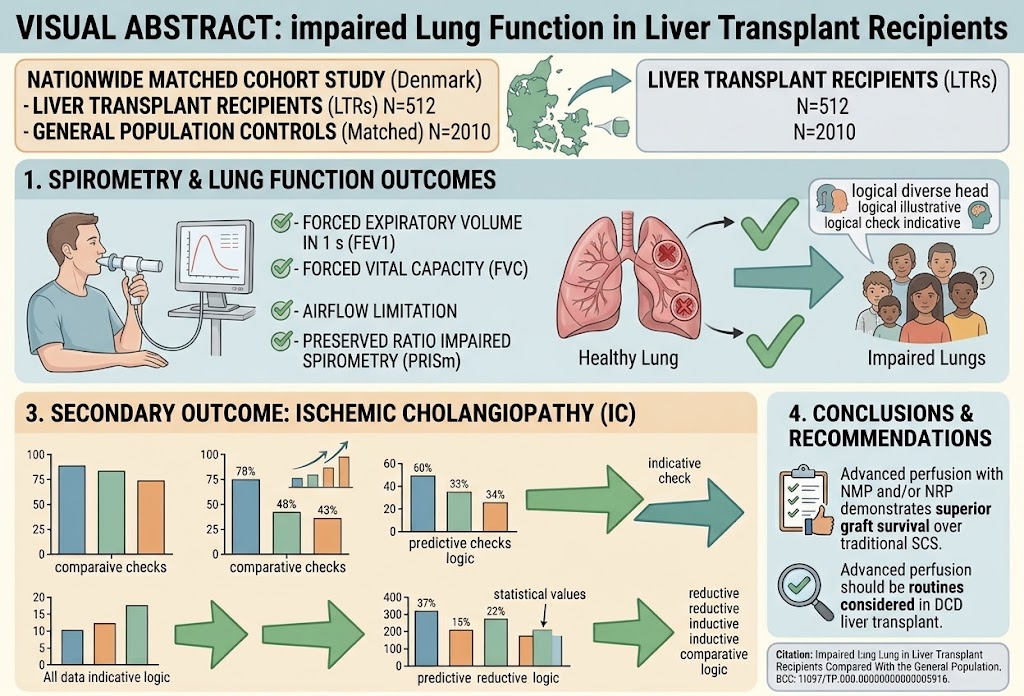
This investigation utilized data from two large Danish cohorts: The Danish Comorbidity in Liver Transplant Recipients study and The Copenhagen General Population Study. The study population included 512 adult liver transplant recipients and 2010 age- and sex-matched controls from the general population. Spirometry testing was performed to evaluate lung function. Spirometric parameters included Forced Expiratory Volume in 1 second (FEV1), Forced Vital Capacity (FVC), airflow limitation characterized by a reduced FEV1/FVC ratio, and the presence of preserved ratio impaired spirometry (PRISm), defined as reduced FEV1 with preserved FEV1/FVC ratio.
Dyspnea was assessed using the modified Medical Research Council (mMRC) dyspnea scale. Multivariable adjustments accounted for confounders including age, sex, ethnicity, cumulative smoking exposure, and educational status.
Key Findings
The study found that liver transplant recipients had a significantly higher prevalence of airflow limitation (10.7%) compared to matched controls (7.1%), with a P value of 0.01 indicating statistical significance. Notably, PRISm was more than twice as prevalent in liver transplant recipients (23.8%) versus controls (11.8%), with P < 0.001.
Adjusted analyses demonstrated that living with a transplanted liver independently increased the odds of airflow limitation (adjusted odds ratio [aOR] 2.06; 95% confidence interval [CI], 1.41-3.01) and PRISm (aOR 2.88; 95% CI, 2.08-3.99). Liver transplant recipients also had significantly lower mean FEV1 by 363 mL (95% CI, 297-430 mL) and lower FVC by 549 mL (95% CI, 467-632 mL) compared to controls.
Regarding symptoms, liver transplant recipients reported worse dyspnea scores on the mMRC scale, indicating more severe and frequent respiratory symptoms. Within the liver transplant cohort, a history of pulmonary infection was associated with doubled odds of airflow limitation (aOR 2.23; 95% CI, 1.06-4.66).
These findings collectively suggest a substantial pulmonary burden in the liver transplant population, encompassing both objective lung function impairments and subjective respiratory symptoms.
Expert Commentary
This study adds crucial evidence that chronic pulmonary impairment is a significant yet underrecognized comorbidity among liver transplant recipients. The elevated prevalence of airflow limitation and PRISm may relate to a variety of factors including immunosuppression-related infections, underlying chronic liver disease sequelae, and potential impacts of transplant-related medications. PRISm, in particular, is increasingly recognized as a predictor of adverse cardiovascular and respiratory outcomes in general populations and its presence here warrants further investigation.
From a mechanistic perspective, chronic liver disease and transplantation are associated with systemic inflammation, altered immune responses, and vascular abnormalities that may contribute to pulmonary remodeling and dysfunction. Moreover, post-transplant infections appear to exacerbate airflow limitation, underscoring the need for vigilant pulmonary infection prevention and management.
While robust in design, the study is observational and cannot establish causality. The cohort being from Denmark may limit direct generalizability to ethnically or socioeconomically different populations, and residual confounding cannot be excluded. Nevertheless, the large sample size and matched design provide compelling evidence that supports enhanced pulmonary evaluation in liver transplant care.
Conclusion
Liver transplant recipients experience significantly impaired lung function manifested by increased airflow limitation, PRISm, and reduced FEV1 and FVC. This physiological compromise correlates with increased dyspnea and likely contributes to morbidity in this population. Given these findings, clinicians managing liver transplant recipients should incorporate routine pulmonary assessment and consider early intervention strategies to mitigate chronic lung disease progression. Future research should explore longitudinal trajectories of pulmonary function post-transplant and investigate targeted interventions to improve respiratory outcomes in this vulnerable group.
Funding and Clinical Trials
The original study was conducted using data from nationwide Danish cohorts, supported by institutional and governmental research funds. No clinical trial registration was applicable as this is an observational cohort study.
References
1. Arentoft N, Afzal S, Pommergaard HC, et al. Impaired Lung Function in Liver Transplant Recipients Compared With the General Population: A Nationwide Matched Cohort Study. Transplantation. 2026 Sep 17; PMID: 42753246.
2. Balestro E, Calabrese F, Poletti V. The Lung in Liver Diseases: A Review of Clinical and Pathophysiological Mechanisms. Int J Mol Sci. 2021;22(5):2582.
3. Celli BR, MacNee W; ATS/ERS Task Force. Standards for the diagnosis and treatment of patients with COPD: a summary of the ATS/ERS position paper. Eur Respir J. 2004 Jun;23(6):932-46.
4. Neder JA, Steenbruggen I, Faarup J, et al. Preserved Ratio Impaired Spirometry: Underappreciated Persistent Lung Function Abnormality With Symptoms and Mortality Risk. Chest. 2023;163(1):119-134.