Highlight
This retrospective study investigates the differential impacts of neoadjuvant chemotherapy (NACT) and adjuvant chemotherapy (ACT) on surgical complications following immediate prepectoral tissue expander (TE)-based breast reconstruction after mastectomy. Key findings reveal that ACT is associated with a significantly higher risk of major complications compared to NACT and no chemotherapy. Interestingly, perioperative leukopenia correlates with certain complication patterns, including lower infection but higher hematoma and skin necrosis rates.
Study Background
Prepectoral implant-based breast reconstruction has regained popularity as an approach following mastectomy, offering benefits such as reduced pain and improved cosmesis by avoiding muscle elevation. However, implant-based reconstruction carries inherent risks including infection and implant loss, which can be compounded by chemotherapy-related immunosuppression. Neoadjuvant chemotherapy—administered before surgery—is increasingly utilized for breast cancer to downstage tumors and facilitate breast conservation or enable better reconstruction outcomes. Yet, the immunomodulatory effects and leukopenia induced by NACT might influence postoperative healing and infection risk after reconstruction surgery. Conversely, adjuvant chemotherapy, initiated postoperatively, may also affect complication rates differently due to timing and immune status. Clarifying how timing of chemotherapy influences complication profiles in prepectoral tissue expander reconstruction remains an important clinical question to optimize patient outcomes and guide perioperative management.
Study Design
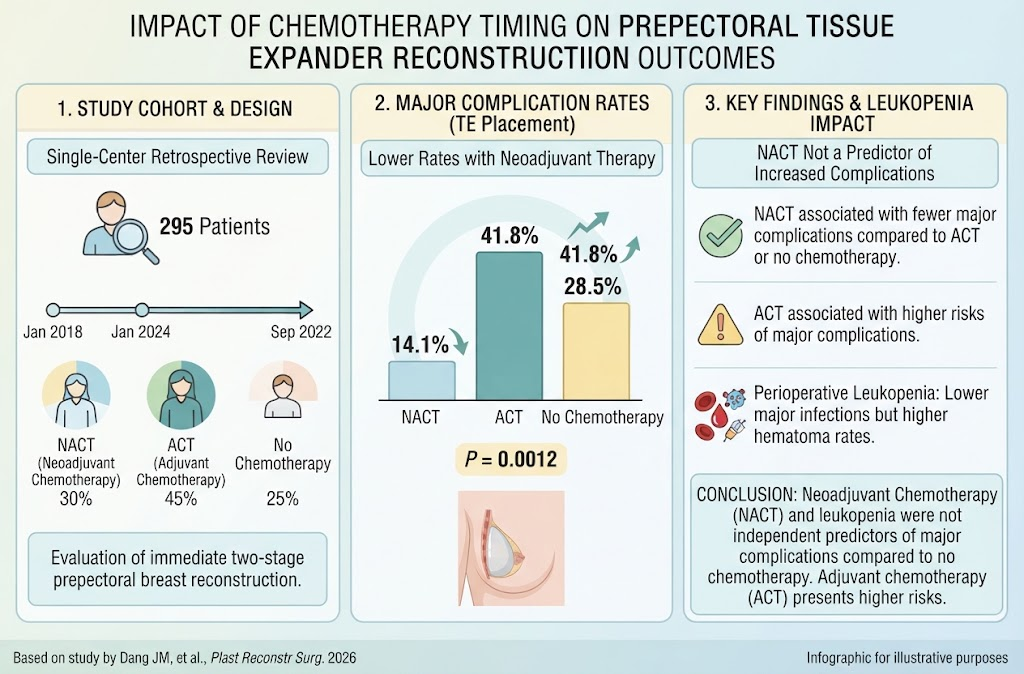
The investigators conducted a single-center retrospective review from January 2018 to September 2022, encompassing 295 patients undergoing two-stage immediate prepectoral TE-based breast reconstruction post-mastectomy. The cohort was stratified into three groups based on chemotherapy timing: neoadjuvant chemotherapy (NACT), adjuvant chemotherapy (ACT), and no chemotherapy. Additionally, the presence of perioperative leukopenia was recorded to assess its impact on surgical outcomes. Outcomes of interest were major complications following TE placement and implant exchange, including infection, hematoma, skin necrosis, explantation, and reoperation. Statistical analysis included univariate comparisons and a multivariate mixed effects logistic regression to identify predictors of major complications.
Key Findings
The study found a striking differential in complication rates related to chemotherapy timing. Patients receiving NACT experienced the lowest rates of major complications after TE placement (14.1%), compared to those receiving ACT (41.8%) or no chemotherapy (28.5%), with a statistically significant difference (p=0.0012). This counterintuitive finding suggests that NACT may not increase, and may even decrease, perioperative morbidity in the context of immediate prepectoral reconstruction.
Importantly, when evaluating individual complications following TE placement, no significant differences emerged among chemotherapy groups. Similarly, outcomes after implant exchange were comparable across all groups, suggesting that the increased complication risk with ACT is predominantly associated with the immediate postoperative period following TE insertion.
Analysis of perioperative leukopenia uncovered nuanced effects. Patients with leukopenia experienced lower rates of major infections but higher rates of hematoma following TE placement, indicating a complex interplay between immune suppression and bleeding risk. Additionally, after implant exchange, leukopenic patients had lower explantation rates but higher incidences of skin necrosis and reoperation, underscoring the varied influence of leukopenia on wound healing and surgical recovery.
Statistical Insights
The use of mixed effects logistic regression allowed adjustment for confounding variables, reinforcing that ACT independently predicted higher major complication risk in this surgical context. The absence of increased risk with NACT or leukopenia challenges traditional concerns that perioperative immunosuppression inevitably worsens surgical outcomes in implant reconstruction.
Expert Commentary
This study offers important clinical insights, especially as prepectoral reconstruction becomes widely adopted and neoadjuvant chemotherapy is increasingly preferred in breast cancer management. The finding that ACT, rather than NACT, confers higher risk may reflect differences in tissue healing environment, timing of immune suppression relative to surgery, or patient selection biases. The observed protective effect of NACT could relate to tumor downstaging reducing surgical complexity or to optimized perioperative planning.
It is essential to consider limitations inherent to retrospective analyses, including potential selection bias and unmeasured confounders such as variations in chemotherapy regimens, radiation therapy, and surgical technique. Prospective studies and multicenter cohorts would help confirm these findings and refine perioperative protocols.
Mechanistically, leukopenia’s mixed effect on various complications suggests that neutrophil depletion may reduce infection risk but impair coagulation or skin perfusion, leading to hematoma and necrosis. These findings highlight the need for balanced strategies to manage immune and hemostatic parameters perioperatively.
Conclusion
The study by Dang et al. significantly advances understanding of how chemotherapy timing influences outcomes in prepectoral TE-based breast reconstruction. While adjuvant chemotherapy substantially elevates major postoperative complications, neoadjuvant chemotherapy and perioperative leukopenia do not worsen—and may even mitigate—certain risks compared with no chemotherapy. These results emphasize the importance of careful patient selection and multidisciplinary coordination when planning chemotherapy and reconstructive surgery sequences. Further prospective research is warranted to validate these observations and develop optimized care pathways that minimize reconstruction morbidity and improve oncologic outcomes.
Funding and Clinical Trials
No specific funding or clinical trials information was reported for this study.
References
- Dang JM, Gupta N, Alnaseri T, Demirjian M, Kwan L, Teshome M, DeLong M. Association of Neoadjuvant Versus Adjuvant Chemotherapy on Pre-Pectoral Tissue Expander Based Reconstruction Outcomes Following Mastectomy. Plastic and Reconstructive Surgery. 2026 Oct 14;PubMed PMID: 42873130.
- Cordeiro PG. Breast reconstruction after surgery for breast cancer. N Engl J Med. 2008;359(15):1590-601.
- Spears J, Ganeshan A, Patel KM, Moura A, Mirzabeigi MN. Outcomes and Strategies in Prepectoral Breast Reconstruction. Current Breast Cancer Reports 2020;12:157–166.
- Nazerali R, Dragomir A, Rappaport V, Morzycki A, Smith S, Lung C. Impact of chemotherapy on surgical outcomes in implant-based breast reconstruction: a systematic review. Plast Reconstr Surg Glob Open. 2019;7(10):e2476.