Highlight
- Higher lifetime oestrogen exposure indices correlate with delayed biological aging measured by phenotypic age acceleration.
- Increased total oestrogen exposure (TEE) is consistently associated with lower all-cause and cardiovascular mortality in two large cohorts.
- Elevated lifetime oestrogen exposure predicts modestly longer estimated life expectancy at midlife.
- Associations with increased breast and endometrial cancer incidence highlight the need for nuanced interpretation of oestrogen’s risks and benefits.
Study Background
Oestrogens are key female sex hormones influencing reproductive function, cardiovascular health, bone metabolism, and cellular aging processes. The cumulative exposure to endogenous oestrogen across a woman’s lifespan—shaped by menarche, menopause, pregnancies, and hormonal therapies—may impact biological aging and longevity. Bridging the gap between reproductive history and survival outcomes is challenging, with conflicting evidence on whether prolonged oestrogen exposure confers health benefits or increases cancer risks. Understanding the complex relationships between lifetime oestrogen exposure indices and aging trajectories is critical to optimize women’s health strategies in postmenopause, a key period of increased morbidity and mortality.
Study Design
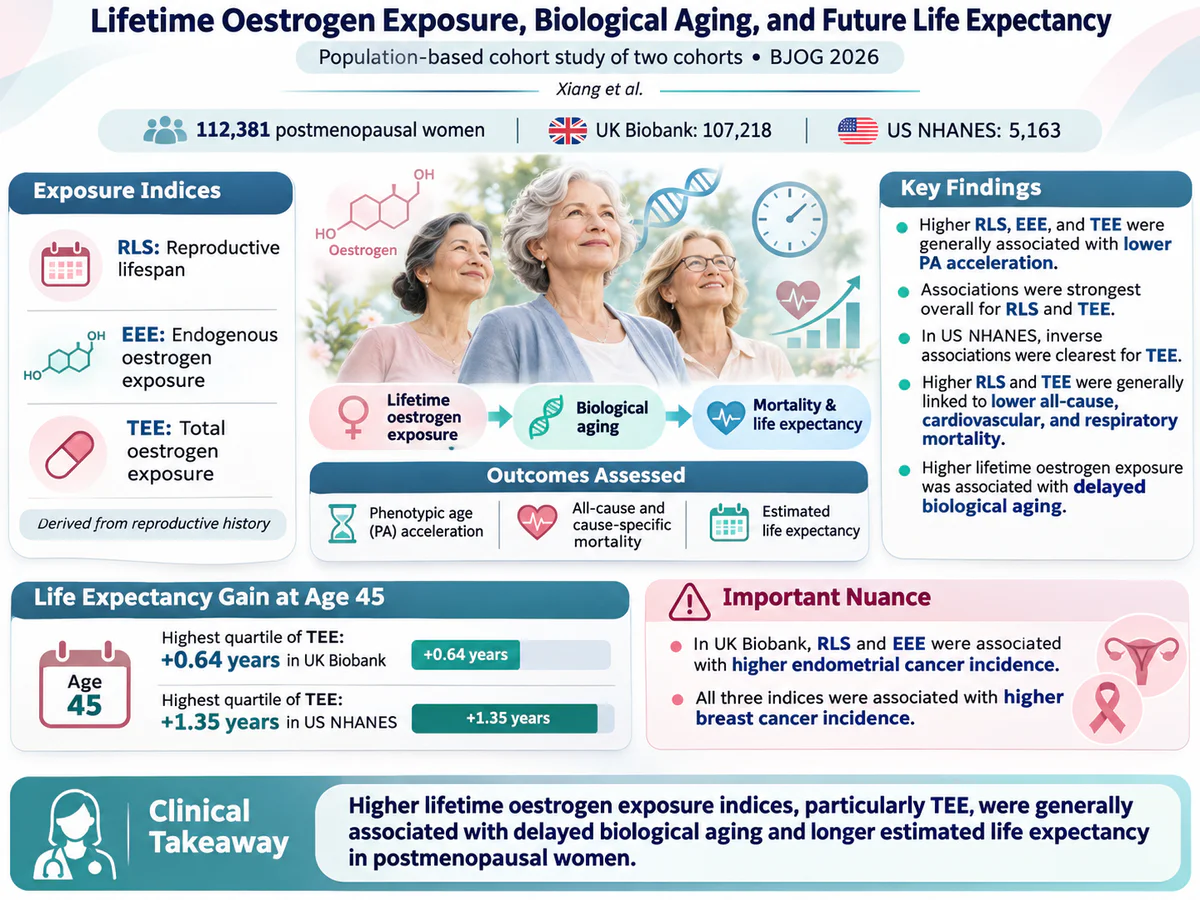
This prospective population-based cohort investigation utilized data from two large and independent datasets: the UK Biobank (n=107,218 postmenopausal women) and the US National Health and Nutrition Examination Survey (NHANES; n=5,163 postmenopausal women). Lifetime oestrogen exposure was quantified through three reproductive-history-based indices:
- Reproductive lifespan (RLS): Time interval between menarche and menopause.
- Endogenous oestrogen exposure (EEE): Reproductive lifespan adjusted for periods of pregnancy and oral contraceptive use, accounting for fluctuations in oestrogen levels.
- Total oestrogen exposure (TEE): Combination of EEE and exogenous hormone therapy exposure.
Biological aging was evaluated using phenotypic age acceleration (PA acceleration), a composite biomarker integrating clinical chemistries and immune markers predictive of morbidity and mortality. The primary clinical endpoints included all-cause mortality, cause-specific mortality (cardiovascular, respiratory, cancer), and estimated life expectancy at age 45. Multivariable linear regression, Cox proportional hazards models, and flexible parametric survival models were applied, adjusting for key confounders such as age, socioeconomic status, BMI, smoking, and comorbidities.
Key Findings
The major findings span both large cohorts, with confirmatory patterns:
Association with Biological Aging
In the UK Biobank cohort, higher RLS, EEE, and especially TEE were inversely associated with PA acceleration, indicating slower biological aging. The effect sizes were notable; for example, women in the highest quartile of RLS had a beta coefficient of -0.31 (95% confidence interval [CI]: -0.40 to -0.22) for PA acceleration compared to the lowest quartile. The US NHANES cohort corroborated these findings most significantly for TEE.
Mortality Risk Reduction
Across both cohorts, elevated RLS and TEE were linked to significantly lower risks of all-cause mortality and cause-specific mortality, including cardiovascular and respiratory deaths. These associations persisted after robust multivariable adjustment, supporting a protective role of prolonged lifetime oestrogen exposure on survival.
Life Expectancy Gains
Using flexible parametric survival models, the highest quartile of TEE correlated with an increased estimated life expectancy at age 45 by 0.64 years (95% CI: 0.30 to 0.97) in the UK Biobank and 1.35 years (95% CI: 0.20 to 2.50) in US NHANES participants. These modest but clinically meaningful extensions in lifespan emphasize the potential impact of hormonal milieu on longevity.
Cancer Incidence Considerations
The study also found that higher RLS and EEE were associated with increased endometrial cancer incidence, while all three indices (RLS, EEE, TEE) predicted elevated breast cancer incidence within the UK Biobank. This underscores the inherent trade-offs in lifetime oestrogen exposure, heightening cancer risks while offering cardiovascular and longevity benefits.
Expert Commentary
These findings provide compelling evidence that cumulative lifetime oestrogen exposure, especially when incorporating both endogenous and exogenous sources as captured by TEE, acts as a biomarker for decelerated biological aging and improved survival outcomes in postmenopausal women. This aligns with mechanistic insights on oestrogen’s roles in modulating inflammation, vascular health, and mitochondrial function.
However, the increased incidence of hormone-dependent cancers represents a crucial clinical caveat, necessitating individualized risk-benefit analyses for interventions affecting oestrogen exposure, such as hormone replacement therapy. The study’s strengths include large sample sizes, replication across cohorts, and comprehensive adjustment of confounders, though residual biases and limitations inherent to observational design remain.
Future research should explore molecular underpinnings linking oestrogen signaling to aging pathways and develop personalized strategies to maximize healthy lifespan while mitigating oncogenic risks.
Conclusion
This prospective analysis reveals that higher lifetime oestrogen exposure, particularly total oestrogen exposure, associates with delayed biological aging and extended life expectancy in postmenopausal women. These benefits are balanced against increased risks of breast and endometrial cancer. Clinicians should consider reproductive history as an integral factor in women’s aging trajectories and survivorship care.
Translating these insights into clinical practice requires nuanced approaches to hormone-based therapies, recognizing that lifetime hormonal milieu significantly influences female morbidity and mortality beyond reproductive outcomes.
Funding and ClinicalTrials.gov
The original study did not report specific funding sources or clinical trial registration data. Further details may be available via the publishing journal.
References
- Levine ME, et al. An epigenetic biomarker of aging for lifespan and healthspan. Aging (Albany NY). 2018;10(4):573-591.
- Trenti A, et al. Estrogen, Angiogenesis, Immunity and Cell Metabolism: Solving the Puzzle. Int J Mol Sci. 2018;19(3):859.
- Barrett-Connor E. Endogenous estrogen and coronary heart disease in women. J Clin Endocrinol Metab. 1997;82(5):1537-1541.
- Collaborative Group on Hormonal Factors in Breast Cancer. Breast cancer and hormone replacement therapy. Lancet. 1997;350(9084):1047-1059.
Specialty calculators
For clinical reference; use professional judgment.