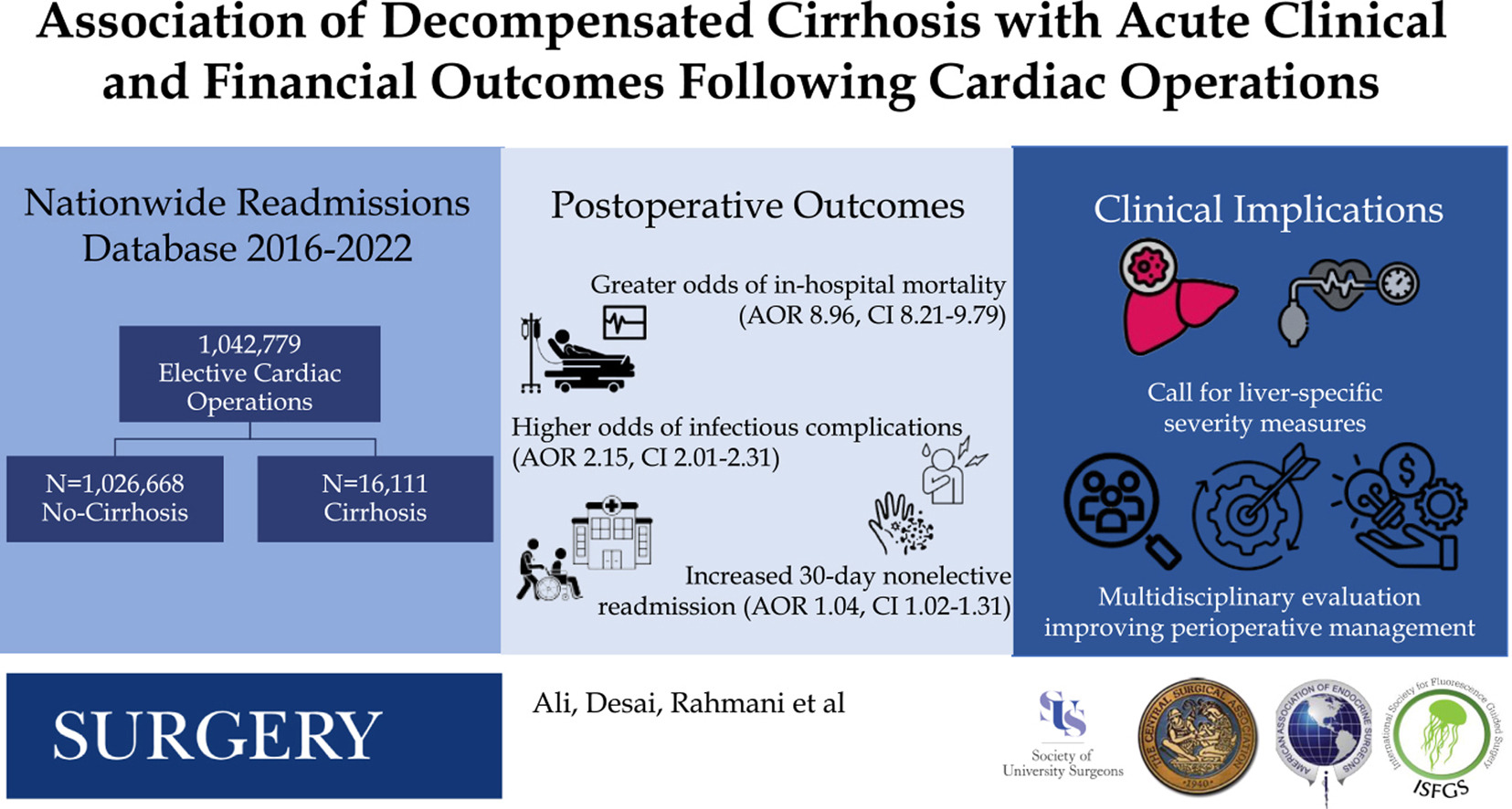
Highlight
This large-scale national study identifies decompensated cirrhosis as a critical independent risk factor for poor outcomes after elective cardiac surgeries, including coronary, valvular, and proximal aortic procedures. Patients with cirrhosis exhibited nearly ninefold increased mortality risk and significantly higher rates of cardiac, infectious, and renal complications. Additionally, these patients incurred substantially greater healthcare resource utilization, evident in prolonged hospital stays and increased costs.
Study Background
Cardiac surgery is often necessary for patients with coronary artery disease, valvular pathologies, or aortic conditions. However, the presence of chronic liver disease, particularly decompensated cirrhosis characterized by complications such as ascites, esophageal varices, or hepatic encephalopathy, complicates perioperative management. Cirrhotic patients are known to have altered hemostasis, immune dysfunction, and multisystem impairments, which may increase surgical risk. Yet, conventional risk models frequently underestimate adverse outcomes in this specific population, leading to challenges in clinical decision-making and patient counseling.
Given the increasing prevalence of cirrhosis globally and improved surgical techniques, understanding the true impact of advanced liver disease on postoperative outcomes remains a vital unmet need.
Study Design
This retrospective cohort study utilized data from the Nationwide Readmissions Database spanning 2016 to 2022, focusing on adult elective hospitalizations for cardiac operations including coronary artery bypass grafting, valve replacement or repair, and proximal aortic surgery. Patients with advanced or decompensated cirrhosis were identified by clinical markers such as ascites, variceal hemorrhage, or encephalopathy to classify them within the cirrhotic group. To ensure patient group homogeneity, cases involving heart transplantation, ventricular assist device implantation, or infective endocarditis were excluded.
Multivariable logistic regression models adjusted for demographic factors, comorbidities using the Elixhauser Comorbidity Index, and socioeconomic status were developed to quantify the association between cirrhosis and key outcomes: in-hospital mortality, postoperative cardiac, infectious, and renal complications, length of stay, and hospitalization costs.
Key Findings
From over one million elective cardiac surgery records, 1.6% (16,111) had decompensated cirrhosis. This group had a higher female proportion (37.0% vs. 28.9%) and greater comorbidity burden (median Elixhauser Index 7 vs. 5). A disproportionate number belonged to the lowest income quartile (26.7% vs. 24.1%), suggesting socioeconomic disparities.
Adjusted analyses revealed that patients with decompensated cirrhosis had dramatically increased odds of in-hospital mortality (adjusted odds ratio [aOR] 8.96, 95% confidence interval [CI] 8.21–9.79), underlining an almost ninefold risk compared to non-cirrhotic patients. They also faced significantly higher adjusted odds for postoperative cardiac complications (aOR 1.99, 95% CI 1.90–2.11), infectious complications including sepsis and wound infections (aOR 2.15, 95% CI 2.01–2.31), and renal complications such as acute kidney injury and need for dialysis (aOR 2.87, 95% CI 2.71–3.04).
Furthermore, cirrhotic patients experienced prolonged hospitalizations and substantially increased financial costs, reflecting the burden on healthcare resources.
Expert Commentary
This study robustly confirms that decompensated cirrhosis is a formidable risk factor for adverse outcomes following cardiac surgery, emphasizing the limitations of current risk calculators that often do not fully account for liver disease severity. The pathophysiological mechanisms include coagulopathy, portal hypertension, altered immune responses, and renal dysfunction, all contributing to perioperative instability.
Clinicians must incorporate liver disease status into preoperative evaluation and risk stratification paradigms to facilitate informed shared decision-making. Alternative therapeutic options and enhanced perioperative optimization, such as correction of coagulopathy, prophylactic antibiotics, and careful fluid and renal function management, may improve outcomes.
Nonetheless, limitations include reliance on administrative coding which might underestimate cirrhosis severity nuances and residual confounding factors. External validation in prospective cohorts and integration of liver-specific scoring systems like MELD or Child-Pugh in cardiac surgery patients should be considered.
Conclusion
Patients with decompensated cirrhosis undergoing elective cardiac surgery represent a high-risk group with significantly increased mortality, complications, hospital stay, and costs. This underscores the need for enhanced preoperative risk assessment tools that incorporate liver disease severity and focused perioperative management strategies tailored to this population. Further research should seek to refine predictive models and explore less invasive alternatives or adjunctive therapies to mitigate risks and improve clinical and economic outcomes.
Reference
Ali K, Desai K, Rahmani J, Ali SS, Lai O, Mehta D, Justo M, Benharash P. Association of decompensated cirrhosis with acute clinical and financial outcomes following cardiac operations. Surgery. 2026 Sep;197:110394. doi: 10.1016/j.surg.2026.110394. Epub 2026 Jun 15. PMID: 42424762.