Highlight
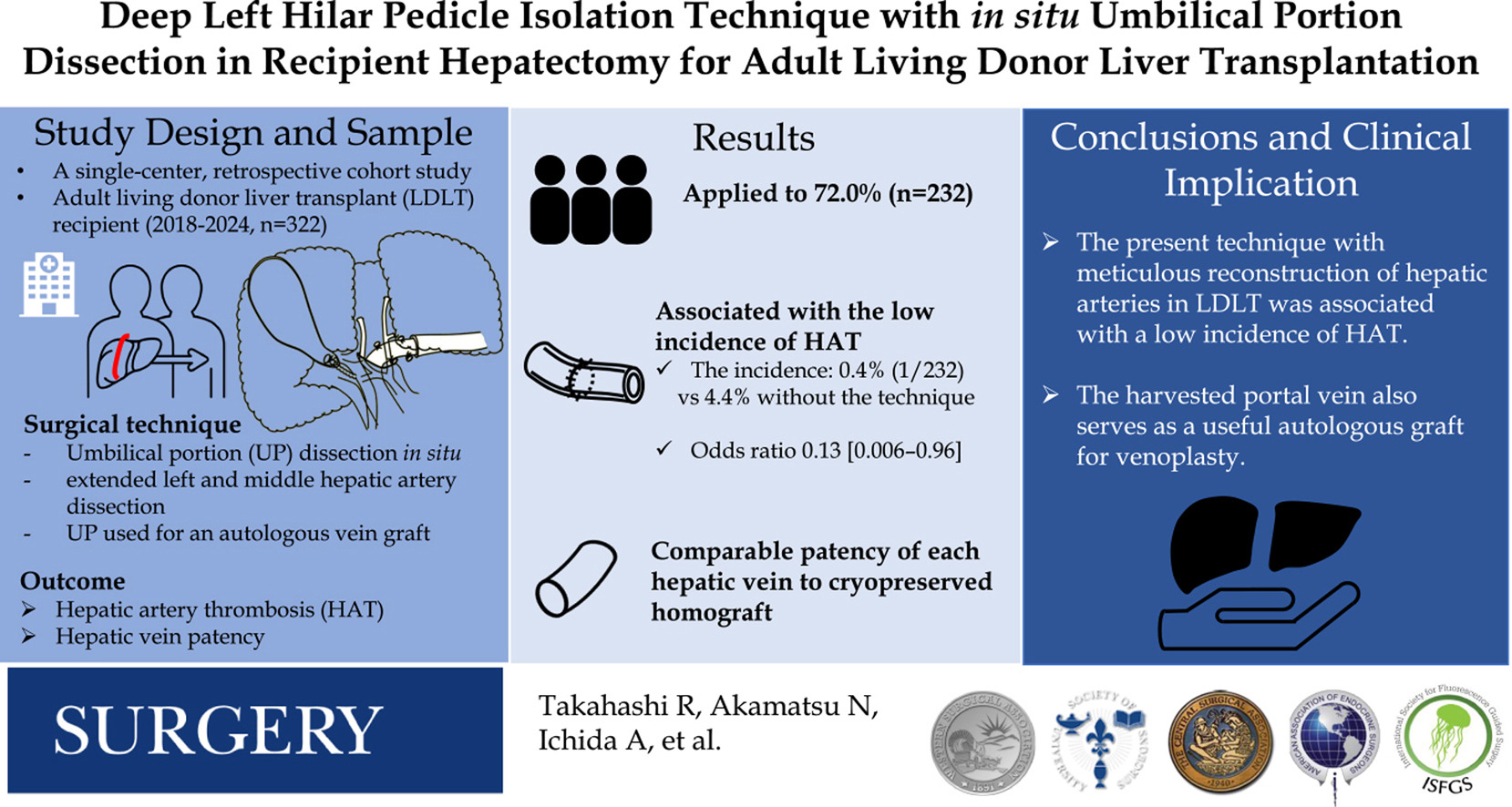
- The deep left hilar pedicle isolation with in situ umbilical portion dissection facilitates meticulous vascular reconstruction in adult living donor liver transplantation (LDLT).
- This surgical approach is associated with a significantly reduced incidence of hepatic arterial thrombosis (HAT), a serious post-transplant complication.
- The umbilical portion of the portal vein, preserved with the round ligament, can serve as a reliable autologous venous graft, with patency comparable to cryopreserved homografts.
- This method offers a practical and reproducible strategy to improve perioperative outcomes in LDLT recipients.
Study Background
Adult living donor liver transplantation is a complex surgical procedure that demands precise vascular reconstruction to ensure graft viability and long-term function. Hepatic arterial thrombosis remains a significant post-transplant complication leading to graft failure and increased morbidity. Technical challenges in dissecting and reconstructing the hepatic artery and portal vein contribute to this risk. The surgical anatomy around the left hilar region is intricate, complicating arterial and venous anastomoses, especially when multiple hepatic arteries are involved. Optimal management strategies for vascular reconstruction are essential to improve graft survival and reduce postoperative complications. This study addresses these challenges by detailing and evaluating a surgical technique that includes deep left hilar pedicle isolation combined with in situ dissection of the umbilical portion of the portal vein to facilitate vascular reconstruction.
Study Design
A retrospective review was conducted on adult recipients of living donor liver transplantation at a single institution from 2018 to 2024. Among 322 recipients, the novel isolation technique involving in situ dissection of the umbilical portion was applied in 232 patients (72%). Key endpoints included the incidence of vascular and biliary complications, particularly hepatic arterial thrombosis; the patency of reconstructed veins using autologous grafts isolated from the umbilical portion; and a comparison of graft patency between autologous vein grafts and cryopreserved homografts. Multivariable analysis was performed to evaluate the association between the surgical technique and the occurrence of HAT controlling for potential confounders.
Key Findings
The application of the deep left hilar pedicle isolation technique with in situ umbilical portion dissection was associated with a notably low incidence of hepatic arterial thrombosis. Overall, 1.9% of transplant recipients developed hepatic arterial thrombosis; however, this rate was significantly reduced to 0.4% in patients who underwent the novel isolation technique. Multivariable logistic regression analysis confirmed that this surgical approach was independently linked to a markedly lower risk of HAT (odds ratio [OR] 0.13, 95% confidence interval [CI] 0.006–0.96; P = 0.045), underscoring its protective effect.
Additionally, the umbilical portion of the portal vein, preserved with the round ligament during in situ dissection, served as an autologous venous graft for venous reconstruction. Patency rates of veins reconstructed with this autologous graft were comparable to those reconstructed with cryopreserved homografts, suggesting that the autologous graft is a viable and effective alternative. The technique also enabled extensive and precise dissection of the left and middle hepatic arteries, facilitating meticulous arterial reconstruction in complex vascular anatomy.
Importantly, the surgical method contributed to reducing the technical complexity of recipient hepatectomy and vascular reconstruction, potentially decreasing operative time and improving outcomes. Safety outcomes were favorable, with no increase in biliary complications or other vascular issues attributable to the technique.
Expert Commentary
Hepatic arterial thrombosis remains a formidable challenge after living donor liver transplantation due to its association with ischemic complications and graft loss. Strategies enhancing arterial reconstruction precision are critical. The described technique offers a significant advancement by combining anatomical dissection and graft resourcefulness. The ability to use the umbilical portion as an autologous venous graft is particularly noteworthy, potentially reducing reliance on cryopreserved homografts, which may carry risks of immunogenicity and availability issues.
While the retrospective nature of the study limits definitive causal inference, the strong association between the technique and reduced HAT incidence is compelling. Future prospective, multicenter studies or randomized controlled trials could further validate these findings and explore long-term graft survival and patient outcomes.
This approach aligns with principles outlined in contemporary transplant surgical guidelines advocating for meticulous vascular reconstructions to minimize thrombotic complications. Integration of this technique into surgical practice may set a new standard for LDLT recipient hepatectomy.
Conclusion
The deep left hilar pedicle isolation technique combined with in situ umbilical portion dissection represents an effective surgical innovation in adult living donor liver transplantation. It facilitates the challenging dissection and reconstruction of multiple hepatic arteries, significantly lowers the incidence of hepatic arterial thrombosis, and provides a convenient source of autologous venous graft material for venoplasty. This practical, reproducible strategy holds promise to improve perioperative vascular outcomes and graft survival. Further research is warranted to confirm its utility in broader patient populations and to optimize long-term benefits.
Funding and Registration
The study did not specify external funding sources, and no clinical trial registration was reported.
References
- Takahashi R, Akamatsu N, Ichida A, et al. Deep left hilar pedicle isolation technique with in situ umbilical portion dissection for recipient hepatectomy in adult living donor liver transplantation. Surgery. 2026 Jun 15;197:110396. PMID: 42442166.
- Silva MA, Plevris JN. Vascular complications in liver transplantation. Curr Opin Organ Transplant. 2012 Apr;17(2):121-7.
- Jarnagin WR, Geller DA. Living donor liver transplantation: technical issues and recipient outcomes. Hepatology. 2007 Sep;46(3): 644-52.