Highlight
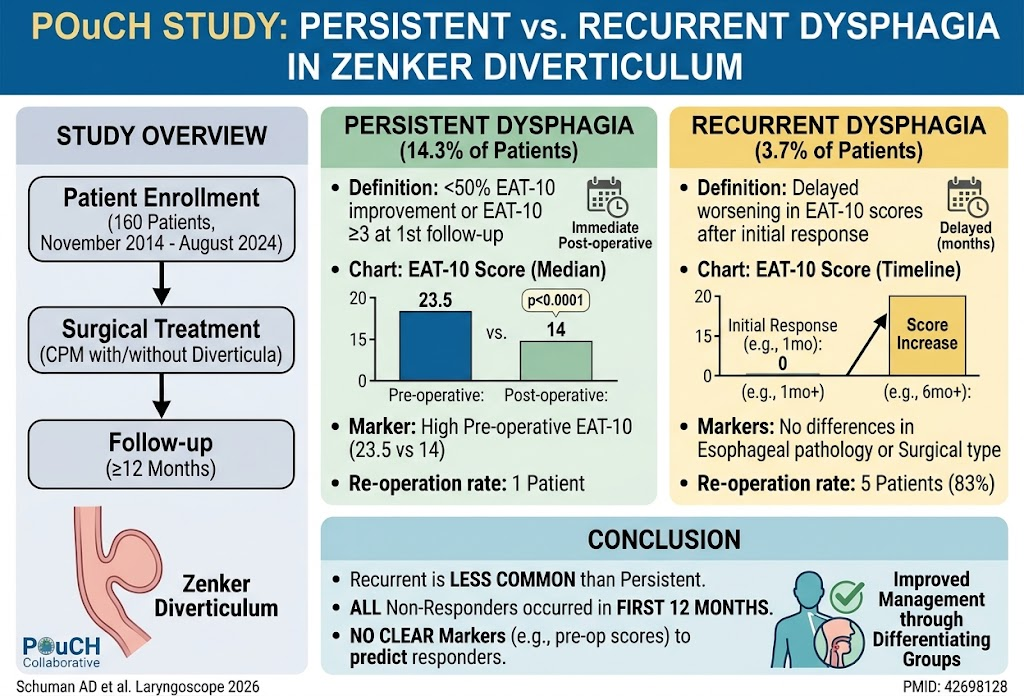
- Persistent dysphagia immediately after surgery for CPMD with or without Zenker diverticulum is more common than recurrent dysphagia during follow-up.
- Preoperative dysphagia severity, as measured by EAT-10, is higher in patients with persistent dysphagia compared to responders.
- Recurrent dysphagia occurs later, is rare (3.7%), and often requires re-operation.
- No significant difference in surgical outcomes between endoscopic and open procedures was observed.
Study Background
Zenker diverticulum (ZD) is a pulsion diverticulum arising from the posterior hypopharyngeal wall due to dysfunction of the cricopharyngeus muscle, a key component of the upper esophageal sphincter. This condition often causes dysphagia and other symptoms such as regurgitation and aspiration. Surgical intervention targeting cricopharyngeal muscle dysfunction (CPMD) and diverticular resection or suspension is the primary treatment. However, postoperative outcomes vary, with some patients experiencing persistent (unchanged or insufficient improvement immediately after surgery) or recurrent (return or worsening after initial improvement) dysphagia. Differentiating these clinical entities is crucial as they bear different implications for patient management, prognosis, and potential need for re-intervention.
Despite the known burden of persistent and recurrent swallowing problems post-surgery, there remains inadequate characterization of epidemiology, predictive factors, and response patterns, especially in prospectively followed cohorts. The POuCH (Prospective Outcomes of Cricopharyngeus Hypertonicity) multicenter study was designed to address these knowledge gaps over a decade-long enrollment and follow-up period.
Study Design
The POuCH study is a prospective, multicenter cohort investigation including patients diagnosed with CPMD with and without coexisting Zenker diverticulum who underwent surgical treatment between November 2014 and August 2024. The study mandated a minimum of 12 months postoperative follow-up, allowing differentiation between early persistent symptoms and later recurrent dysphagia.
Surgical interventions comprised endoscopic and open approaches addressing the dysfunctional cricopharyngeus muscle, with or without diverticulectomy depending on anatomical considerations.
Outcomes were primarily assessed using the Eating Assessment Tool-10 (EAT-10), a validated patient-reported outcome instrument quantifying dysphagia severity. An EAT-10 score below 3 was considered normal. Persistent dysphagia was operationally defined as patients exhibiting less than 50% improvement in EAT-10 compared to preoperative baseline or having an EAT-10 score of 3 or greater at the initial postoperative follow-up. Recurrent dysphagia was defined in patients initially responding to surgery (improved EAT-10 scores) but subsequently experiencing a delayed deterioration during the course of follow-up.
Key Findings
Among 160 included patients, 23 (14.3%) manifested persistent dysphagia immediately after surgery, a markedly higher incidence than recurrent dysphagia, seen in 6 patients (3.7%). Most patients with recurrent dysphagia (five of six) required re-operation, signifying the clinical relevance of this subgroup.
Baseline EAT-10 scores differed significantly between groups: patients with persistent dysphagia had a median score of 23.5 (IQR 12.0-28.5), whereas responders had a median score of 14.0 (IQR 8-24), p=0.05. This suggests preoperative severity may help anticipate poor immediate postoperative response.
At first postoperative evaluation, persistent dysphagia patients had a median EAT-10 of 14 (IQR 8-21), while responder patients had near-normal scores (median 0, IQR 0-2), p<0.0001. Notably, esophageal pathology did not differ between groups, indicating comorbid esophageal diseases were unlikely to explain symptom persistence.
No significant difference was found in response rates between endoscopic and open surgical approaches, supporting that both methods can be effective when appropriately selected.
The temporal pattern showed that all persistent dysphagia cases were evident within the first 12 months post-surgery, while recurrent dysphagia appeared later in the follow-up interval.
Expert Commentary
This comprehensive prospective study provides clarity to a traditionally challenging aspect of managing Zenker diverticulum and CPMD surgery outcomes. Persistent dysphagia immediately post-surgery likely reflects incomplete resolution of cricopharyngeal dysfunction or surgical failure, emphasizing the need for close early postoperative monitoring and perhaps adjunctive therapies or re-intervention.
Conversely, recurrent dysphagia, though less frequent, represents a distinct clinical problem, often necessitating further surgery. The absence of clear predictive markers for surgical non-response highlights the need for personalized assessment and perhaps novel diagnostic tools such as high-resolution manometry or imaging to better stratify risk.
The equivalence of endoscopic and open surgery in outcomes align with previous literature suggesting that endoscopic approaches, being less invasive, can be first-line where feasible. Limitations of the study include potential selection bias inherent in multicenter cohorts and the reliance solely on patient-reported outcomes without correlating instrumental assessments.
Future research should explore predictive biomarkers and mechanistic insights into muscle dysfunction and healing post-surgery. Integration of objective functional testing may enhance postoperative management strategies.
Conclusion
The POuCH study elucidates the clinical differentiation between persistent and recurrent dysphagia following surgery for CPMD with or without Zenker diverticulum. Persistent dysphagia is more common and occurs early, associated with higher baseline symptom burden. Recurrent dysphagia is rarer, delayed, and often requires reoperation.
These findings highlight the importance of vigilant postoperative surveillance and tailored therapeutic approaches. Although neither patient baseline characteristics nor surgical approach reliably predicted persistent dysphagia, all persistent cases manifested by 12 months, providing a clinical window for intervention decisions.
Enhanced understanding of these patterns facilitates improved patient counseling, follow-up protocols, and informs surgical decision-making in this complex patient population.
Funding and Clinical Trials Registration
Information on funding sources and clinical trials registration was not specified in the original report.
References
1. Schuman AD, Allen J, Altaye M, et al. Differentiating Persistent and Recurrent Dysphagia in Zenker Diverticulum: A POuCH Study. The Laryngoscope. 2026; DOI: 10.1002/lary.42698128. PMID: 42698128.
2. Blumin JH, Koufman JA. Zenker’s Diverticulum: Diagnosis and Treatment. Otolaryngol Clin North Am. 2008;41(2): 279-288.
3. O’Riordan DP, Romano A, Vaezi MF. Dysphagia Assessment and Management: Current Concepts and Future Directions. Curr Gastroenterol Rep. 2017;19(4):19.
4. Belafsky PC, Mouadeb DA, Rees CJ, et al. Validity and Reliability of the Eating Assessment Tool (EAT-10). Ann Otol Rhinol Laryngol. 2008;117(12):919-924.