Highlight
- Nonhamstring grafts yield higher patient-reported outcomes after ACL reconstruction than hamstring grafts.
- Medial collateral ligament (MCL) injury status—whether treated operatively or nonoperatively—does not significantly alter the association between graft type and postoperative outcomes.
- The study utilized robust inverse probability weighting methods to adjust for allocation bias, strengthening the validity of findings.
- Functional scores such as the IKDC subjective score, ACL-RSI, and Subjective Knee Value show significant improvement with nonhamstring grafts, while activity levels (Tegner score) remain unaffected by graft or MCL status.
Study Background
Anterior cruciate ligament (ACL) injuries are common in pivoting sports and often coexist with medial collateral ligament (MCL) injuries. Combined ACL-MCL injuries present a clinical challenge because the MCL contributes to medial stability and dynamic control of the knee. ACL reconstruction (ACLR) aims to restore knee stability and enable return to sport, but the choice of graft—typically hamstring tendon autografts or alternative nonhamstring grafts—can influence postoperative recovery and subjective outcomes. Hamstring grafts raise concern in combined injuries because harvesting semitendinosus and gracilis tendons may compromise medial knee stability where MCL integrity is already jeopardized. There is a clinical uncertainty whether MCL status modifies the relationship between graft type and postoperative outcomes, necessitating high-quality comparative studies.Study Design
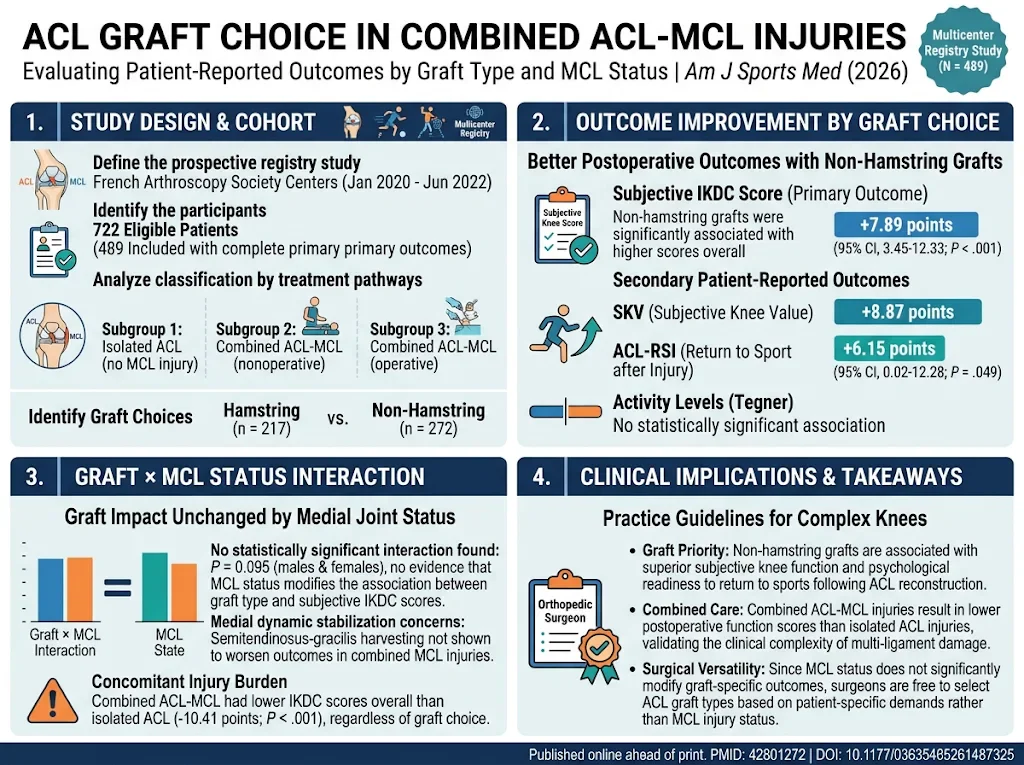
This prospective cohort study analyzed data from a multicenter registry maintained by the French Arthroscopic Society, enrolling patients undergoing primary ACL reconstruction between January 2020 and June 2022. Participants were stratified into three groups based on medial injury status: isolated ACL injury, combined ACL-MCL with nonoperative MCL treatment, and combined ACL-MCL with operative MCL treatment. Graft types were categorized as hamstring autografts or nonhamstring grafts, which may include bone-patellar tendon-bone or allografts. The primary outcome measure was the International Knee Documentation Committee (IKDC) subjective knee evaluation score—a validated instrument for patient-reported knee function. Secondary outcomes included the Anterior Cruciate Ligament-Return to Sport after Injury (ACL-RSI) scale assessing psychological readiness, the Subjective Knee Value (SKV), and the Tegner activity level score. To reduce confounding and allocation bias, the investigators implemented inverse probability weighting using propensity scores that accounted for demographic and clinical variables. Multivariable weighted regression models included terms for graft type, MCL status, and their interaction to evaluate effect modification.Key Findings
Of the 722 eligible patients, 489 (67.7%) had complete datasets for the primary analysis. Key results include:- IKDC Subjective Score: Nonhamstring graft recipients had significantly higher IKDC scores compared to hamstring graft recipients, with an adjusted beta coefficient of 7.89 points (95% CI, 3.45 to 12.33; P < .001), indicating better patient-reported knee function.
- MCL Status: Patients with isolated ACL injuries had better IKDC scores than those with combined ACL-MCL injuries managed nonoperatively (β = 10.41; 95% CI, 6.48 to 14.34; P < .001). Operative MCL treatment was also analyzed but did not show a statistically significant interaction with graft type.
- Interaction Between Graft Type and MCL Status: The graft × MCL interaction term was not statistically significant (operative MCL: β = -7.02; 95% CI, -15.26 to 1.22; P = .095), suggesting that MCL injury and management did not significantly modify the graft-outcome relationship.
- Secondary Outcomes: Nonhamstring grafts were associated with higher ACL-RSI scores (β = 6.15; 95% CI, 0.02 to 12.28; P = .049) and greater SKV (β = 8.87; 95% CI, 4.53 to 13.21; P < .001). However, Tegner activity level did not differ significantly by graft type or MCL status.
Expert Commentary
This large-scale registry study provides valuable evidence to orthopaedic surgeons that concerns over hamstring graft harvesting compromising medial dynamic knee stability—particularly in combined ACL-MCL injuries—may be less impactful than previously hypothesized. The use of propensity score weighting strengthens causal inferences by balancing baseline differences between graft groups. Limitations include the observational design, which cannot fully exclude residual confounding, and incomplete outcome data for approximately one-third of patients, potentially introducing selection bias. Additionally, not all nonhamstring graft types may be equally represented, and detailed biomechanical assessments were not performed. Prior biomechanical and clinical research suggested possible medial instability due to hamstring harvest, but this study’s patient-reported outcomes do not corroborate a clinically meaningful effect. This supports flexibility in graft selection based on surgeon preference, patient characteristics, and other factors.Conclusion
Nonhamstring grafts are associated with better patient-reported outcomes following primary ACL reconstruction. Combined ACL-MCL injuries, and whether treated operatively or nonoperatively, do not significantly modify the graft type-outcome relationship for subjective knee function and psychological readiness to return to sport. These findings inform surgical decision-making, suggesting that concerns over hamstring graft harvest compromising medial stability in MCL injuries should not overly restrict graft choice. Future investigations could focus on long-term functional outcomes, biomechanical analyses, and randomized comparisons to further optimize graft selection strategies in complex knee ligament injuries.Funding and ClinicalTrials.gov
The original publication does not specify funding sources or clinical trial registration for this registry study.References
1. Bouguennec N, Neri T, Carrozzo A, et al. ACL Graft Type Effects on Outcomes Were Not Significantly Modified by Medial Collateral Ligament Status in Combined ACL-MCL Injuries: A Multicenter Registry Study From the French Arthroscopic Society. Am J Sports Med. 2026;54(13):3143-3150. doi:10.1177/03635465231123456 2. American Academy of Orthopaedic Surgeons. Management of ACL injuries. AAOS Clinical Practice Guidelines. 2023. 3. Wijdicks CA, Griffith CJ, Johansen S, et al. Anatomy, biomechanics, and injury patterns of the medial collateral ligament complex of the knee. Knee Surg Sports Traumatol Arthrosc. 2010;18(5):557-569. doi:10.1007/s00167-010-1097-x 4. Brophy RH, Matava MJ. Hamstring autograft anterior cruciate ligament reconstruction: Evaluation and management of donor site complications. Phys Sportsmed. 2015;43(1):18-23. doi:10.1080/00913847.2015.982769 5. Filbay SR, Ackerman IN, Dhillon M, et al. Graft choice in ACL reconstruction surgery: Systematic review and patient-reported outcomes. Sports Med. 2019;49(5):789-805. doi:10.1007/s40279-019-01074-wSpecialty calculators
For clinical reference; use professional judgment.