Highlights
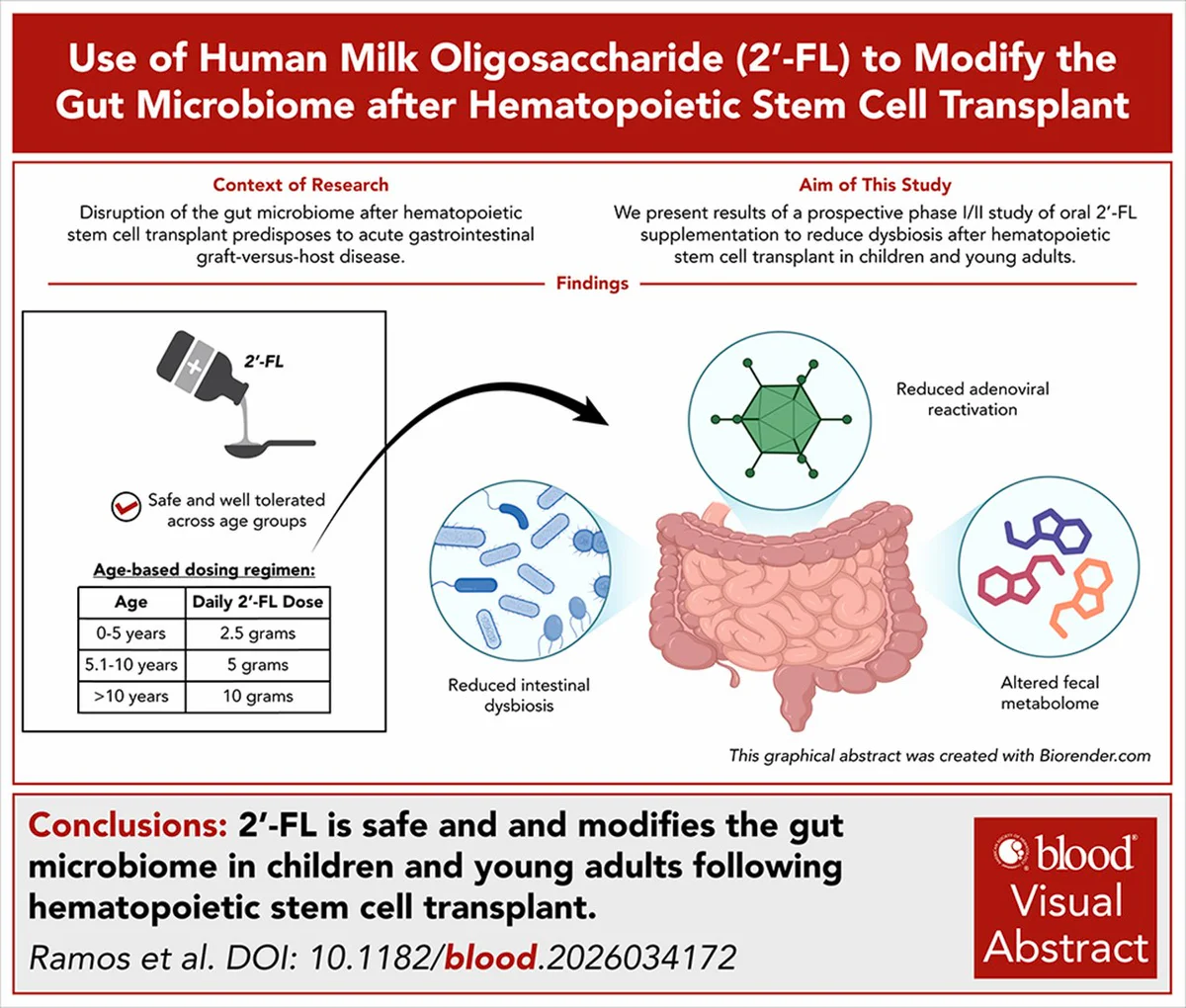
- Oral administration of 2′-FL in children undergoing allo-HSCT is safe and well tolerated.
- 2′-FL preserves gut microbiome diversity during the critical peritransplant period, countering dysbiosis.
- It enriches key beneficial bacteria, particularly Bifidobacteria and Blautia, associated with gut homeostasis.
- 2′-FL reduces incidence of grade II-IV acute gastrointestinal GVHD and adenovirus reactivation, indicating improved immune outcomes.
Background
Allogeneic hematopoietic stem cell transplantation (allo-HSCT) is a curative therapy for various malignant and nonmalignant hematologic diseases in children. However, posttransplant complications, especially acute gastrointestinal graft-versus-host disease (GI GVHD), remain a major cause of morbidity and mortality. Intestinal dysbiosis characterized by loss of microbial diversity and depletion of beneficial commensals has been implicated as a critical risk factor for the development of GI GVHD and infectious complications such as viral reactivations. Given the pivotal role of the gut microbiome in mucosal immune homeostasis and epithelial integrity, strategies targeting microbiome restoration hold promise. Human milk oligosaccharides (HMOs), such as 2′-fucosyllactose (2′-FL), are complex glycans naturally abundant in human breast milk, acting as prebiotics favoring the growth of beneficial taxa like Bifidobacteria. Preclinical and clinical evidence supports HMOs’ capacity to promote intestinal epithelial protection, regulate inflammation, and influence systemic immunity. However, their role in the allogeneic transplant setting, particularly pediatric populations, had not been fully elucidated until recently.Key Content
Chronological Development of Evidence
While early microbiome-targeted interventions in allo-HSCT mainly focused on antibiotics stewardship and fecal microbiota transplantation, the introduction of specific prebiotics like HMOs represents a novel therapeutic avenue. The referenced phase 1/2 prospective study by Ramos et al. (2026) is one of the first to systematically evaluate safety, tolerability, microbiome modulation, and clinical outcomes of 2′-FL in pediatric allo-HSCT recipients.Study Design and Patient Population
This single-institution trial enrolled 70 pediatric patients who received daily oral 2′-FL starting from the beginning of conditioning therapy until day +30 post-transplant. Patients adhered to ≥60% dosing were analyzed with appropriate contemporary age-matched controls (n=29) from institutional biorepository samples. The primary endpoints were safety in phase 1 and preservation of microbiome diversity in phase 2.Microbiome Diversity and Composition
Using Shannon diversity indices from fecal samples, the study demonstrated that 2′-FL recipients maintained microbiome diversity from baseline to day +30, whereas controls experienced significant diversity declines (P=0.04). Generalized linear mixed model analyses after adjustment identified enrichment of Bifidobacteria and Blautia species in the 2′-FL cohort, taxa previously associated with gut homeostasis and anti-inflammatory properties.Metabolomic and Immune Biomarker Correlations
Metabolomic profiling revealed higher fecal levels of isoleucine (P=0.005), tyrosine (P=0.05), and taurine (P=0.04) in those receiving 2′-FL. These metabolites are recognized for their roles in epithelial regeneration and protection. Furthermore, plasma levels of regulatory islet-derived 3α (Reg3α), a damage-associated marker in gut epithelium, showed a trend towards reduction (P=0.053), and suppressor of tumorigenicity 2 (ST2), an established inflammatory biomarker and predictor for GVHD, was significantly lower (P=0.038) in the 2′-FL group.Clinical Outcomes: GVHD and Infectious Complications
The incidence of grade II-IV acute GI GVHD was 0% among 2′-FL recipients compared to 17% in controls (P=0.009), indicating a pronounced protective effect. Notably, adenovirus reactivation—a significant posttransplant infectious complication—was absent in the 2′-FL group but occurred in 17% of controls (P=0.009).Expert Commentary
This study provides compelling early clinical evidence that 2′-FL supplementation during allo-HSCT in children can modulate the gut microbiome favorably and translate into clinically meaningful reductions in GI GVHD and viral reactivation. The preservation of microbial diversity is critical post-HSCT, given its association with improved transplant outcomes. Enrichment of Bifidobacteria and Blautia aligns with preclinical data implicating these taxa in mucosal barrier maintenance and immune regulation. Mechanistically, 2′-FL serves as a selective prebiotic substrate promoting beneficial bacteria that produce metabolites supporting epithelial health and modulate immune responses. Reduction of Reg3α and ST2 levels suggests mitigated epithelial damage and systemic inflammation, key factors in GVHD pathogenesis. The absence of adenovirus reactivation further implies improved immune surveillance. While the study is limited by its single-center design and lack of randomized controls, its phase 1/2 framework and correlative multiomics strengthen the translational relevance. Future larger, multi-institutional randomized trials are warranted to confirm efficacy, optimize dosing, and evaluate long-term outcomes including overall survival and chronic GVHD. Integration of HMO supplementation into standard supportive care post-allo-HSCT holds promise as a non-invasive, well-tolerated approach to enhance microbiome resilience and reduce complications. This strategy complements existing microbiome interventions and aligns with precision medicine paradigms targeting host-microbe interactions.Conclusion
Peritransplant oral 2′-FL supplementation in pediatric allo-HSCT recipients is safe and preserves gut microbial diversity, enriching beneficial taxa linked to mucosal health. Corresponding metabolomic and biomarker alterations support protective effects on intestinal epithelium and immune regulation. Clinically, 2′-FL reduces acute GI GVHD incidence and viral reactivations, underscoring its translational potential for improving transplant outcomes. These findings represent a pioneering advance in microbiome-targeted supportive care after pediatric bone marrow transplantation, encouraging further confirmatory trials and exploration of HMOs in diverse immunocompromised populations.References
- Ramos KN, Langenberg L, Lake KE, et al. Human milk oligosaccharide (2′-FL) modifies the gut microbiome in children after bone marrow transplant. Blood. 2026 Oct 29;148(18):2294-2305. doi: 10.1182/blood.2026003457. PMID: 42622257.
- Stein-Thoeringer CK, et al. Nature Medicine. 2019;25(8):1258-1261. doi:10.1038/s41591-019-0492-z. Role of gut microbiome in GVHD.
- Elmadfa I, et al. Nutrients. 2020;12(11):3457. doi:10.3390/nu12113457. Nutritional modulation of human milk oligosaccharides and immune function.
- Simpson P, et al. Front Immunol. 2022;13:841078. doi:10.3389/fimmu.2022.841078. Gut microbiota-targeted therapies in HSCT.
Specialty calculators
For clinical reference; use professional judgment.