Background
Effective communication during hospital discharge is a critical factor in ensuring positive health outcomes and reducing hospital readmissions. This is especially true for patients whose preferred language is not English, often referred to as patients with non-English language preference (NELP). Miscommunication at discharge can lead to misunderstandings regarding medication regimens, follow-up care, and warning signs, particularly among populations with limited English proficiency.
Despite acknowledgment of these challenges, there is limited research that precisely identifies which components of discharge communication are most important to patients with NELP. Understanding these priorities can help tailor discharge processes to better meet patient needs and support successful transitions from hospital to home.
Objective
This study aimed to quantify the preferences of hospitalized patients with NELP regarding different aspects of hospital discharge communication. In addition, it investigated how demographic variables such as age and acculturation, as well as language-related factors, influence patient preferences.
Study Design and Methods
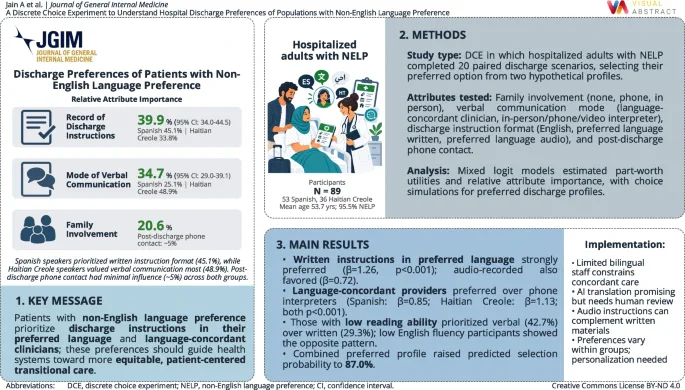
A discrete choice experiment (DCE) methodology was employed. Participants were presented with 20 sets of paired hypothetical discharge scenarios. Each scenario was characterized by one attribute level among four main discharge communication components:
- Family involvement during teaching: none, phone-based, or in-person presence of family members during discharge teaching sessions;
- Mode of verbal communication: use of a language-concordant clinician, in-person interpreter, phone interpreter, or video interpreter;
- Record of discharge instructions: written instructions in English, written in the patient’s preferred language, or audio-recorded instructions in the preferred language;
- Type of post-discharge phone contact: proactive call from primary care nurse, call from hospital nurse, or a dedicated phone number patients could use to call for questions.
Participants selected their preferred scenario from each pair, allowing researchers to infer the relative importance of each attribute and preferred levels within those attributes.
Participants
The study recruited 89 adult participants hospitalized at a large urban safety-net hospital. All participants identified Spanish or Haitian Creole as their preferred language, reflecting populations commonly affected by language barriers in healthcare settings.
Key Findings
The analysis revealed that among discharge communication components, the record of discharge instructions had the greatest relative importance, accounting for approximately 40% of participants’ decision-making weight. Patients most preferred instructions that were provided either written or audio-recorded in their preferred language, emphasizing the need for accessible and understandable information.
The mode of verbal communication was also highly valued, with a 34.7% decision weight. Participants showed a clear preference for healthcare providers who spoke the same language, followed by the use of professional interpreters, especially in-person or video interpreters rather than phone-based ones.
Family involvement in discharge teaching was generally favored, supporting the role of trusted family members in reinforcing understanding and assisting with post-discharge care.
Preferences for types of post-discharge contact had relatively less influence compared to instruction format and communication mode, but patients appreciated proactive outreach from primary care nurses versus reactive contact methods.
Subgroup analyses indicated variability in preferences based on language and acculturation factors, suggesting tailored strategies might be necessary to address diverse patient needs effectively.
Discussion
These findings underscore the critical role of language-concordant, multimodal communication in hospital discharge for NELP patients. Written and audio-recorded materials in the patient’s preferred language enable better comprehension and retention. Similarly, verbal communication delivered directly by language-concordant clinicians or reliable interpreters strengthens trust and clarity.
Family involvement enhances the support system for the patient, contributing to improved management of care after discharge. While follow-up phone contact is valuable, the mode and initiation of contact should align with patient preferences to maximize engagement.
Implications for Healthcare Systems
Healthcare organizations seeking to reduce health disparities and improve outcomes for NELP populations should prioritize implementing discharge protocols that:
- Provide discharge instructions in the patient’s preferred language, using both written and audio formats where feasible;
- Ensure verbal communication is handled by language-concordant clinicians or qualified interpreters, preferably in-person or via reliable video technology;
- Encourage the involvement of family members during discharge education to reinforce instructions and address questions;
- Develop patient-centered post-discharge follow-up strategies that proactively reach out to patients but also offer accessible communication channels.
Integrating these features into transitional care programs can improve patient understanding, adherence to treatment plans, and ultimately reduce readmission rates, thereby promoting health equity.
Conclusion
Hospitalized patients who prefer languages other than English prioritize clear, accessible, and culturally sensitive communication at the time of discharge. Efforts to enhance discharge communication should focus on multimodal approaches tailored to language preferences, including comprehensive records of instructions in the preferred language and family involvement during education. Health systems are encouraged to adopt these evidence-based strategies to improve care transitions and reduce disparities among diverse patient populations.
Specialty calculators
For clinical reference; use professional judgment.