Highlight
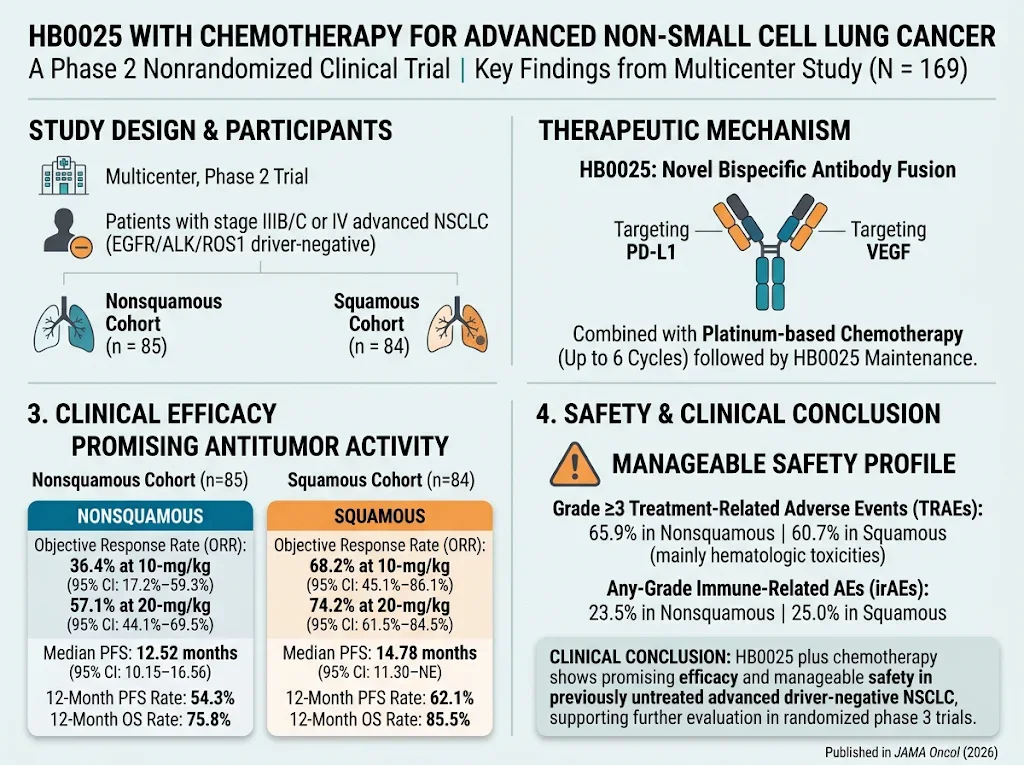
This phase 2 nonrandomized trial investigated HB0025, a novel bispecific antibody targeting both PD-L1 and VEGF, combined with chemotherapy in advanced NSCLC patients without driver mutations. The treatment showed promising objective response rates—up to 74.2% in squamous and 57.1% in nonsquamous histologies—with median progression-free survival exceeding 12 months. Safety was manageable with hematologic toxicity as the most common severe adverse event.
Study Background
Non-small cell lung cancer (NSCLC) accounts for approximately 85% of lung cancer diagnoses globally and remains a leading cause of cancer mortality. Advanced stages (IIIB/C and IV) present significant treatment challenges, particularly in patients who lack sensitizing driver mutations such as EGFR, ALK, or ROS1, limiting targeted therapy options. Immune checkpoint inhibitors targeting the PD-1/PD-L1 axis have improved outcomes, but clinical benefit remains incomplete. Additionally, vascular endothelial growth factor (VEGF) promotes tumor angiogenesis contributing to disease progression. Dual inhibition of PD-L1 and VEGF pathways by bispecific antibodies represents a novel therapeutic avenue to potentially enhance antitumor efficacy by combining immune activation and angiogenesis blockade.
Study Design
This was a multicenter, open-label, phase 2 nonrandomized clinical trial conducted at 13 hospitals across China. Eligible patients had advanced (stage IIIB/C or IV) NSCLC without sensitizing driver mutations (EGFR, ALK, ROS1), including both nonsquamous and squamous histologic subtypes. Patients were enrolled from January 2024 to May 2025. The intervention comprised two dose levels of HB0025 administered intravenously every 3 weeks (10 mg/kg or 20 mg/kg) combined with chemotherapy tailored by histology: pemetrexed/carboplatin for nonsquamous NSCLC and paclitaxel/carboplatin for squamous NSCLC. Up to six cycles of combination therapy were administered, followed by HB0025 maintenance (with or without pemetrexed based on histology) until disease progression or unacceptable toxicity. Primary endpoints were safety and objective response rate (ORR) per RECIST v1.1 assessed by investigators. Secondary endpoints included disease control rate (DCR), duration of response, progression-free survival (PFS), and overall survival (OS).
Key Findings
A total of 169 patients were evaluable for efficacy: 85 with nonsquamous and 84 with squamous NSCLC. The median ages were 63 and 65 years, respectively. In the nonsquamous cohort, the confirmed ORR was 36.4% (95% CI, 17.2%-59.3%) for the 10 mg/kg HB0025 dose and 57.1% (95% CI, 44.1%-69.5%) for the 20 mg/kg dose. In the squamous cohort, ORR was 68.2% (95% CI, 45.1%-86.1%) at 10 mg/kg and 74.2% (95% CI, 61.5%-84.5%) at 20 mg/kg, indicating generally higher responsiveness among squamous cell carcinoma patients.
Median progression-free survival was 12.52 months (95% CI, 10.15-16.56) for nonsquamous and 14.78 months (95% CI, 11.30 to not estimable) for squamous patients. The 12-month PFS rates were 54.3% and 62.1% for nonsquamous and squamous groups, respectively. Overall survival at 12 months was 75.8% (95% CI, 65.0%-83.7%) for nonsquamous and 85.5% (95% CI, 75.8%-91.5%) for squamous patients.
Regarding safety, grade 3 or higher treatment-related adverse events (TRAEs) occurred in 65.9% of nonsquamous and 60.7% of squamous patients, predominantly hematologic toxicities such as neutropenia and anemia. Immune-related adverse events attributable to HB0025 were reported in about 23.5% of nonsquamous and 25% of squamous cohorts, mostly of low to moderate severity and manageable with established protocols.
Expert Commentary
The dual targeting mechanism of HB0025 integrates PD-L1 immune checkpoint inhibition with VEGF-driven angiogenesis blockade, theoretically synergizing to enhance antitumor immune responses while normalizing tumor vasculature. The ORRs and median PFS reported here exceed many historical outcomes of chemotherapy combined with single-agent immune checkpoint inhibitors in driver mutation-negative NSCLC. The higher response rates in squamous NSCLC are particularly encouraging, given the historically limited therapeutic options in this subgroup.
Limitations include the nonrandomized design and relatively small sample size, which necessitate cautious interpretation. The absence of a control arm limits direct comparison to standard therapies, and long-term overall survival data remain immature. Nonetheless, safety results suggest a tolerable profile consistent with similar immunotherapy-antiangiogenic combinations. Further phase 3 randomized studies are essential to validate these findings and establish the clinical benefit definitively.
Conclusion
HB0025 combined with chemotherapy demonstrated promising efficacy and manageable safety in patients with advanced, driver variant-negative NSCLC across histologic subtypes. These data support the rationale for advancing HB0025 into randomized phase 3 trials to potentially expand treatment options for this difficult-to-treat population. This study adds to growing evidence favoring bispecific antibody approaches in lung cancer immunotherapy.
Funding and Registration
The trial was funded by the study sponsors as detailed in the original publication. Clinical trial registration: ClinicalTrials.gov Identifier: NCT06758557.
References
1. Zhou F, Wang L, Bai J, et al. HB0025 With Chemotherapy for Advanced Non-Small Cell Lung Cancer: A Phase 2 Nonrandomized Clinical Trial. JAMA Oncol. 2026 Nov 5. PMID: 42986615.
2. Reck M, Rodríguez-Abreu D, Robinson AG, et al. Pembrolizumab versus chemotherapy for PD-L1–positive non–small-cell lung cancer. N Engl J Med. 2016;375(19):1823-1833.
3. Herbst RS, Baas P, Kim DW, et al. Pembrolizumab versus docetaxel for previously treated, PD-L1-positive, advanced non-small-cell lung cancer (KEYNOTE-010): a randomised controlled trial. Lancet. 2016;387(10027):1540-1550.
4. Socinski MA, Jotte RM, Cappuzzo F, et al. Atezolizumab for first-line treatment of metastatic nonsquamous NSCLC. N Engl J Med. 2018;378(24):2288-2301.
5. Ferrara N, Hillan KJ, Novotny W. Bevacizumab (Avastin), a humanized anti-VEGF monoclonal antibody for cancer therapy. Biochem Biophys Res Commun. 2005;333(2):328-335.
Specialty calculators
For clinical reference; use professional judgment.