Highlight
1. GLP-1 receptor agonists (GLP-1RAs) show significant reduction in all-cause mortality in bronchiectasis patients with type 2 diabetes (T2D) compared to DPP-4 and SGLT2 inhibitors. 2. GLP-1RAs are associated with lowered risks of acute respiratory failure and lower respiratory tract infections relative to other commonly used antidiabetic agents. 3. Despite these benefits, GLP-1RA use did not significantly reduce bronchiectasis exacerbations compared with DPP-4i and SGLT2i. 4. The mortality benefits were pronounced across demographic groups, especially in obese patients, hinting at potential disease-modifying effects beyond glycemic control.Study Background
Bronchiectasis is a chronic pulmonary disorder characterized by abnormal bronchial dilation, chronic inflammation, and recurrent respiratory infections leading to progressive lung damage. Currently, no therapies have conclusively demonstrated disease-modifying effects. Concurrently, type 2 diabetes is a frequent comorbidity that may exacerbate bronchiectasis progression and complications through immune dysregulation and inflammation. Glucagon-like peptide-1 receptor agonists (GLP-1RAs), primarily developed for T2D management, exhibit anti-inflammatory and immunomodulatory properties that suggest a potential benefit beyond glucose lowering. However, their impact on bronchiectasis clinical outcomes remained unexplored until recently. This research directly addresses this critical gap by comparing clinical outcomes in bronchiectasis patients with T2D treated with GLP-1RAs versus other antidiabetic agents with less overt anti-inflammatory effects, namely dipeptidyl peptidase-4 inhibitors (DPP-4i) and sodium-glucose cotransporter-2 inhibitors (SGLT2i).Study Design and Methods
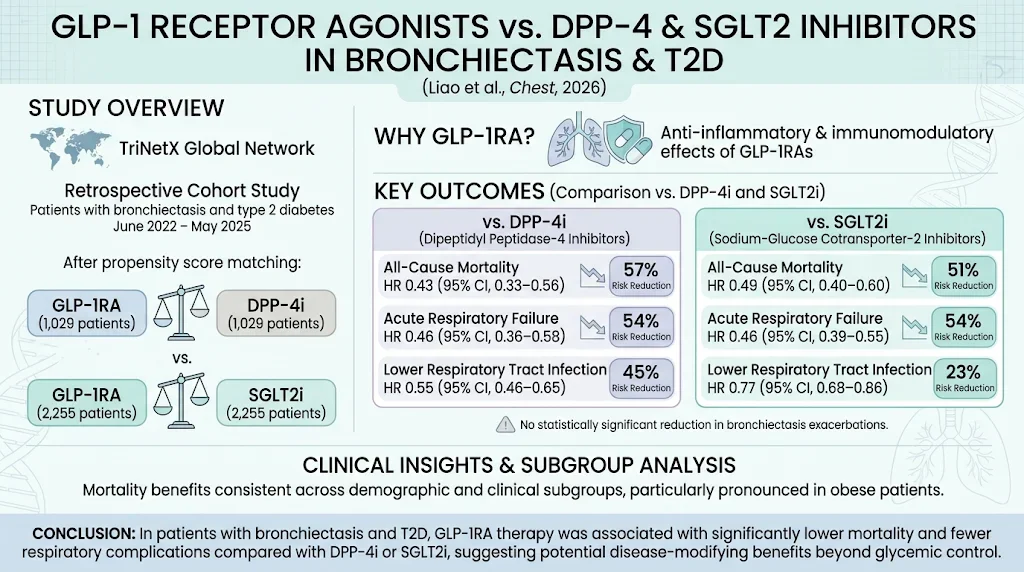
Leveraging the TriNetX global federated research network, the authors conducted a retrospective cohort study involving adult patients with diagnosed bronchiectasis and type 2 diabetes initiating GLP-1RA therapy between June 1, 2022, and May 30, 2025. Two comparator cohorts were established: patients initiating DPP-4i and those initiating SGLT2i, to evaluate relative clinical effectiveness. Propensity score matching was utilized to adjust for baseline confounders such as demographics, comorbidities, and prior respiratory disease severity, generating balanced cohorts of 1,029 patients per group for GLP-1RA versus DPP-4i and 2,255 patients per group for GLP-1RA versus SGLT2i comparisons. The primary endpoints assessed were all-cause mortality, bronchiectasis exacerbations, acute respiratory failure, and incidence of lower respiratory tract infections during follow-up. Hazard ratios (HR) and 95% confidence intervals (CI) were calculated to quantify relative risks. Subgroup analyses stratified outcomes by clinical and demographic variables, including obesity status.Key Findings
The study found robust and consistent evidence favoring GLP-1RA therapy over DPP-4i and SGLT2i in terms of survival and respiratory complication outcomes. Compared to DPP-4i, GLP-1RA use was associated with a 57% reduction in all-cause mortality (HR 0.43; 95% CI 0.33-0.56), a 54% reduction in acute respiratory failure (HR 0.46; 95% CI 0.36-0.58), and a 45% reduction in lower respiratory tract infections (HR 0.55; 95% CI 0.46-0.65). Similarly, GLP-1RA demonstrated mortality benefit compared to SGLT2i with a 51% risk reduction (HR 0.49; 95% CI 0.40-0.60), as well as reductions in acute respiratory failure (54% reduction, HR 0.46; 95% CI 0.39-0.55) and lower respiratory tract infections (23% reduction, HR 0.77; 95% CI 0.68-0.86). These benefits were observed consistently across multiple subpopulations, with heightened mortality reductions observed in obese patients (a subgroup known to have amplified systemic inflammation). Notably, GLP-1RA did not significantly impact bronchiectasis exacerbations compared with the comparator drugs, implying that while GLP-1RAs may improve severe adverse respiratory outcomes and survival, exacerbation frequency may remain unaffected.Table: Summary of Hazard Ratios Comparing GLP-1RA to DPP-4i and SGLT2i
| Outcome | GLP-1RA vs DPP-4i HR (95% CI) | GLP-1RA vs SGLT2i HR (95% CI) | |————————–|——————————–|——————————-| | All-cause mortality | 0.43 (0.33 – 0.56) | 0.49 (0.40 – 0.60) | | Acute respiratory failure | 0.46 (0.36 – 0.58) | 0.46 (0.39 – 0.55) | | Lower respiratory infection| 0.55 (0.46 – 0.65) | 0.77 (0.68 – 0.86) | | Bronchiectasis exacerbations | No significant difference | No significant difference |Expert Commentary
This study is pioneering in exploring the comparative effectiveness of GLP-1 receptor agonists in patients with bronchiectasis complicated by T2D. The observed substantial reductions in mortality and serious respiratory complications support the concept that GLP-1RA’s pleiotropic actions include attenuation of chronic inflammation and improvement of respiratory pathophysiology. Mechanistically, GLP-1RAs modulate immune responses and reduce pro-inflammatory cytokines, which may underlie their benefits in this cohort. The absence of a significant effect on bronchiectasis exacerbations warrants further investigation—possibly pointing to the multifactorial triggers of exacerbations that extend beyond systemic inflammatory modulation. Limitations of the study include its observational nature and reliance on real-world data, which, despite propensity matching, cannot rule out residual confounding. Additionally, the retrospective follow-up limits causal inference and detailed phenotyping of bronchiectasis severity. Future randomized controlled trials are essential to confirm these findings and determine optimal GLP-1RA regimens tailored for pulmonary benefits. Furthermore, integrating biomarkers and imaging could help identify subsets of patients who derive the most benefit. The findings align with evolving paradigms to repurpose diabetes drugs for respiratory and inflammatory diseases, underscoring the potential to transform bronchiectasis management.Conclusion
In summary, GLP-1 receptor agonists confer significant clinical advantages over DPP-4 and SGLT2 inhibitors in patients with bronchiectasis and type 2 diabetes, evidenced by markedly reduced all-cause mortality and respiratory complications such as acute respiratory failure and lower respiratory tract infections. These data suggest potential disease-modifying effects of GLP-1RAs beyond their glucose-lowering properties, opening avenues for novel therapeutic strategies in managing bronchiectasis with metabolic comorbidities. Prospective trials and mechanistic studies are warranted to validate and extend these promising findings into routine clinical practice.Funding and Clinical Trials Registration
The original study did not specify funding details or clinicaltrials.gov registration. Future research should ensure transparent funding disclosures and trial registrations to support evidence credibility.References
Liao KM, Chuang YM, Hsu WH, Kuo CY, Wu JY, Shiau BW, Kostikas K, Criner GJ, Lai CC. Comparative Effectiveness of GLP-1 Receptor Agonists versus DPP-4 and SGLT2 Inhibitors in Patients with Bronchiectasis and Type 2 Diabetes. Chest. 2026 Nov 13. PMID: 43025805. Additional background references: 1. Chalmers JD, et al. Management of Bronchiectasis in Adults. Am J Respir Crit Care Med. 2021; 203(1):e1–e18. 2. Nauck MA, Meier JJ. Incretin therapies: how do they work? Diabetes Obes Metab. 2018;20 Suppl 1:5-19. 3. Seiglie JA, et al. GLP-1 receptor agonists in diabetes and cardiovascular protection: A mechanistic review. Curr Diab Rep. 2022;22(3):117-131.Specialty calculators
For clinical reference; use professional judgment.