Introduction: The Challenge of Myeloproliferative Neoplasms and Treatment Limitations
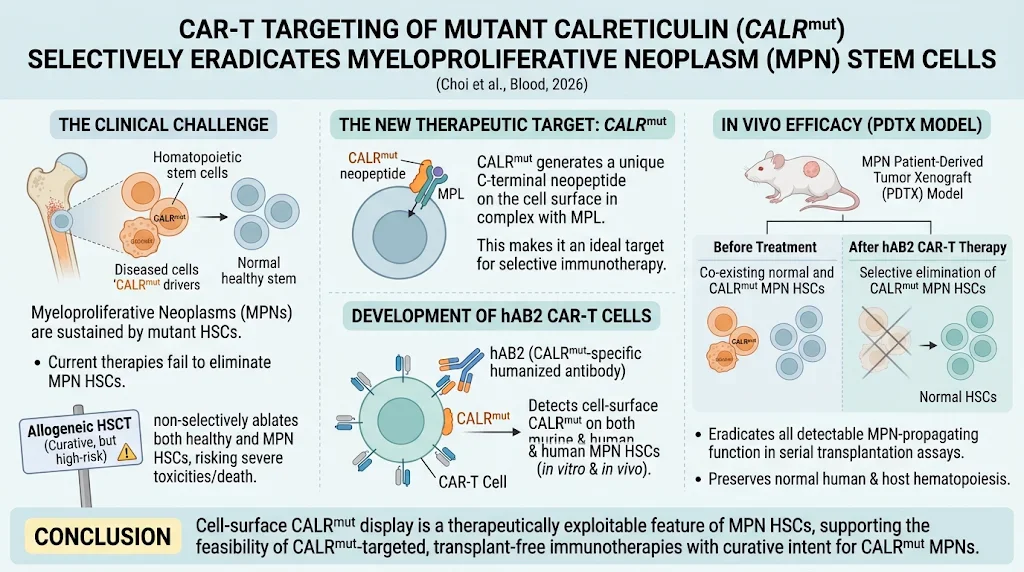
Myeloproliferative neoplasms (MPNs) are clonal hematopoietic stem cell disorders characterized by uncontrolled proliferation of mature blood cells. These diseases typically arise from driver mutations affecting key hematopoietic regulators, with JAK2, MPL, and calreticulin (CALR) mutations being predominant. Although current therapeutic strategies can manage symptoms and reduce thrombotic risk, they fail to eradicate MPN-sustaining hematopoietic stem cells (HSCs), leading to persistent disease and potential progression to myelofibrosis or acute leukemia. Allogeneic hematopoietic stem cell transplantation (HSCT) remains the only curative treatment but indiscriminately ablates both malignant and normal HSCs, requiring risky donor stem-cell replacement and exposing patients to significant morbidity and mortality.Mutant Calreticulin as a Selective Therapeutic Target
Mutations in CALR, found in a substantial subset of MPN patients, result in a novel C-terminal neopeptide uniquely expressed on MPN cells. This mutant CALR must form a complex with the thrombopoietin receptor (MPL) on the cell surface to activate oncogenic signaling pathways, driving proliferation and disease propagation. This surface expression of mutant CALR complexes provides a highly specific target epitope absent in normal hematopoietic cells, presenting an opportunity for selective immunotherapeutic approaches that can spare healthy cells.Study Design and Methods
Choi et al. engineered a high-affinity humanized antibody, designated hAB2, specifically recognizing the mutant CALR epitope. This antibody was integrated into chimeric antigen receptor (CAR) constructs to produce hAB2 CAR-T cells capable of selectively targeting CALR-mutated MPN cells. The study evaluated both murine models and human patient-derived tumor xenograft (PDTX) models, focusing on the expression of surface mutant CALR in functional MPN HSCs and the capacity of the engineered CAR-T cells to ablate these stem cell populations in vivo.Key Findings
The research demonstrated that functional MPN-sustaining HSCs from both mice and humans consistently express surface mutant CALR detectable by the hAB2 antibody. The PDTX model allowed rigorous assessment of CAR-T efficacy against human CALRmut MPN HSCs within a physiological niche. Treatment with hAB2 CAR-T cells resulted in selective elimination of CALRmut MPN HSCs without compromising residual normal hematopoiesis in the host. Importantly, serial transplantation assays confirmed the complete eradication of MPN-propagating capacity, underlining the therapy’s potential to achieve durable remission without the need for allogeneic HSCT.Clinical and Therapeutic Implications
This study provides a robust preclinical proof-of-concept that mutant CALR surface expression in MPN HSCs can be therapeutically exploited by CAR-T cell approaches. By selectively targeting only malignant hematopoietic stem cells, this strategy could circumvent the complications of current HSCT, including graft-versus-host disease and treatment-related mortality. Moreover, the ability to preserve normal hematopoiesis reduces the requirement for stem-cell replacement, significantly improving safety and patient quality of life.Expert Commentary and Considerations
The findings by Choi et al. add to the growing body of evidence supporting precision immunotherapies tailored to unique neoplastic antigens in hematologic malignancies. The specificity of hAB2 CAR-T cells for the mutant CALR neoepitope strongly mitigates off-target toxicity risks. However, clinical translation will require addressing challenges such as CAR-T cell persistence, potential antigen escape mechanisms, and manufacturing scalability. Further studies are warranted to evaluate long-term responses, potential immunogenicity, and combinational strategies with current therapeutic modalities.Conclusion
Selective CAR-T cell therapy targeting mutant calreticulin represents a promising, transplant-free approach to eradicate MPN-sustaining stem cells in CALR-mutated myeloproliferative neoplasms. The demonstration of effective in vivo clearance of malignant HSCs while preserving normal hematopoiesis opens new avenues for curative immunotherapy in MPN patients, potentially transforming the clinical management of these disorders.Funding and Clinical Trials
The original study was published by Choi DC et al. in Blood (2026), supported by institutional research funds and relevant grants. Clinical trials to validate safety and efficacy in patients are anticipated but currently not registered.References
1. Choi DC, Medico G, Lebedeva IV, et al. CAR-T Targeting of Mutant Calreticulin Selectively Eradicates Myeloproliferative Neoplasm-Sustaining Stem Cells. Blood. 2026 Nov 12. PMID: 43023553. 2. Tefferi A, et al. Myeloproliferative Neoplasms: Molecular Pathogenesis and Treatment. Blood. 2018;132(23):2456–2466. 3. Newberry KJ, et al. Targeting Calreticulin Mutations in Myeloproliferative Neoplasms. Expert Opin Ther Targets. 2021;25(7):607-615.Specialty calculators
For clinical reference; use professional judgment.