Highlight
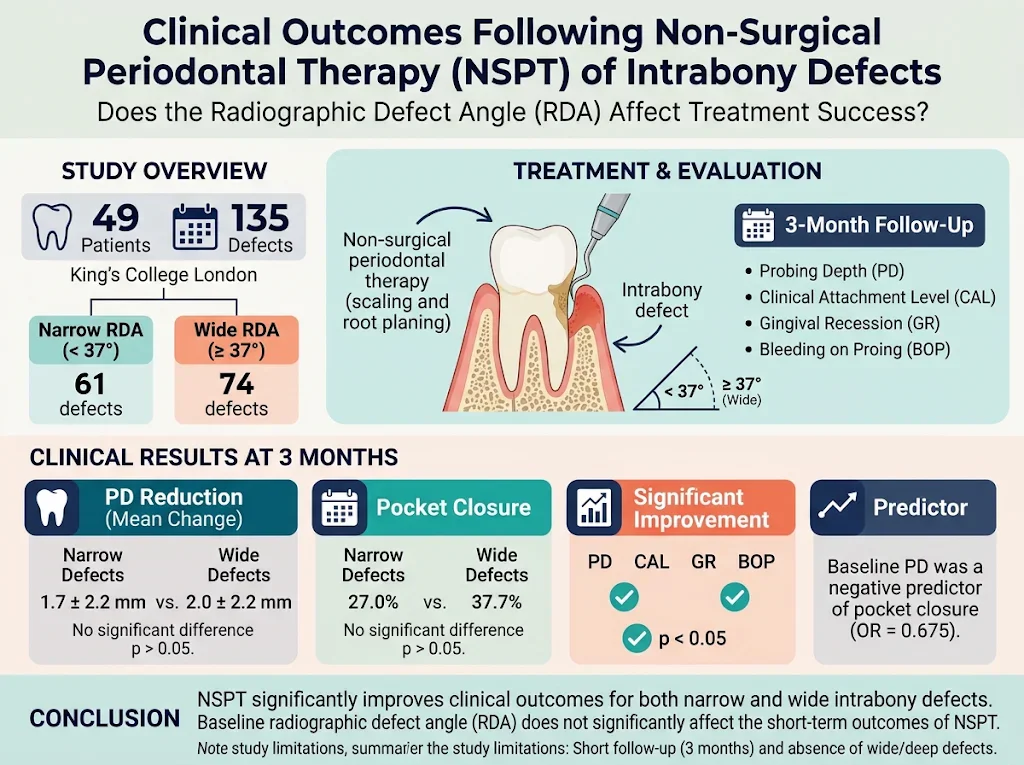
- Non-surgical periodontal therapy (NSPT) significantly improves clinical parameters in intrabony defects after 3 months, regardless of defect angle.
- No statistically significant difference was found in probing depth (PD) reduction or pocket closure rates between narrow (<37°) and wide (≥37°) radiographic defect angles.
- Deeper baseline probing depths negatively predict the likelihood of pocket closure following NSPT.
- Short-term follow-up and limited representation of wide/deep intrabony defects limit generalizability of these findings.
Study Background
Intrabony periodontal defects, characterized by vertical bone loss adjacent to teeth, pose a significant challenge in periodontal therapy and are a major contributor to halting disease progression and preserving dentition. Non-surgical periodontal therapy (NSPT), which includes scaling and root planing, remains the primary intervention for managing chronic periodontitis and intrabony defects prior to or without surgical intervention. Traditionally, the morphology of intrabony defects, including the radiographic defect angle (RDA), has been posited to influence treatment outcomes. Narrow defect angles are often considered more favorable for regenerative approaches. However, the influence of RDA on the effectiveness of NSPT has not been definitively established. Understanding whether RDA affects clinical response to NSPT may guide clinicians in treatment planning and prognostication.Study Design
This retrospective clinical study screened 49 patients with 135 intrabony defects from King’s College London Biobank. The cohort was dichotomized based on radiographic defect angle: narrow (4 mm) stratified within narrow and wide angle groups was also performed. Multilevel regression analysis was used to identify predictors of pocket closure.Key Findings
Overall, NSPT resulted in statistically significant improvement across key clinical outcomes at 3 months, with both narrow and wide defect groups showing reductions in PD and CAL and decreases in BOP (p 0.05). The incidence of pocket closure was 27% in narrow defects and 37.7% in wide defects, again without significant intergroup difference. The subgroup analysis considering shallow versus deep intrabony components did not yield statistically significant outcome differences related to RDA, although the sample included few wide/deep defects, potentially limiting power. Multilevel logistic regression identified baseline PD as a significant negative predictor for pocket closure (odds ratio = 0.675), indicating that deeper pockets reduced the likelihood of achieving closure post-NSPT. Neither radiographic defect angle nor the depth of the intrabony component independently predicted outcomes.Expert Commentary
These findings contribute to the nuanced understanding of intrabony defect management, suggesting that intrinsic radiographic morphology, specifically RDA, may not critically influence short-term clinical response to NSPT. This aligns with the notion that mechanical debridement reduces inflammation regardless of bony defect configuration, at least in the initial healing phase. However, this study’s limitations warrant cautious interpretation. The short-term 3-month follow-up limits insight into long-term stability and regeneration potential. Moreover, the scarcity of wide and/or deep defects constrains applicability to more complex cases often encountered clinically. Future prospective trials with longer follow-up and larger sample sizes stratified by defect morphology are needed to clarify these relationships and guide tailored periodontal therapy. Importantly, the negative predictive role of baseline PD on pocket closure emphasizes the clinical imperative for early intervention and supports the adjunctive consideration of surgical or regenerative approaches in deeper defects to optimize outcomes.Conclusion
This retrospective analysis demonstrates that non-surgical periodontal therapy yields meaningful short-term improvements in clinical parameters of intrabony defects irrespective of radiographic defect angle. Baseline probing depth remains a critical predictor of treatment success, overshadowing the influence of defect angle. While encouraging, these findings should be interpreted within the context of the study limitations, and cannot be generalized to all intrabony defect types, especially wide and deep lesions. Clinicians should continue to integrate comprehensive clinical and radiographic assessment in periodontal treatment planning, considering NSPT as a valuable initial approach but recognizing scenarios that may warrant more advanced interventions.Funding and ClinicalTrials.gov
This study was conducted using samples from the Biobank of King’s College London. Details about study funding and registration were not reported.References
1. Cortellini P, Tonetti MS. Strategies for periodontal regeneration in intrabony defects: a systematic review. J Clin Periodontol. 2015;42 Suppl 16:S204-14. 2. Eickholz P, Kim TS, et al. Healing and clinical outcomes after non-surgical and surgical periodontal therapies: a systematic review and meta-analysis. J Clin Periodontol. 2020;47(4):436-445. 3. Jepsen S, Caton JG, et al. Periodontal Defect Morphology and Its Impact on Therapy Outcomes: Consensus Report. J Periodontol. 2019;90(6):720-730.Specialty calculators
For clinical reference; use professional judgment.