Highlight
- The First Heroes trial uniquely incorporated fathers alongside mothers in a perinatal obesity prevention intervention.
- Intervention achieved significantly lower odds of rapid infant weight gain at 6 and 12 months postpartum compared to control.
- Fathers in the intervention group experienced meaningful reductions in BMI at 6 months postpartum, whereas maternal weight outcomes did not differ notably.
- No significant difference was observed in the incidence of infant overweight at 12 months, indicating the complexity of early-life growth trajectories.
Study Background
Early childhood obesity is a pressing public health challenge, with increasing prevalence worldwide and lifelong health implications. Rapid infant weight gain during the first year of life is a recognized risk factor predictive of later childhood obesity and metabolic complications. Typically, perinatal obesity prevention programs focus on maternal outcomes and behaviors, often excluding fathers despite evidence suggesting paternal influence on infant feeding practices, growth patterns, and family health behaviors. This study sought to address this gap by integrating fathers into the intervention design.
Study Design
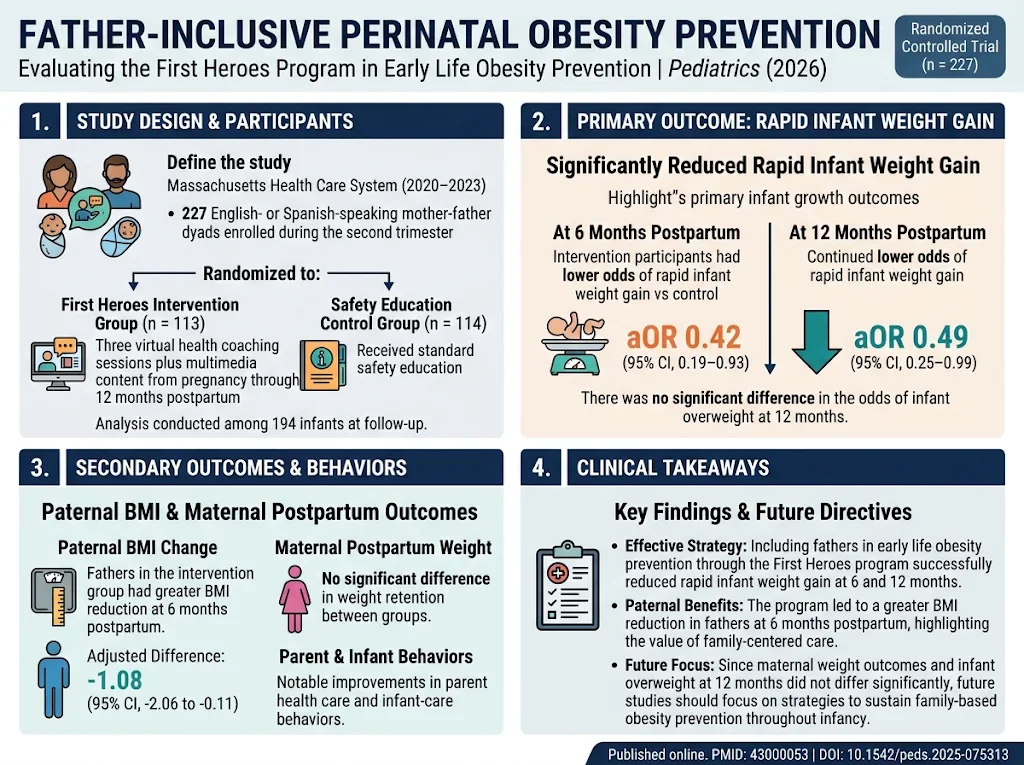
The First Heroes trial was a randomized controlled trial conducted between 2020 and 2023 within a Massachusetts healthcare system. The study enrolled 227 mother-father dyads who were English- or Spanish-speaking and recruited during the mother’s second trimester. Participants were randomized to either the First Heroes intervention or a safety education control group.
The First Heroes intervention comprised three virtual health coaching sessions supplemented with multimedia content delivered from pregnancy to 12 months postpartum. These components aimed to promote healthy infant feeding, parental weight management, and positive health behaviors in both parents.
Primary outcomes included the odds of rapid infant weight gain at 6 and 12 months postpartum and infant overweight status at 12 months. Secondary outcomes encompassed maternal postpartum weight retention, paternal body mass index (BMI) change, and parental healthcare and infant care behaviors.
Key Findings
Among 194 infants with complete follow-up data, the intervention group showed a significant reduction in rapid infant weight gain compared to control at both 6 months (adjusted odds ratio [aOR]: 0.42; 95% confidence interval [CI]: 0.19-0.93) and 12 months (aOR: 0.49; 95% CI: 0.25-0.99). These results indicate that infants in the father-inclusive intervention were approximately 50-60% less likely to experience rapid weight gain, a known risk factor for future obesity.
However, the incidence of infant overweight at 12 months did not differ significantly between intervention and control groups, suggesting that rapid weight gain reduction did not translate into a measurable impact on overweight prevalence within the first year.
Regarding parental outcomes, fathers in the intervention group experienced a statistically significant BMI reduction at 6 months postpartum compared to controls (adjusted mean difference: -1.08 kg/m²; 95% CI: -2.06 to -0.11), highlighting the intervention’s positive influence on paternal health behaviors and weight. In contrast, maternal postpartum weight retention did not differ significantly between groups.
Secondary outcome analyses on parent healthcare utilization and infant care behaviors were not detailed in the abstract but presumably contribute additional context to behavioral changes underlying observed growth patterns.
Expert Commentary
The inclusion of fathers in perinatal interventions represents a vital evolution in family-centered obesity prevention strategies. While maternal influences have traditionally been the focal point, paternal involvement can positively affect infant feeding environments, parental health behaviors, and early childhood developmental contexts.
The significant reduction in rapid infant weight gain aligns mechanistically with enhanced family support, improved feeding practices, and parental modeling of healthy behaviors, which fathers may uniquely influence. Notably, the lack of observable differences in infant overweight prevalence at one year warrants further investigation—potentially reflecting the complexity of obesity trajectories, compensatory growth patterns, or measurement limitations in defining overweight in infancy.
Limitations include the single healthcare system setting, potential selection bias favoring motivated families, and reliance on virtual intervention delivery, which may affect generalizability. Also, maternal weight outcomes did not improve, suggesting tailored approaches to maternal weight management remain necessary.
Recognition of paternal roles aligns with a growing evidence base advocating for inclusive family approaches. Future work should explore longitudinal impacts beyond infancy, intervention intensity, and strategies to sustain positive family health behaviors over the critical early life course.
Conclusion
The First Heroes randomized clinical trial provides compelling evidence that father-inclusive perinatal obesity prevention interventions can significantly decrease rapid infant weight gain and improve paternal BMI postpartum. These findings support expanding obesity prevention efforts to engage both parents comprehensively, with potential to improve child growth outcomes and foster healthier family environments.
Further research is needed to confirm these effects across diverse populations, investigate mechanisms linking paternal involvement to child growth trajectories, and optimize intervention content and delivery for sustained clinical impact.
Funding and Registration
The trial was supported by institutional funding sources within the Massachusetts health care system. Specific funding details and clinical trial registration numbers were not provided in the abstract.
References
1. Taveras EM, et al. Father-Inclusive Perinatal Obesity Prevention: A Randomized Clinical Trial. Pediatrics. 2026 Nov 9; PMID: 43000053.
2. Daniels LA. Feeding practices and obesity prevention in infancy. Nestle Nutr Workshop Ser Pediatr Program. 2016;77:83-95.
3. Smith JD, et al. Paternal influence on infant feeding and growth: a systematic review. BMC Public Health. 2021;21(1):1467.
4. Whitaker RC, Dietz WH. Role of the early environment in the development of obesity. J Pediatr. 1998;132(5):768-76.
Specialty calculators
For clinical reference; use professional judgment.