Highlight
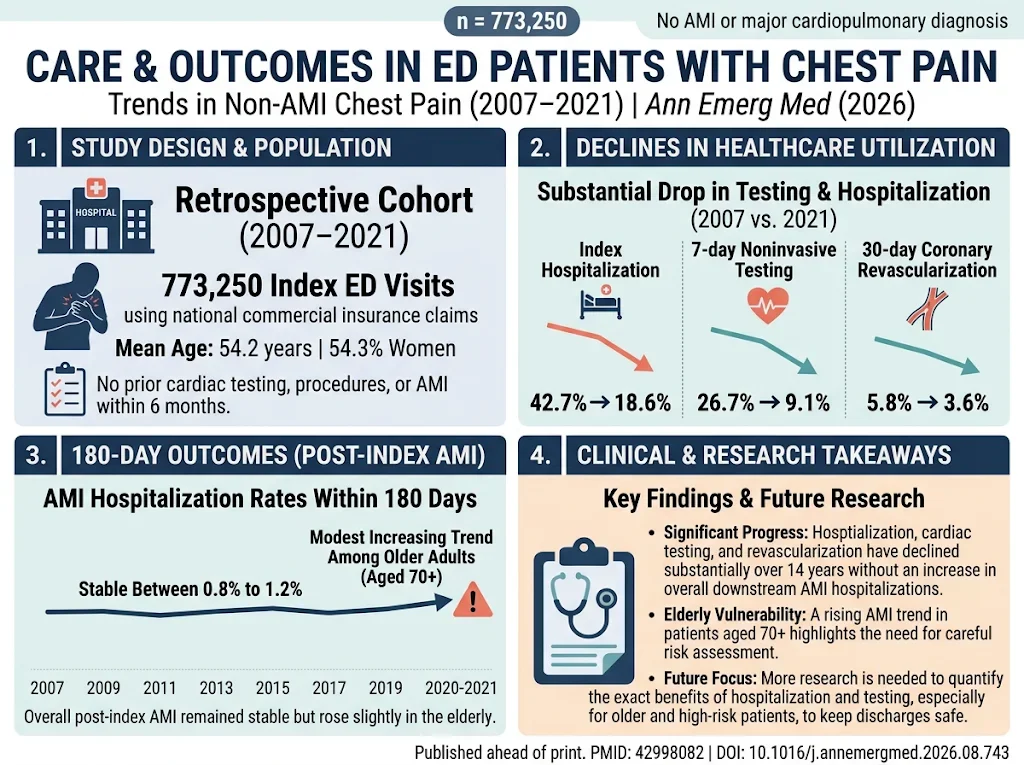
– Hospitalization rates for emergency department patients with chest pain but no acute myocardial infarction (AMI) decreased from 42.7% in 2007 to 18.6% in 2021.
– Utilization of 7-day noninvasive cardiac testing declined from 26.7% to 9.1%, and 30-day coronary revascularization dropped from 5.8% to 3.6%.
– Despite these declines in hospital-based interventions, the 180-day risk of subsequent AMI hospitalization remained stable overall, though a modest increase was observed in patients aged 70 years and older.
– The findings underscore the need to balance resource utilization and patient safety, especially in older populations at higher cardiovascular risk.
Study Background
Chest pain is one of the most common and challenging presentations in emergency departments (EDs), prompting extensive diagnostic evaluation to rule out life-threatening causes, notably acute myocardial infarction (AMI). While early AMI diagnosis and management have witnessed major advances, a large subset of chest pain patients are ultimately found not to have AMI. Despite low short-term event rates in such patients, historical caution has resulted in substantial hospitalization and extensive cardiac testing to exclude other forms of coronary disease or risk. This practice contributes to high healthcare costs and resource use, alongside potential iatrogenic harm from unnecessary testing and procedures.
Recent clinical pathways and risk stratification tools aim to identify low-risk patients safe for discharge without inpatient admission or invasive diagnostics, yet data tracking national trends over time in the care and outcomes of these patients remain limited. Furthermore, understanding whether decreased resource use affects downstream outcomes such as late AMI is crucial, particularly in older adults who may harbor higher undetected risk.
Study Design
This large retrospective study analyzed administrative claims data from a national commercial insurer over a 15-year period (2007–2021), identifying emergency department visits where chest pain was the principal diagnosis without concurrent AMI or other major cardiopulmonary diagnoses. The cohort excluded patients with recent cardiac testing, prior coronary procedures, or recent AMI hospitalizations within six months to focus on new presentations without known advanced cardiac disease.
The primary utilization outcomes were index hospitalization (hospital admission at the time of ED visit), 7-day follow-up noninvasive cardiac testing (e.g., stress testing, imaging), and 30-day coronary revascularization procedures. The principal clinical outcome was subsequent AMI hospitalization within 180 days. Adjusted annual rates and trends over time were assessed using statistical models accounting for patient clustering and confounders, with subgroup analyses by age.
Key Findings
The study included 773,250 index ED chest pain visits (mean age 54.2 years; 54.3% women). Over the studied period, hospitalization rates plummeted from 42.7% to 18.6%, reflecting a near 60% relative reduction in direct inpatient admissions following chest pain presentation without AMI diagnosis.
Concurrently, the utilization of noninvasive cardiac testing within 7 days post-ED visit markedly declined from 26.7% to 9.1%. This decrease suggests increasing confidence in outpatient or observation management strategies and risk stratification algorithms that safely reduce unnecessary testing. Likewise, 30-day coronary revascularization rates dropped from 5.8% to 3.6%, implying fewer invasive procedures performed in this population.
Crucially, these reductions in resource utilization did not coincide with an overall rise in adverse cardiac events; the adjusted 180-day rate of subsequent AMI hospitalization remained stable at approximately 0.8% to 1.2%, indicating safety in less aggressive care for the overall cohort. However, patients aged 70 years and older exhibited a modest but statistically significant increase in post-index AMI hospitalizations, highlighting a vulnerable subgroup that may require closer vigilance and tailored care approaches.
Expert Commentary
These findings align with evolving clinical guidelines emphasizing rapid risk stratification and selective use of hospitalization and testing in chest pain management. The substantial declines in hospital admissions and cardiac testing reflect gains in outpatient protocols and evidence-based clinical decision rules that safely de-escalate care for low-risk patients.
However, the observed modest increase in 180-day AMI hospitalizations in older adults warrants careful interpretation. Older patients often have atypical presentations, comorbidities, and higher baseline cardiovascular risk, underscoring the need for balance between avoiding overtreatment and missing clinically significant disease. Future research should focus on optimizing risk assessment tools integrating age-specific parameters and possibly novel biomarkers to guide personalized management strategies.
Limitations of the study include reliance on administrative claims data, which may lack granular clinical details such as symptom characteristics, ECG findings, or high-sensitivity troponin results. Also, the insurer population may limit generalizability to uninsured or publicly insured patients. Nonetheless, the large sample size and longitudinal scope provide valuable real-world insights.
Conclusion
This comprehensive analysis of U.S. emergency department chest pain patient management over 15 years reveals dramatic declines in hospitalization, cardiac testing, and early coronary intervention among patients without AMI diagnosis, without an adverse impact on medium-term AMI risk overall. These trends reflect successful adoption of more conservative, risk-based care paradigms that can safely reduce healthcare utilization and costs.
Nonetheless, the modest increase in subsequent AMI among older adults highlights an important subgroup requiring further research to define optimal diagnostic and management pathways to ensure safety. Clinicians should continue implementing validated risk stratification approaches while remaining vigilant for higher risk individuals who may benefit from more intensive evaluation or follow-up.
Future investigations should quantify the benefits and risks of hospitalization and cardiac testing in diverse patient subgroups, integrate emerging diagnostic technologies, and refine patient-centered care models to optimize outcomes in this common emergency presentation.
Funding and Clinical Trials
This study was conducted using commercially insured claims data. The authors reported no specific funding. No clinical trial registration applies.
References
1. Chou SC, Wharam JF, Hsia RY. Trends in Care and Outcomes Among Emergency Department Patients With Chest Pain Without Myocardial Infarction. Ann Emerg Med. 2026 Nov 6; PMID: 42998082.
2. Amsterdam EA, et al. 2014 AHA/ACC guideline for the management of patients with non–ST-elevation acute coronary syndromes. Circulation. 2014.
3. Hess EP, et al. Clinical risk stratification for patients with chest pain in the emergency department: a systematic review. JACC. 2015.
4. Than M, et al. Use of a 2-hour accelerated diagnostic protocol to assess patients with chest pain in the Asia-Pacific region (ADAPT trial). Lancet. 2012.
Specialty calculators
For clinical reference; use professional judgment.