Highlight
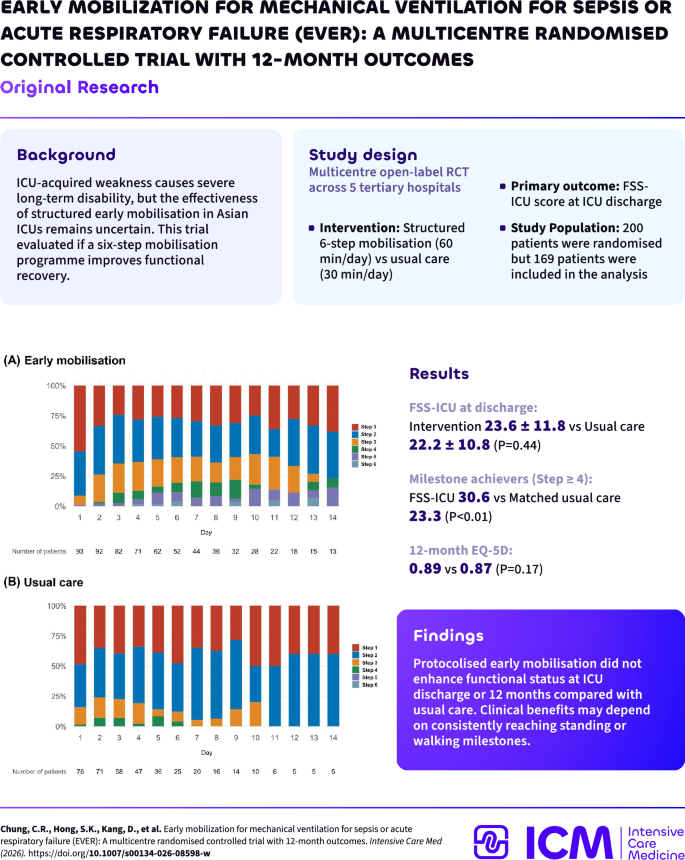
- This large multicenter randomized controlled trial in South Korea assessed a structured early mobilization protocol for mechanically ventilated adults with sepsis or acute respiratory failure.
- The intervention led to earlier initiation, more frequent sessions, and longer duration of mobilization compared to usual care.
- No significant difference was found in functional status assessed by the Functional Status Score for the ICU (FSS-ICU) at ICU discharge or in long-term outcomes up to 12 months.
- Patients who achieved a higher mobilization step (sit to stand or above) showed improved functional status compared to matched controls, indicating the potential benefit of more intensive early mobilization.
Study Background
Early mobilization of critically ill adults receiving mechanical ventilation has been recommended to mitigate ICU-acquired weakness, enhance functional recovery, and improve long-term outcomes. However, the optimal timing, dosing, and practical effectiveness of early mobilization remain uncertain, especially in Asian intensive care units (ICUs), which often differ in staffing, culture, and clinical practices. Sepsis and acute respiratory failure are leading causes of ICU admission globally, presenting an at-risk population for profound muscle weakness and long-term physical and cognitive impairments. This study aimed to address this evidence gap by evaluating a structured six-step early mobilization program in mechanically ventilated adults with sepsis or respiratory failure and its impact on short- and long-term functional recovery.
Study Design
The Early mobilization for mechanical ventilation for sepsis or acute respiratory failure (EVER) trial was a multicenter, randomized, open-label controlled study conducted between September 2020 and July 2024 across five tertiary hospitals in South Korea.
Eligible patients were adults with sepsis or acute respiratory failure expected to require invasive mechanical ventilation for at least 48 hours. They were randomized 1:1 to either the intervention group, which received a structured six-step early mobilization protocol, or to usual care.
The intervention involved earlier initiation of mobilization, defined steps progressing from passive range of motion to sitting, standing, and ambulation, with adjustments based on patient safety and tolerance.
The primary endpoint was functional status at ICU discharge measured by the Functional Status Score in the ICU (FSS-ICU), a validated tool assessing mobility and function. Secondary outcomes included in-hospital mortality, muscle strength, physical performance, and patient-reported outcomes such as quality of life (EQ-5D, SF-36), psychological symptoms (IES-R-K), cognitive function (MoCA-Blind), and post-intensive care syndrome (PICS) evaluations assessed up to 12 months post-enrollment.
Analyses were conducted on an intention-to-treat basis.
Key Findings
A total of 169 patients were randomized, with 93 allocated to the intervention and 76 to usual care. Baseline characteristics were comparable between groups.
– The intervention group started mobilization significantly earlier with a median time of 30 hours versus 45.9 hours in usual care.
– They also received more frequent sessions (median 11 vs. 4) and greater cumulative mobilization time (median 330 vs. 120 minutes).
Despite this increased mobilization activity, the primary outcome, FSS-ICU at ICU discharge, was not significantly different between groups (mean 23.6 [SD 11.8] vs. 22.2 [SD 10.8]; P = 0.44).
However, a subgroup analysis revealed that patients achieving mobilization Step 4 or higher (able to perform sit to stand or more intensive activity) exhibited significantly higher FSS-ICU scores compared with matched usual care patients (mean 30.6 vs. 23.3; P < 0.01), suggesting a threshold effect of mobilization intensity on functional recovery.
Longitudinal assessments over 12 months showed improvement in quality of life, cognitive function, and psychological symptoms in both groups, but no statistically significant differences between intervention and control were observed.
Mortality rates and serious adverse events were similar across study arms, indicating that early mobilization was safe and feasible under protocolized conditions.
Expert Commentary
The EVER trial provides important evidence regarding early mobilization in mechanically ventilated patients with sepsis or respiratory failure within an Asian ICU setting.
The lack of a significant difference in the primary outcome despite increased mobilization suggests that merely initiating earlier or more frequent mobilization may not be sufficient to improve overall functional outcomes in this population. Possible explanations include the heterogeneous severity of illness, differences in patient responsiveness, or limitations in achieving sufficiently intensive mobilization early during critical illness.
Notably, patients who progressed to standing or higher levels of mobilization fared better functionally, underscoring the importance of individualized goals to reach meaningful mobility milestones.
These findings align with other recent trials that report mixed results for early mobilization, reinforcing the need to identify which patients benefit most and how to optimize protocols to yield durable functional improvements.
Limitations include the open-label design, potential variations in usual care between centers, and challenges in the generalizability to different healthcare settings. Nonetheless, the rigorous multicenter randomized design and comprehensive longitudinal follow-up strengthen the study’s clinical relevance.
Conclusion
In this rigorously conducted multicenter randomized controlled trial involving mechanically ventilated adults with sepsis or acute respiratory failure, a structured protocolized early mobilization program led to earlier and more frequent physical activity but did not translate to improved functional status at ICU discharge or up to 12 months compared with usual care.
Achieving higher levels of mobilization may be associated with better outcomes, suggesting future research should focus on patient selection, tailored mobility targets, and overcoming barriers to intensive mobilization.
Clinicians should continue to follow current guidelines recommending early mobilization while recognizing the complexity of critically ill patients’ recovery and the need for multifaceted rehabilitation strategies beyond ICU discharge.
Funding and Clinical Trials Registration
The EVER trial was registered under ClinicalTrials.gov number NCT04582760 (12 October 2020). Funding sources were not explicitly detailed in the abstract.
References
1. Schweickert WD, et al. Early physical and occupational therapy in mechanically ventilated, critically ill patients: a randomized controlled trial. Lancet. 2009;373(9678):1874-1882.
2. Morris PE, et al. Standardized rehabilitation and hospital length of stay among patients with acute respiratory failure: a randomized clinical trial. JAMA. 2016;315(24):2694-2702.
3. Hodgson CL, et al. Early mobilisation and recovery in mechanically ventilated patients in the ICU: a bi-national, multi-centre, prospective cohort study. Crit Care Resusc. 2018;20(1):18-25.
4. Denehy L, et al. Exercise rehabilitation for patients with intensive care unit-acquired weakness: A systematic review and meta-analysis. Crit Care Med. 2020;48(4):471-480.
5. Needham DM, et al. Improving long-term outcomes after discharge from intensive care unit: report from a stakeholders’ conference. Crit Care Med. 2012;40(2):502-509.
6.Chung CR, Hong SK, Kang D, Ko RE, Cho J, Kim W, Do JG, Shin MJ, Shin YB, Ahn SY, Won YH, Lee SI, Lee HJ, Lee HB, Jang M, Kang J, Suh GY. Early mobilization for mechanical ventilation for sepsis or acute respiratory failure (EVER): a multicenter randomized controlled trial with 12-month outcomes. Intensive Care Med. 2026 Aug 26. doi: 10.1007/s00134-026-08598-w. Epub ahead of print. PMID: 42645557.
(These references provide foundational context and evidence on early mobilization and ICU rehabilitation.)