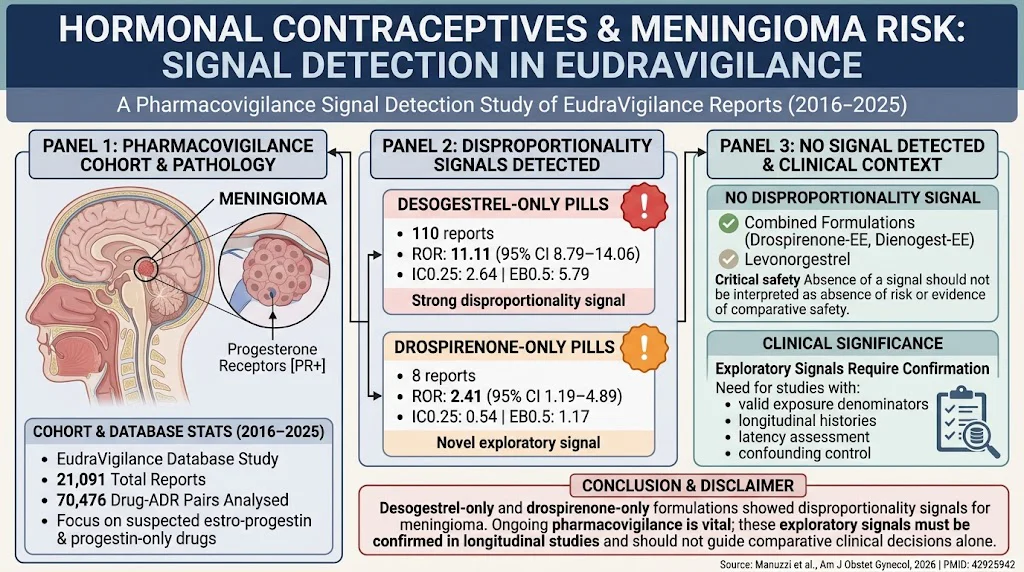
Pharmacovigilance analysis reveals increased reporting odds of meningioma associated with desogestrel-only and drospirenone-only hormonal therapies.
No disproportional safety signals identified for combined estro-progestin formulations or levonorgestrel-based therapies.
Findings emphasize the biological plausibility of hormone-driven meningioma development, given the tumor’s female predominance and progesterone receptor expression.
Further longitudinal studies with robust exposure data are critical to validate these exploratory safety signals.
Study Background and Disease Burden
Meningioma, one of the most common intracranial tumors, displays a marked female predominance, implicating hormonal influences particularly from progestogens in its pathogenesis and progression. Clinically, meningiomas are often slow-growing but can cause significant morbidity depending on size and location, with the anterior and middle skull base being frequent sites correlating with higher levels of progesterone receptor expression.
Exogenous hormonal therapies, including estro-progestin and progestin-only drugs, are widely prescribed for contraception and other gynecologic or menopausal indications, often over extended periods. Epidemiological evidence has suggested that some progestins, especially with long-term or high cumulative dosing, may increase meningioma risk. Additionally, case reports document spontaneous tumor regression following cessation of hormone therapy or reductions in progestogen levels, supporting hormonal modulation of tumor dynamics.
Given the widespread use of these therapies and potential serious outcomes, robust safety monitoring remains a critical public health priority.
Study Design
This study utilized the EudraVigilance pharmacovigilance database to detect safety signals linking estro-progestin and progestin-only drugs with meningioma reports. The dataset encompassed adverse drug reaction (ADR) reports submitted over a ten-year period from January 2016 through December 2025.
Drugs evaluated included the drospirenone-ethinylestradiol combination, dienogest-ethinylestradiol combination, drospirenone-only, desogestrel-only, and levonorgestrel.
Only reports with these agents identified as suspected drugs were included, excluding those where they appeared solely as concomitant medications. Disproportionality analyses were conducted using three complementary signal detection methodologies:
Reporting Odds Ratio (ROR)
Information Component (IC)
Empirical Bayes Geometric Mean (EBGM)
These methods assess whether meningioma reports are statistically overrepresented relative to other ADRs for the drugs, strengthening signal validation.
Key Findings
From the dataset of 21,091 reports involving 70,476 drug-ADR pairs, the vast majority concerned female patients, reflecting both hormonal therapy indications and meningioma’s epidemiology.
Significant disproportionality signals emerged for meningioma with two drug formulations:
– Desogestrel-only formulations: 110 meningioma reports yielded ROR 11.11 (95% CI 8.79-14.06), IC025 2.64, and EB05 5.79, indicating a strong signal.
– Drospirenone-only formulations: 8 meningioma reports showed a novel exploratory signal with ROR 2.41 (95% CI 1.19-4.89), IC025 0.54, and EB05 1.17.
No disproportionality was detected for combined estro-progestin drugs or levonorgestrel-only formulations, though the authors caution against interpreting these findings as definitive evidence of safety due to potential limitations in reporting and exposure data.
Importantly, the study also identified other serious ADRs such as cardiovascular events and newly reported reactions warranting further surveillance.
Expert Commentary and Biological Plausibility
These findings align with the biological rationale that meningioma pathophysiology involves hormonal modulation, particularly via progesterone pathways, given the high progesterone receptor prevalence in tumor tissues and clinical observations of tumor regression after hormone withdrawal.
The disproportionality signals for desogestrel and drospirenone-only formulations corroborate previous epidemiological data implicating progestins in meningioma risk, especially with prolonged exposure or higher dosages. However, the smaller number of reports for drospirenone-only formulations render this an exploratory signal necessitating confirmation.
The lack of signal for combined estro-progestin formulations suggests a nuanced role of hormonal components, receptor affinity, metabolism, or exposure dynamics that require deeper investigation.
Limitations of spontaneous reporting systems include under-reporting, reporting biases, and absence of denominator data for drug exposure, precluding causal inference. Confounding variables such as indication, patient comorbidities, and prior therapies are often unavailable.
Therefore, while this pharmacovigilance study provides important signal detection, robust prospective studies with accurate exposure measurement, longitudinal follow-up, and confounder control remain essential to establish causality and guide clinical decisions.
Conclusion
This signal detection study leveraging EudraVigilance data highlights potential safety concerns regarding meningioma risk with desogestrel-only and drospirenone-only hormonal therapies. The findings strengthen previous epidemiological suggestions of hormone-associated meningioma development and underscore the importance of continuing pharmacovigilance and detailed research.
Clinicians should remain vigilant and conduct individualized risk-benefit evaluations when prescribing long-term progestin therapies. These results should stimulate further confirmatory investigations incorporating valid exposure data, treatment duration, latency considerations, and control for confounders to better elucidate these safety signals.
Until more definitive evidence is available, the current signals should not dictate treatment withdrawal but rather inform shared decision-making and consideration of alternative contraceptive or hormonal regimens where appropriate.
Funding and Clinical Trials Registration
The original study did not report external funding. No clinical trials registration information is available.
References
1. Manuzzi A, Fazio E, Nikitina V, Broccoli M, Montanaro N, Motola D. Assessing the Safety of Estro-Progestin and Progestin-only drugs: A Signal Detection Study of Meningioma Reports in EudraVigilance. American Journal of Obstetrics and Gynecology. 2026 Oct 24. PMID: 42925942.
2. Claus EB, Bondy ML, Schildkraut JM, Wiemels JL, Wrensch M, Black PM. Epidemiology of intracranial meningioma. Neurosurgery. 2005 Apr;57(4):1088-95; discussion 1088-95.
3. Wiemels JL, Wrensch M, Claus EB. Epidemiology and etiology of meningioma. Journal of Neuro-Oncology. 2010 Apr;99(3):307-14.
4. Nordén M, Backlund LM, Granov A, et al. The role of sex steroids and their receptors in meningioma development. Neurosurg Rev. 2018;41(1):227-233.
5. Bouskill KE, Yasrebi M, Romero-Guzman E, et al. Hormonal contraceptives and risk of meningioma: A systematic review and meta-analysis. Contraception. 2021 Oct;110:41-50.