Highlight
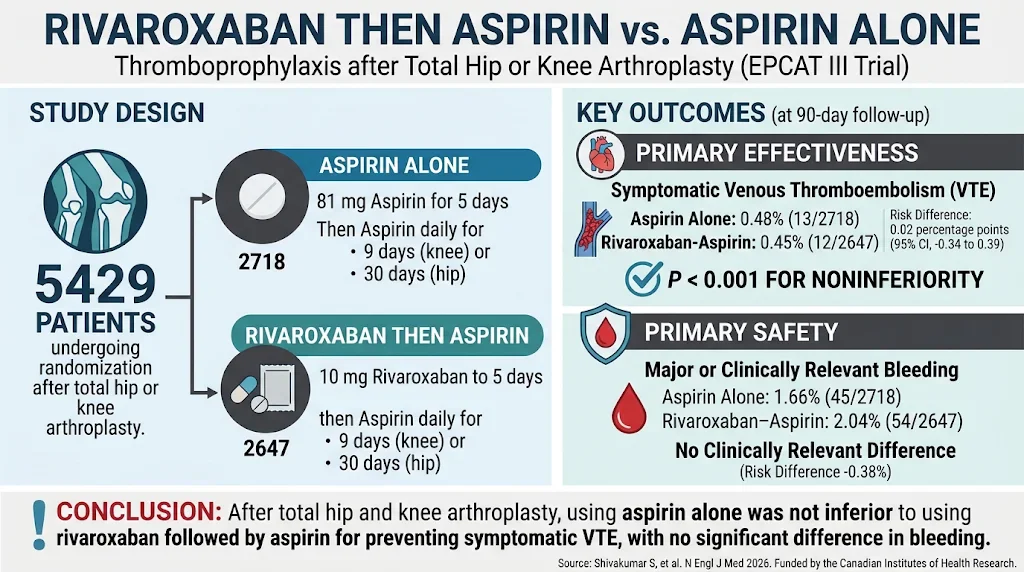
This landmark multicenter randomized trial demonstrated that aspirin alone for thromboprophylaxis after total hip or knee arthroplasty is noninferior to a regimen of rivaroxaban for 5 days followed by aspirin, with comparable rates of symptomatic venous thromboembolism and bleeding complications documented up to 90 days post-surgery.
The study enrolled over 5,400 patients, providing robust evidence to potentially simplify postoperative anticoagulation protocols.
Study Background
Venous thromboembolism (VTE), encompassing deep-vein thrombosis (DVT) and pulmonary embolism (PE), is a significant cause of postoperative morbidity and mortality following total hip arthroplasty (THA) and total knee arthroplasty (TKA). Preventing VTE is critical given the high thrombosis risk associated with orthopedic lower-limb surgeries due to venous stasis, endothelial injury, and hypercoagulability.
Current guidelines recommend pharmacologic thromboprophylaxis, traditionally using potent anticoagulants such as direct oral anticoagulants (DOACs) or low molecular weight heparin (LMWH), but aspirin is also used widely because of its low cost, ease of administration, and favorable safety profile. Nevertheless, controversy remains regarding the optimal agent and the duration of therapy, especially concerning the efficacy of aspirin alone compared to initial anticoagulation with rivaroxaban followed by aspirin.
Study Design
The EPCAT III trial was a multicenter, double-blind, randomized controlled trial designed to compare two thromboprophylaxis strategies in patients undergoing primary total hip or knee arthroplasty.
Patients were randomized to receive one of the following regimens:
- Rivaroxaban group: 10 mg oral rivaroxaban once daily for the first 5 days postoperatively, then 81 mg aspirin once daily (for a total of 35 days after hip arthroplasty and 14 days after knee arthroplasty).
- Aspirin-alone group: 81 mg aspirin once daily starting immediately postoperatively for the entire duration (14 days after knee arthroplasty and 35 days after hip arthroplasty).
The primary effectiveness outcome was symptomatic venous thromboembolism (proximal DVT or PE) within 90 days post-surgery. The primary safety outcome was major bleeding or clinically relevant nonmajor bleeding events within the same period. The trial was designed to test the noninferiority of aspirin alone compared to the rivaroxaban–aspirin sequential regimen, with a noninferiority margin set at 0.7 percentage points.
Key Findings
A total of 5,429 patients were randomized (2,718 to aspirin alone, 2,647 to rivaroxaban-aspirin). The incidence of symptomatic venous thromboembolism was 0.48% (13 events) in the aspirin-alone group compared to 0.45% (12 events) in the rivaroxaban-aspirin group, yielding a risk difference of 0.02 percentage points (95% confidence interval [CI], -0.34 to 0.39; P < 0.001 for noninferiority). This firmly established aspirin alone as noninferior to the sequential regimen in preventing symptomatic VTE.
Regarding safety, bleeding events (major or clinically relevant nonmajor bleeding) occurred in 1.66% (45 patients) of the aspirin-alone group versus 2.04% (54 patients) in the rivaroxaban-aspirin group (risk difference, -0.38%; 95% CI, -1.11 to 0.34), showing no significant safety disadvantage of aspirin alone.
Subgroup analyses by type of surgery (hip versus knee) showed consistent results with the overall population. The low event rates demonstrate contemporary perioperative care improvements and the efficacy of aspirin-based thromboprophylaxis strategies.
Expert Commentary
The EPCAT III trial adds rigorous evidence supporting aspirin monotherapy as a viable thromboprophylaxis strategy after total hip or knee arthroplasty. This challenges the conventional practice of using initial rivaroxaban or other DOACs, which, while effective, are often costlier and may carry greater bleeding risks or patient burden.
Some limitation considerations include exclusion of patients at extremely high thrombotic risk or those with contraindications to aspirin, which may limit generalizability to those groups. Moreover, the study follow-up was limited to 90 days, although this timeframe captures the majority of postoperative VTE events.
Current guidelines such as those from the American College of Chest Physicians acknowledge aspirin as an option in certain low-risk patients, but the EPCAT III data may promote broader incorporation and simplification of thromboprophylaxis protocols.
Conclusion
The EPCAT III trial provides compelling evidence that aspirin alone is noninferior to rivaroxaban followed by aspirin for thromboprophylaxis after total hip or knee arthroplasty. With similar efficacy and bleeding risk profiles, aspirin monotherapy offers a cost-effective, convenient, and safe approach for VTE prevention in these surgical populations.
This finding has potential to influence clinical practice and healthcare policies worldwide, simplifying postoperative care without compromising patient safety or outcomes.
Funding and Clinical Trial Registration
This study was funded by the Canadian Institutes of Health Research. The trial is registered at ClinicalTrials.gov under the identifier NCT04075240.
References
1. Shivakumar S, Matino D, Zukor D, et al. Rivaroxaban Then Aspirin vs. Aspirin Alone after Total Hip or Knee Arthroplasty. N Engl J Med. 2026;395(19):1885-1895. doi:10.1056/NEJMoa2206142
2. Kahn SR, Lim W, Dunn AS, et al. Prevention of VTE in orthopedic surgery patients: Antithrombotic Therapy and Prevention of Thrombosis, 9th ed: American College of Chest Physicians Evidence-Based Clinical Practice Guidelines. Chest. 2012;141(2 Suppl):e278S-e325S.
3. Falck-Ytter Y, Francis CW, Johanson NA, et al. Prevention of VTE in orthopedic surgery patients: antithrombotic therapy and prevention of thrombosis, 9th ed: American College of Chest Physicians Evidence-Based Clinical Practice Guidelines. Chest. 2012;141(2 Suppl):e278S-325S.
Specialty calculators
For clinical reference; use professional judgment.