Highlight
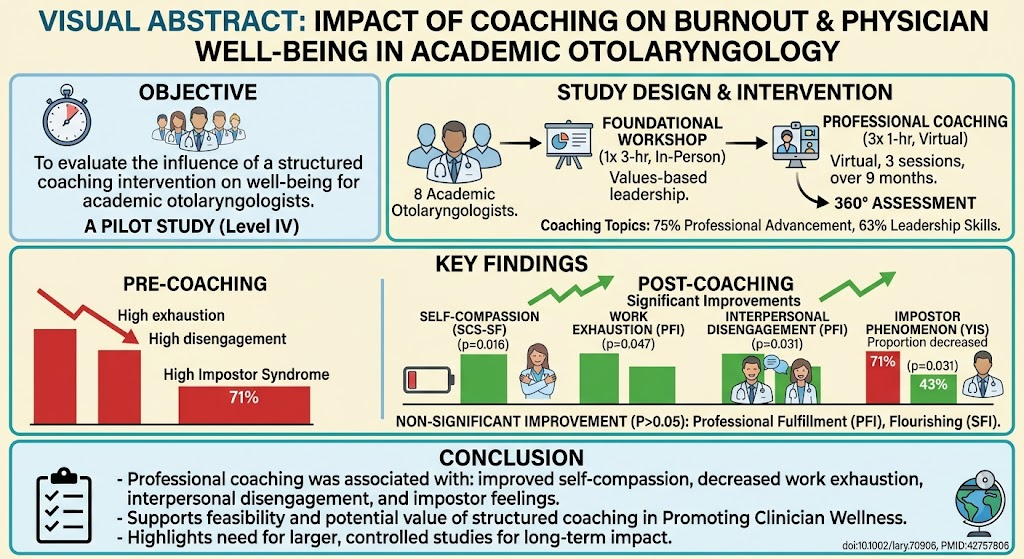
This pilot study demonstrated that structured professional coaching for academic otolaryngologists led to significant improvements in self-compassion, reductions in work exhaustion and interpersonal disengagement, and a notable decrease in impostor syndrome prevalence. These preliminary findings suggest coaching as a feasible strategy to enhance physician well-being and mitigate burnout and psychological distress within this specialty.
Background
Burnout and decreased well-being among physicians represent critical challenges in healthcare, contributing to reduced professional fulfillment, mental health issues, and compromised patient care. Otolaryngology, a surgical subspecialty marked by high clinical demands and academic responsibilities, is not exempt from such risks. Despite growing recognition of burnout’s pervasive impact, there remains an unmet need for tailored interventions that effectively address the complex stressors faced by academic physicians. Professional coaching, focused on personal development and leadership, has emerged as a promising approach, yet evidence in surgical subspecialties, including otolaryngology, is limited.
Study Design
This investigation was a pre-/post-intervention pilot study conducted among eight academic otolaryngologists. The structured coaching intervention comprised a foundational in-person workshop lasting three hours, centered on values-based leadership. Each participant also completed a comprehensive 360° assessment to identify personal and professional development targets. Subsequently, over nine months, participants engaged in three virtual one-hour individual coaching sessions with a certified professional coach. Seven of the participants completed pre- and post-coaching evaluations using validated survey instruments: the Stanford Professional Fulfillment Index (PFI) assessing burnout dimensions and professional fulfillment; the Self-Compassion Scale-Short Form (SCS-SF); the Secure Flourish Index (SFI) measuring overall flourishing; and the Young Impostor Syndrome (YIS) Scale.
Key Findings
The content of coaching sessions was individualized, with a predominant focus on professional advancement (75%) and the development of leadership skills (63%). Statistical analysis using Wilcoxon signed-rank tests indicated significant post-intervention improvements in key domains:
- Self-compassion scores (SCS-SF) increased significantly (p = 0.016), illustrating enhanced emotional resilience and kindness toward oneself.
- Work exhaustion levels, a core element of burnout measured by the PFI, significantly decreased (p = 0.047), indicating reduced fatigue and strain related to work demands.
- Interpersonal disengagement, reflecting emotional distancing from colleagues and patients, also improved significantly (p = 0.031).
Although professional fulfillment (PFI) and overall flourishing (SFI) showed positive directional trends, these changes did not reach statistical significance in this small cohort. Importantly, total scores on the YIS Scale decreased significantly post-coaching (p = 0.031), with the proportion of participants meeting criteria for impostor syndrome reducing markedly from 71% to 43%. This suggests that coaching may effectively alleviate feelings of incompetence and self-doubt common among high-achieving physicians.
Expert Commentary
This study aligns with accumulating evidence supporting professional coaching as a valuable tool for clinician wellness. By fostering self-compassion and leadership efficacy, coaching can counterbalance the high-pressure environments faced by academic physicians. The reduction in impostor syndrome prevalence is particularly noteworthy, as impostor feelings have been implicated in physician burnout and career dissatisfaction. Limitations include the small sample size, lack of a control group, and reliance on self-reported measures, which may introduce bias and limit generalizability. Larger randomized controlled trials are warranted to validate these findings, elucidate long-term effects, and optimize coaching program components for diverse physician populations.
Conclusion
Structured professional coaching holds promise as an intervention to improve mental wellness and mitigate burnout among academic otolaryngologists. Enhanced self-compassion and decreased work-related exhaustion and impostor phenomenon observed in this pilot cohort underscore the potential clinical and organizational benefits of integrating coaching into physician support frameworks. Future research with rigorous and larger-scale designs is critical to establish evidence-based recommendations and facilitate widespread implementation to support clinician resilience and sustainable careers.
Reference
Norouzi A, Johnson K, Xu MJ, Bonilla C, Ishman S, Murr AH, Chang JL, Durr ML. The Impact of Coaching on Burnout and Physician Well-Being in Academic Otolaryngology: A Pilot Study. Laryngoscope. 2026 Sep 18. doi: 10.1002/lary.70906. Epub ahead of print. PMID: 42757806.