Highlight
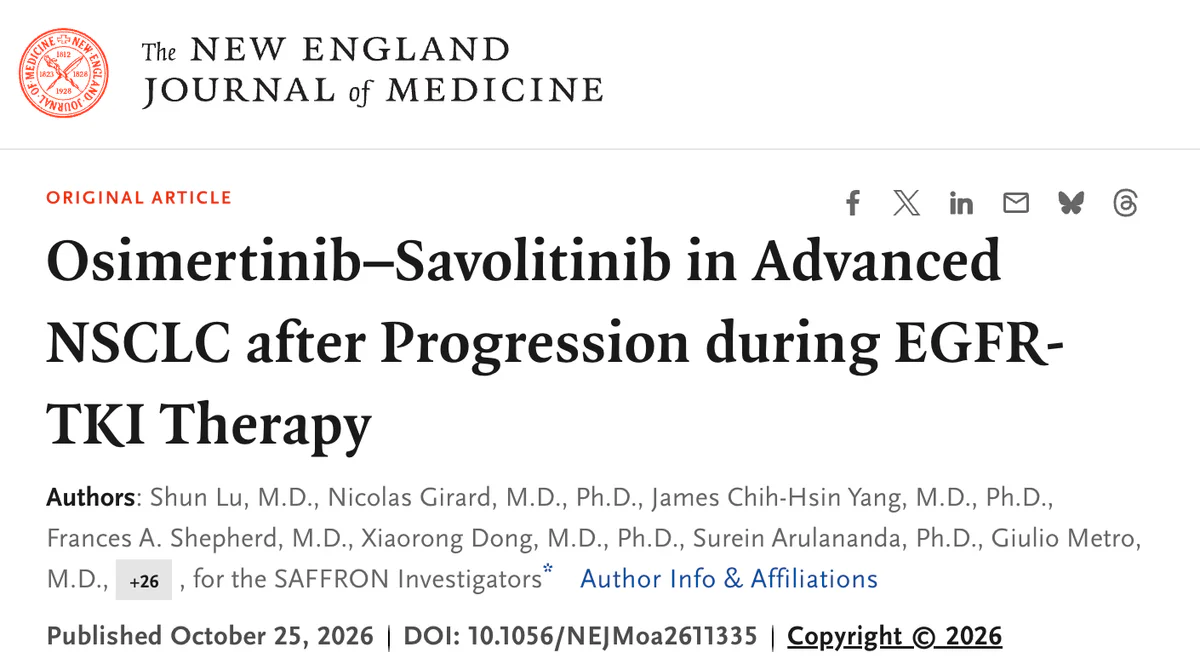
This pivotal international phase 3 SAFFRON trial compared osimertinib plus savolitinib versus platinum-pemetrexed chemotherapy in patients with advanced EGFR-mutated non-small-cell lung cancer (NSCLC) showing MET overexpression or amplification after progression on osimertinib monotherapy. Combination treatment significantly improved progression-free survival (PFS) and overall survival (OS) with manageable safety, highlighting the therapeutic value of dual MET and EGFR blockade in this resistant population.
Study Background
Non-small-cell lung cancer (NSCLC) harboring activating mutations in the epidermal growth factor receptor (EGFR) gene represents a subset of lung cancers with substantial therapeutic advances via EGFR-tyrosine kinase inhibitors (TKIs) such as osimertinib. Despite initial responses to osimertinib, acquired resistance inevitably develops, frequently mediated by mechanisms including MET gene amplification or protein overexpression. MET amplification activates bypass signaling pathways, circumventing EGFR inhibition and driving tumor progression.
Standard platinum-based chemotherapy is often employed after progression; however, outcomes remain suboptimal. Thus, rational combination strategies targeting both EGFR and MET signals are of prime interest to overcome resistance and improve survival outcomes. Savolitinib, a potent and selective MET-TKI, combined with osimertinib, offers a promising approach to target both oncogenic drivers concurrently in patients progressing on osimertinib monotherapy.
Study Design
The SAFFRON trial was an international, randomized, open-label, phase 3 study enrolling patients with locally advanced or metastatic NSCLC harboring sensitizing EGFR mutations who exhibited disease progression during osimertinib therapy. Eligible patients demonstrated MET overexpression (immunohistochemistry 3+ in 3 tumor cells) and/or MET amplification (5 3 gene copies by fluorescence in situ hybridization).
Participants were randomized 1:1 to receive either osimertinib (80 mg daily) plus savolitinib (300 mg twice daily) or standard intravenous platinum-pemetrexed chemotherapy. The primary endpoint was investigator-blinded independent central review-assessed progression-free survival (PFS). Secondary endpoints included overall survival (OS) and safety profiling.
Key Findings
Out of 1746 patients screened, 338 were randomized (171 to osimertinib-savolitinib and 167 to platinum-pemetrexed). Combination treatment significantly improved median progression-free survival compared to chemotherapy, with a hazard ratio (HR) of 0.55 (95% CI, 0.42-0.72; P < 0.001), translating into a 45% reduction in risk of disease progression or death.
At 12 months, the PFS rate was 36% in the osimertinib-savolitinib group versus 10% in the chemotherapy group. Furthermore, the combination achieved significantly longer overall survival, with an HR of 0.68 (95% CI, 0.50-0.91; P = 0.01). The 12-month OS estimates were 70% for the combination group compared with 53% for chemotherapy.
Safety profiles were comparable between groups. The most frequent adverse events (AEs) in the combination arm included peripheral edema (49%), anemia (26%), and diarrhea (26%). Grade 3 or higher AEs occurred in 64% of osimertinib-savolitinib patients versus 63% in the chemotherapy cohort, indicating manageable toxicity. These results underscore a favorable risk-benefit ratio for the dual MET and EGFR inhibition approach.
Expert Commentary
The SAFFRON trial’s robust methodology and positive survival outcomes establish osimertinib plus savolitinib as a new standard option for patients with EGFR-mutated NSCLC exhibiting MET-driven resistance mechanisms post-osimertinib. The combination addresses a significant unmet need by effectively overcoming MET-mediated acquired resistance, which represents an increasingly recognized mechanism contributing to therapeutic failure.
Limitations include the open-label design that might introduce bias in some secondary endpoints, although the primary PFS was centrally reviewed blinded, and all efficacy endpoints demonstrated statistical and clinical significance. Future investigations should explore biomarkers predicting optimal response and resistance mechanisms emerging after combination therapy.
Mechanistic insights highlight the value of simultaneous inhibition of EGFR and MET pathways to suppress compensatory signaling loops and potentiate durable tumor control. These results suggest routine testing for MET alterations upon acquired resistance as critical to guide precision treatment strategies in EGFR-mutant NSCLC.
Conclusion
The SAFFRON phase 3 trial demonstrates that osimertinib combined with savolitinib significantly improves progression-free and overall survival over platinum-pemetrexed chemotherapy in patients with EGFR-mutated advanced NSCLC harboring MET overexpression or amplification after progression on osimertinib. This dual-targeted approach offers an effective, tolerable treatment paradigm in a difficult-to-treat population, reinforcing the necessity of molecular recharacterization at resistance to personalize subsequent lines of therapy.
Given these compelling data, osimertinib-savolitinib combination should be considered a new standard of care for suitable patients, with ongoing research warranted to refine patient selection and manage resistance evolution.
Funding and Clinical Trials Registration
This study was funded by AstraZeneca. The clinical trial registration number is NCT05261399 (SAFFRON trial).