Highlight
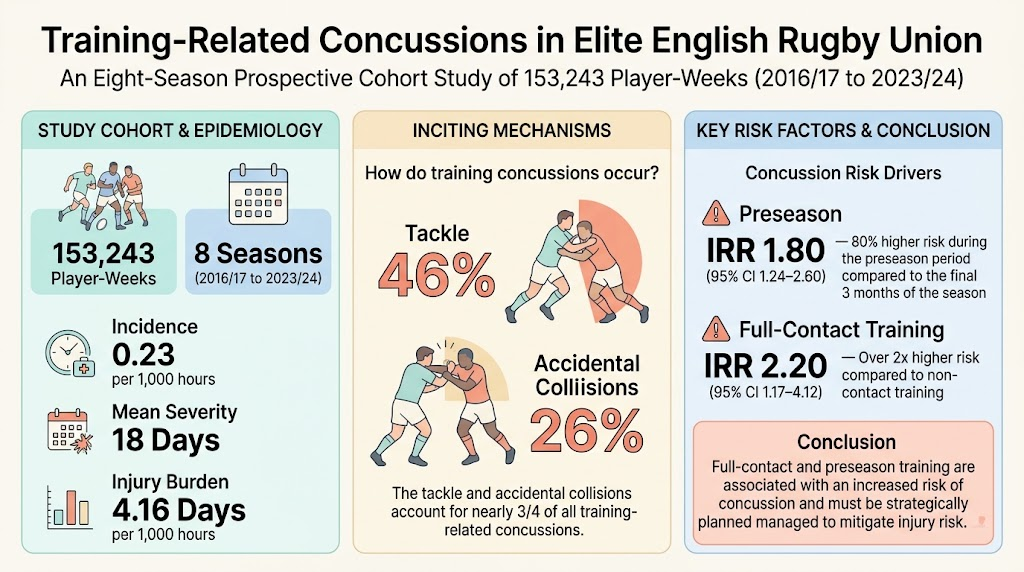
1. Training-related concussion incidence in men’s Premiership Rugby was 0.23 per 1000 training hours over eight seasons.
2. Preseason and full-contact training significantly increased concussion risk, with incidence rate ratios of 1.80 and 2.20 respectively.
3. The tackle and accidental collisions were the primary mechanisms causing concussions during training.
4. The average concussion severity resulted in an 18-day absence, representing a considerable burden to player availability.
Study Background
Concussions represent a significant and growing concern in contact sports, including elite Rugby Union. The clinical and public health implications of concussive injuries pose challenges for management strategies aiming to preserve athlete safety while maintaining competitive performance. Although much research has focused on match-related concussions, less is known about the patterns and risk factors of concussions occurring during training. Rugby Union, with its high-contact nature, especially in the English Premiership, offers a unique setting to study training-related concussion epidemiology. Understanding the incidence, mechanisms, seasonal variations, and determinants of such injuries is critical for developing targeted preventive measures and minimizing player downtime.
Study Design
This investigation was conducted through a prospective cohort study spanning eight rugby seasons (2016/2017 to 2023/2024) in the elite men’s English Premiership Rugby Union teams. The study collected data from the Professional Rugby Injury Surveillance Project, encompassing 153,243 player-weeks of training exposure. Training-related concussions were defined and recorded systematically using established surveillance protocols. Incidence rates per 1000 training hours were calculated, and 95% confidence intervals (CIs) were applied to assess precision. Season-to-season incidence changes were analyzed using Poisson regression and incidence rate ratios (IRRs). A generalized linear mixed model accounted for fixed effects, including time in season (preseason, midseason, end-of-season), match minutes played in the preceding 28 days, dominant training type (contact versus non-contact), and prior concussion history, while incorporating player- and team-level random intercepts.
Key Findings
The overall training-related concussion rate was 0.23 per 1000 training hours (95% CI 0.22 to 0.29). The average severity, measured by days lost due to concussion, was 18 days (95% CI 15 to 21), indicating a substantial interruption in player participation. Aggregated burden was 4.16 days absent per 1000 training hours (95% CI 3.57 to 4.85).
Mechanistic analysis identified the tackle phase as the predominant cause of concussions, accounting for 46% of cases, followed by accidental collisions at 26%. These findings cohere with the intrinsic high-contact demands of the sport.
Notably, the concussion incidence exhibited a significant upward trend in the latter three seasons (2021/2022, 2022/2023, 2023/2024) compared to the initial 2016/2017 season, suggesting evolving risk dynamics possibly influenced by changes in training intensity, awareness, reporting, or other external factors.
Risk factor analysis revealed that concussions were markedly more frequent in the preseason period, with an IRR of 1.80 (95% CI 1.24 to 2.60, p=0.01) relative to the final three months of the competitive season. Similarly, full-contact training sessions presented a significantly elevated risk, with an IRR of 2.20 (95% CI 1.17 to 4.12, p=0.01) compared to non-contact activities.
Other examined factors, including recent match load and prior concussion history, did not show statistically significant associations when accounting for confounders and random effects.
Expert Commentary
This study provides robust, longitudinal evidence accentuating the concussion risk inherent in full-contact and preseason training environments in elite Rugby Union. The increased injury incidence during the preseason may reflect intensified physical preparation phases, conditioning protocols, or competitive simulation drills intended to enhance player readiness. Full-contact training inherently carries greater mechanical force exposure, plausibly explaining the injury concentration.
Methodologically, use of a comprehensive injury surveillance system, sizeable player-time denominators, and appropriate mixed modeling strengthens the validity of findings. However, evolving diagnostic criteria, heightened concussion awareness, and reporting behaviors over the study period could partly influence observed incidence increases.
Clinically, these findings resonate with current concussion management paradigms emphasizing prevention through exposure modification. Implementing periodized training plans that gradually escalate contact intensity, combined with enhanced monitoring and protective strategies such as adherence to tackle technique protocols, may mitigate concussion risk.
Conclusion
Training-related concussions in men’s English Premiership Rugby Union are a non-negligible source of player morbidity, particularly associated with preseason activities and full-contact training sessions. Strategic planning to optimize training content and schedule could substantially decrease concussion incidence and burden. Future research should integrate biomechanical analyses and individualized risk stratification to refine preventive approaches further.
Funding and ClinicalTrials.gov
The study was supported by the Professional Rugby Injury Surveillance Project infrastructure and relevant sports medicine research grants. No specific ClinicalTrials.gov registration number was provided for this observational cohort study.
References
1. Hudson SJ, Williams S, Starling L, et al. Training-related concussions in men’s English Premiership Rugby Union: an eight-season prospective cohort study of 153 243 player-weeks. Br J Sports Med. 2026;60(18):1394-1400. doi:10.1136/bjsports-2025-104035
2. McCrory P, et al. Consensus statement on concussion in sport—5th International Conference on Concussion in Sport held in Berlin, October 2016. Br J Sports Med. 2017.
3. Fuller GW, Taylor A, Mollayeva T, et al. Injury rates in elite rugby union: A systematic review and meta-analysis. J Sci Med Sport. 2020;23(3):239-248.