Highlights
- Elafibranor, a dual PPAR-α/δ agonist, significantly achieves alkaline phosphatase (ALP) normalization in PBC patients with incomplete response to ursodeoxycholic acid (UDCA).
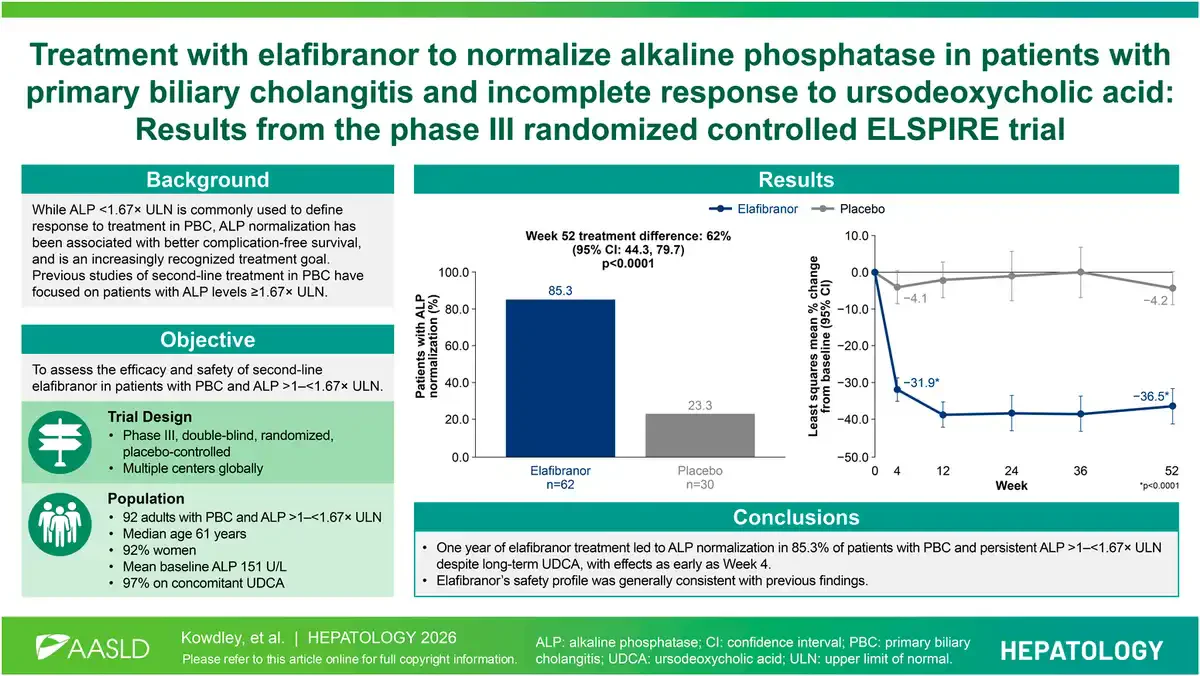
- The phase III ELSPIRE trial demonstrated 85.3% ALP normalization after 52 weeks of elafibranor versus 23.3% with placebo, highlighting a robust biochemical response.
- Beyond ALP normalization, elafibranor improves complete biochemical responses including total bilirubin and transaminases without significant new safety concerns.
- Evidence underscores ALP normalization as a meaningful surrogate endpoint linked with improved transplant-free and complication-free survival in PBC.
Background
Primary biliary cholangitis (PBC) is a chronic cholestatic liver disease characterized by autoimmune-mediated destruction of intrahepatic bile ducts, progressive cholestasis, fibrosis, and eventual liver failure. Ursodeoxycholic acid (UDCA) remains first-line therapy and improves survival; however, many patients exhibit incomplete biochemical response, defined commonly as failure to reduce alkaline phosphatase (ALP) below 1.67 times the upper limit of normal (ULN), which is associated with ongoing disease activity and increased risk of adverse outcomes including transplantation and mortality. Normalization of ALP (≤ULN) has emerged as a superior prognostic biomarker, associating with better complication-free survival and liver-related outcomes. Hence, therapeutic strategies aimed at achieving ALP normalization have become a focus in PBC management, particularly for those with incomplete response or intolerance to UDCA. Elafibranor is an oral, selective dual agonist of peroxisome proliferator-activated receptors (PPAR) α and δ with anti-inflammatory, anti-fibrotic, and metabolic modulating properties. Initial phase II trials indicated favorable biochemical improvement in PBC patients with elevated ALP despite UDCA, warranting pivotal phase III evaluation.Key Content
Chronological Development of Evidence for Elafibranor in PBC
The initial clinical investigations of elafibranor demonstrated its potential to modulate cholestatic liver injury through PPAR-mediated pathways, improving bile acid metabolism and inflammatory profiles. In 2024, a multinational phase III trial (ELATIVE, NCT04526665) assessed efficacy and safety in a broader PBC population characterized by ALP ≥1.67× ULN despite UDCA therapy. Results published in New England Journal of Medicine reported a 51% biochemical response achieving ALP 1 and <1.67× ULN who had incomplete response or intolerance to UDCA, a cohort with elevated but less severe ALP elevation. Involving 92 patients randomized 2:1 to elafibranor 80 mg or placebo for 52 weeks, ELSPIRE evaluated ALP normalization (≤ULN, ≤120 U/L) as the primary endpoint—a more ambitious biochemical target linked to improved clinical outcomes.ELSPIRE Trial Findings
At Week 52 in ELSPIRE, 85.3% of elafibranor-treated patients normalized ALP compared with 23.3% in the placebo arm (treatment difference 62.0%; 95% CI 44.3-79.7; p<0.0001). The least squares mean percentage change in ALP from baseline was -36.5% with elafibranor versus -4.2% with placebo (p<0.0001). A larger fraction of elafibranor patients also achieved ALP normalization coupled with ≥15% reduction from baseline and complete biochemical response (normalization of ALP, total bilirubin, transaminases, albumin, and INR), underscoring its broad biochemical efficacy. Safety analyses revealed favorable tolerability without new safety signals, consistent with previous studies. Adverse events were manageable, aligning with the known safety profile of PPAR agonists.Comparative and Integrated Evidence
Comparing ELATIVE and ELSPIRE trials provides a comprehensive understanding of elafibranor’s therapeutic window. While ELATIVE demonstrated significant biochemical response in patients with more severe ALP elevations, normalization rates were relatively lower (15%). Conversely, ELSPIRE’s data in patients with moderately elevated ALP yielded a substantially higher normalization rate (85.3%), suggesting that earlier intervention with elafibranor in PBC progression might optimize biochemical control and prognosis. These trials converge to support elafibranor as an effective second-line agent complementing UDCA, aiming not just for ALP reduction <1.67× ULN but complete normalization, a clinically meaningful goal associated with improved transplant-free survival.Expert Commentary
The introduction of elafibranor marks an important advance in PBC treatment paradigms by targeting PPAR-α/δ pathways involved in bile acid homeostasis, inflammation, and fibrosis. The robust ALP normalization achieved in ELSPIRE advocates revisiting treatment response definitions and goals in PBC to emphasize normalization rather than relative reduction. This aligns with accumulating evidence linking ALP normalization to superior clinical outcomes. Guideline perspectives have traditionally focused on ALP cutoffs (e.g., <1.67× ULN per Paris criteria), but emerging data from trials like ELSPIRE may reshape criteria for treatment success and definitions of biochemical remission. Elafibranor’s safety and efficacy profile strengthens its position as a viable second-line or adjunctive therapy to UDCA, particularly in patients with residual ALP elevation between 1 and 1.67× ULN who previously had limited options. Limitations include relatively small sample sizes inherent to rare disease studies and the need for further long-term outcome data linking ALP normalization via elafibranor to hard clinical endpoints such as hepatic decompensation or transplantation. Moreover, pruritus improvement was not a significant finding, reflecting a need for combinatorial approaches or adjunctive therapies addressing symptomatic burden. Biologically, dual PPAR-α/δ agonism modulates lipid metabolism, mitochondrial function, and bile acid synthesis, providing a multi-faceted mechanism that counteracts cholestatic injury and fibrosis progression. This mechanistic rationale supports the translational potential of elafibranor beyond biochemical markers, warranting exploration in other cholestatic diseases.Conclusion
The phase III ELSPIRE trial substantiates elafibranor’s role in achieving ALP normalization in patients with primary biliary cholangitis exhibiting incomplete response to UDCA and moderately elevated ALP. Its efficacy, combined with a tolerable safety profile, positions elafibranor as an effective second-line therapeutic option shifting treatment goals toward full biochemical remission. Future directions should include longitudinal studies correlating biochemical normalization to clinical outcomes and integration into PBC management guidelines. Continued research on combinatorial regimens and symptom-directed therapies remains critical for holistic patient care.References
- Kowdley KV, Lawitz E, Bowlus CL, et al. Treatment with elafibranor to normalize alkaline phosphatase in patients with primary biliary cholangitis and incomplete response to ursodeoxycholic acid: Results from the phase III randomized controlled ELSPIRE trial. Hepatology. 2026 Nov 5. doi:10.1097/HEP.0000000000001906. PMID: 42987205.
- Lawitz E, Kowdley KV, Bowlus CL, et al. Efficacy and Safety of Elafibranor in Primary Biliary Cholangitis. N Engl J Med. 2024 Feb 29;390(9):795-805. doi:10.1056/NEJMoa2306185. PMID: 37962077.
Specialty calculators
For clinical reference; use professional judgment.