Highlight
This randomized controlled trial (RCT) assessed the effect of daily individualized music therapy during weaning from invasive mechanical ventilation (IMV) in critically ill ICU patients. Key findings include no significant reduction in weaning duration, but notable benefits in reducing agitation and sedation levels, lowering propofol requirements, and decreasing tracheostomy rates. Music therapy also suggested potential benefits in stress reduction and ICU stay length, promoting a humanized care approach.
Study Background
Weaning from invasive mechanical ventilation is a critical phase in the care of ICU patients, often complicated by agitation, anxiety, pain, and delirium. These factors can prolong weaning duration and increase patient discomfort, sedation requirements, and overall ICU stay. Excessive sedation, especially with agents like propofol, carries risks such as respiratory depression and delayed recovery. Nonpharmacological interventions that can reduce agitation and stress during weaning could optimize patient outcomes and improve ICU care experience.
Music therapy, as a creative and biopsychosocial intervention, has been proposed to alleviate anxiety and agitation in critical care, potentially enhancing patient comfort and reducing medication needs. However, robust randomized evidence regarding its utility during the weaning process has been limited.
Study Design
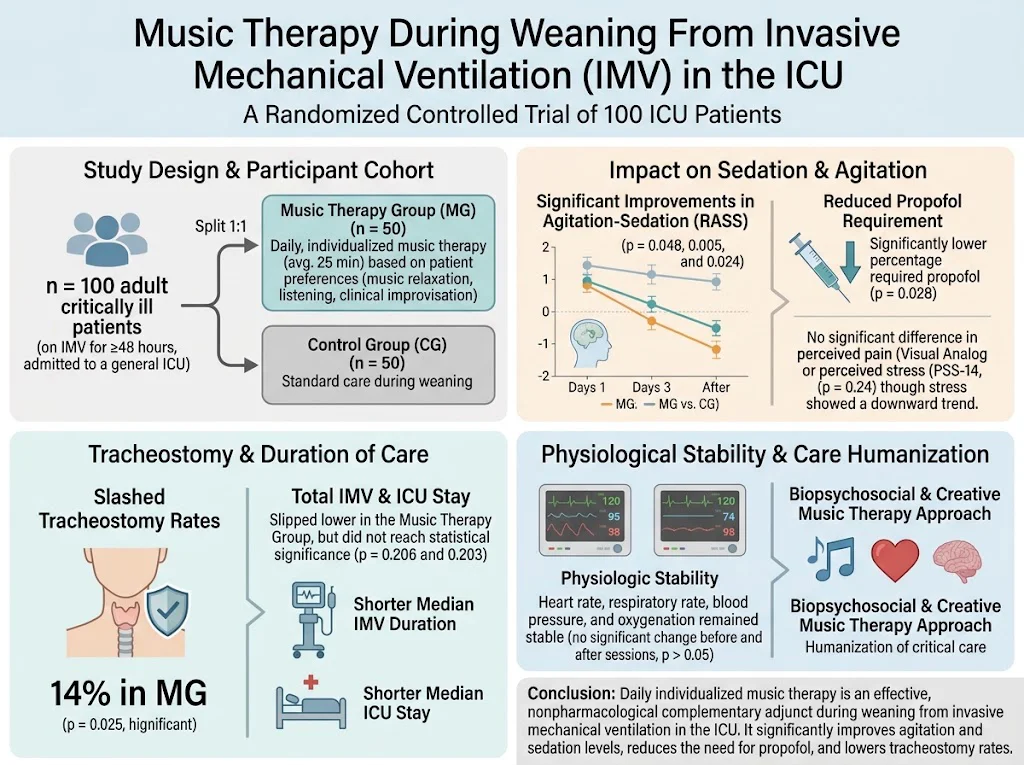
This study was a prospective randomized controlled trial conducted in a general ICU involving 100 adult critically ill patients who had received invasive mechanical ventilation for at least 48 hours. Participants were randomized into two parallel groups:
- Control group: received standard care during weaning from IMV.
- Music therapy group (MG): received standard care plus daily individualized music therapy sessions lasting approximately 25 minutes. The sessions were designed according to patients’ specific needs and musical preferences and included components such as music relaxation, passive listening, and clinical improvisation tailored to alleviate distress.
The primary endpoint was duration of weaning from IMV. Secondary endpoints included agitation and sedation levels (measured with the Richmond Agitation-Sedation Scale, RASS), doses of sedation and analgesics, pain levels (Visual Analog Scale), delirium incidence, perceived stress assessed by the Perceived Stress Scale-14 (PSS-14) after 90 days, tracheostomy rates, as well as total IMV and ICU length of stay. Vital physiologic parameters were recorded before and after music therapy sessions.
Key Findings
Primary Outcome – Weaning Duration: No statistically significant difference was found in the duration of weaning from IMV between the music therapy group and the control group (p = 0.97), indicating music therapy did not accelerate extubation timelines in this cohort.
Agitation and Sedation: The MG demonstrated significantly improved agitation and sedation levels as measured by the RASS on days 1 and 3 of intervention (p values ranging from 0.005 to 0.048). Notably, a smaller proportion of patients in the MG required propofol (p = 0.028), suggesting music therapy contributed to reduced sedation medication needs, which may have favorable safety implications.
Pain and Stress: There were no significant differences in perceived pain scores between groups. However, trends favored the MG with lower PSS-14 scores at 90 days (p = 0.24), implying potential long-term stress reduction benefits although lacking statistical significance here.
Tracheostomy Rates and Lengths of Stay: A significant reduction in tracheostomy rates was observed in the MG (14% vs. higher in control; p = 0.025), suggesting that music therapy may reduce the need for this invasive airway intervention. Median total IMV and ICU stay durations were shorter in the MG but did not reach statistical significance (p = 0.206 and 0.203, respectively).
Physiologic Parameters: Heart rate, respiratory rate, blood pressure, and oxygen saturation did not show significant changes before and after music therapy sessions, indicating hemodynamic stability during intervention.
Expert Commentary
This trial adds to the growing evidence supporting music therapy as a safe, non-invasive adjunctive approach that can beneficially modulate agitation and sedation during the challenging weaning period in ventilated ICU patients. The significant reduction in sedation requirements and tracheostomy rates is clinically meaningful, particularly in a patient group where oversedation and prolonged ventilation carry risks.
Nonetheless, the absence of benefit on the primary endpoint (weaning duration) suggests music therapy alone may not expedite liberation from mechanical ventilation. The complex multifactorial nature of weaning likely limits the impact of any single modality. Further, the study’s sample size and variability may have influenced detectability of differences in ICU length of stay or long-term stress outcomes.
Mechanistically, music therapy’s capacity to reduce sympathetic nervous system activity and anxiety could explain the observed lower sedation needs and reduced agitation. The significantly lower tracheostomy rate is particularly intriguing and may relate to better respiratory mechanics and patient cooperation enabled by reduced distress.
Future investigations should explore optimal timing, session frequency, and integration of music therapy within multidisciplinary weaning protocols, as well as screening for subpopulations most likely to benefit. Incorporating biomarkers of stress and detailed neurocognitive evaluations could elucidate mechanisms and durability of effects. Importantly, this study highlights the value of a biopsychosocial, humanized approach in critical care that fosters patient-centeredness beyond pure physiologic targets.
Conclusion
Daily individualized music therapy during weaning from invasive mechanical ventilation appears to be a valuable complementary intervention, improving sedation management, lowering agitation, and reducing the frequency of tracheostomy among ICU patients. Although it did not shorten weaning duration, it potentially improves patient comfort and long-term stress outcomes while promoting the humanization of critical care. Larger multicenter trials are warranted to confirm these findings and optimize implementation strategies.
Funding and Registration
The study was published in Critical Care Medicine on October 21, 2026, by Pereiro et al. No specific funding or clinical trial registration is noted in the abstract. Further details should be sought in the full publication.
References
- Pereiro S, Corral E, Del Campo P, et al. Music Therapy During Weaning From Invasive Mechanical Ventilation in the ICU: A Randomized Controlled Trial. Crit Care Med. 2026; PMID: 42904879.
- Chlan LL, Engeland WC, Anthony R, et al. Influence of music on the anxiety and sedative requirement in mechanically ventilated patients. Crit Care Nurse. 2013;33(2):15-25. doi:10.4037/ccn2013114.
- Bradt J, Dileo C, Grocke D, Magill L. Music interventions for mechanically ventilated patients. Cochrane Database Syst Rev. 2010;(12):CD006902. doi:10.1002/14651858.CD006902.pub2.
- Simons KS, Verweij E, van den Boogaard M, et al. Effects of music intervention on physiological stress response and anxiety in mechanically ventilated intensive care patients. Crit Care. 2018;22(1):253.
Specialty calculators
For clinical reference; use professional judgment.