Highlight
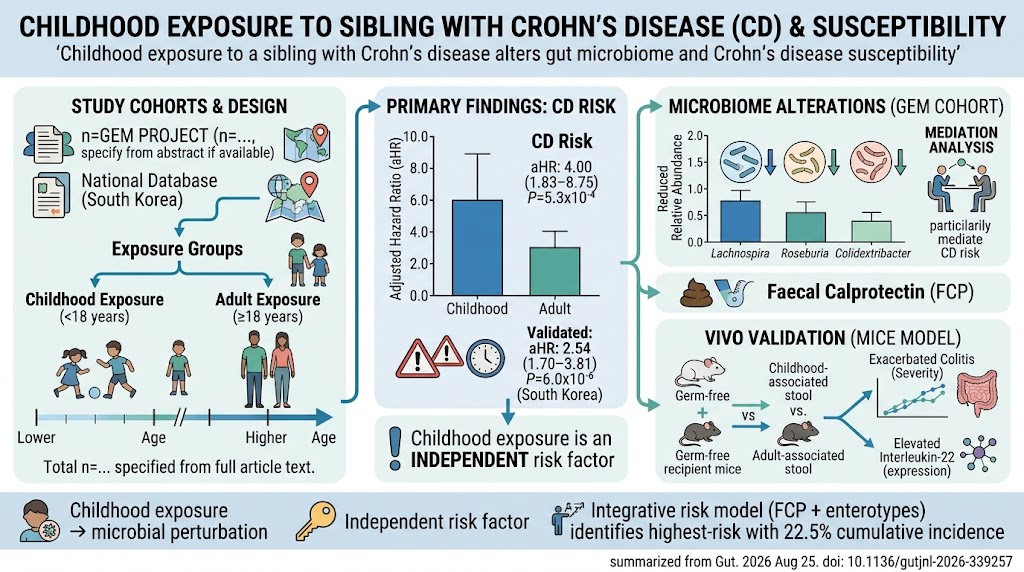
- Children exposed to siblings with Crohn’s disease (CD) have a fourfold increased risk of developing CD compared to those exposed in adulthood.
- Distinct gut microbial changes, including reduced Lachnospira, Roseburia, and Colidextribacter, partially mediate this increased risk.
- Transfer of microbiota from childhood-exposed siblings worsens colitis and modulates mucosal immunity in germ-free mouse models.
- A predictive model combining fecal calprotectin and microbial enterotypes identifies high-risk siblings with up to 22.5% 10-year incidence of CD.
Study Background
Crohn’s disease (CD) is a chronic inflammatory bowel disease with a complex interplay of genetic, environmental, and microbial factors contributing to its pathogenesis. Family members of affected individuals, particularly siblings, are known to harbor a higher risk of developing CD, yet the mechanisms through which familial exposure influences disease susceptibility remain incompletely understood. The gut microbiome has gained attention as a crucial mediator in this risk, influencing intestinal immune responses and barrier functions. Understanding how early-life exposures within families shape the microbiome and disease risk could inform preventive strategies and therapeutic targets.
Study Design
This study leveraged data from two large cohorts: the Genetic Environmental Microbial (GEM) Project and a nationwide South Korean database. It assessed the association between timing of sibling exposure to CD (childhood vs. adulthood) and subsequent CD onset. In the GEM cohort, the gut microbiome profiles of siblings with childhood versus adult exposure were analyzed. To investigate causality, fecal samples from these groups served as inocula in a T-cell transfer model of colitis in germ-free mice. Additionally, the researchers developed an integrative risk prediction model combining fecal calprotectin (FCP), a marker of intestinal inflammation, with microbiome-derived enterotypes, validated internally within the GEM cohort.
Key Findings
Increased Risk with Childhood Exposure
Childhood exposure to a sibling with CD was associated with a significantly higher risk of developing CD compared to adult exposure, with an adjusted hazard ratio (aHR) of 4.00 (95% CI 1.83–8.75; p=5.3×10⁻⁴) in the GEM cohort. This finding was independently validated in the South Korean cohort (aHR 2.54; 95% CI 1.70–3.81; p=6.0×10⁻⁶), indicating robustness across diverse populations.
Microbial Alterations Linked to Exposure
Microbial profiling revealed that childhood exposure correlated with reduced relative abundances of several short-chain fatty acid-producing bacteria, namely Lachnospira, Roseburia, and Colidextribacter. Mediation analyses suggested these microbial shifts partially explain the increased CD susceptibility, reinforcing the gut microbiome’s role as a mechanistic link.
Experimental Confirmation in Animal Model
Transferring fecal microbiota from childhood-exposed siblings into germ-free mice significantly exacerbated colitis severity and simultaneously elevated mucosal interleukin-22 (IL-22) expression. IL-22 is known to modulate mucosal immunity and epithelial repair, implicating microbial-immune interactions in triggering or amplifying intestinal inflammation.
Risk Prediction Model
The combined clinical-microbial risk model identified siblings with elevated fecal calprotectin and specific enterotypes enriched for Blautia or Prevotella as having the highest risk, with a projected 10-year cumulative CD incidence of 22.5%. This model may aid early identification of at-risk individuals for closer monitoring or preventive interventions.
Expert Commentary
This study compellingly links familial environmental exposure during childhood to Crohn’s disease risk, mediated through gut microbial alterations. It advances the concept that the timing of exposure and early-life microbial ecology critically shape immune development and disease trajectories. The integration of human cohort data with mechanistic mouse studies strengthens causal inference, highlighting the translational potential of microbiome-modulating strategies.
Limitations include reliance on observational cohort data for epidemiologic associations, which could be influenced by unmeasured confounders such as diet or antibiotic use. The gut microbiome varies geographically and ethnically, potentially affecting generalizability despite the inclusion of diverse populations. Further longitudinal studies are needed to monitor microbiome evolution before CD onset and confirm biomarkers.
Conclusion
Early childhood exposure to siblings with Crohn’s disease is a significant, independent risk factor for developing CD, likely mediated by gut microbiome perturbations that influence intestinal immune responses. Identifying high-risk individuals through combined microbial and inflammatory biomarkers offers a promising approach for early intervention. This research underscores the importance of the early-life microbial environment in shaping chronic intestinal disease susceptibility and paves the way for microbiome-targeted preventive and therapeutic strategies in familial CD contexts.
Funding and ClinicalTrials.gov
The study was funded by grants supporting the GEM Project and affiliated research institutions. Clinical trials registrations related to GEM or associated interventions were not specified in the reported study.
References
Chen R, Kim HJ, Bushra M, Dang CP, Li Q, Espin-Garcia O, et al. Childhood exposure to a sibling with Crohn’s disease alters gut microbiome and Crohn’s disease susceptibility. Gut. 2026 Aug 25. PMID: 42642218. https://pubmed.ncbi.nlm.nih.gov/42642218/
Additional relevant literature:
1. Lloyd-Price J, et al. Multi-omics of the gut microbial ecosystem in inflammatory bowel diseases. Nature. 2019;569(7758):655–662.
2. Knights D, et al. Complex host genetics influence the microbiome in inflammatory bowel disease. Genome Med. 2014;6(12):107.
3. Levine A, et al. Pediatric Crohn’s disease: advances and future directions. Nat Rev Gastroenterol Hepatol. 2021;18(2):101–114.