Highlight
– Placenta-derived small extracellular vesicles (P-sEVs) in maternal blood exhibit altered lipid profiles and physical characteristics in type 1 diabetes (T1D) pregnancies.
– Lipidomic trajectories in P-sEVs differ significantly during gestation between normoglycemic and T1D pregnancies, reflecting disrupted placental metabolic adaptation.
– Specific lipid species in P-sEVs associate strongly with fetal hyperinsulinemia assessed by cord blood C-peptide, indicating potential for minimally invasive fetal metabolic status monitoring.
– These findings provide novel insights into placental pathophysiology in T1D and potential biomarkers for fetal risk stratification.
Study Background
Pregnancy requires intricate metabolic adaptations within the placenta to support fetal growth and development. The placenta dynamically modulates nutrient transport, hormone synthesis, and energy metabolism across gestation. In pregnancies complicated by type 1 diabetes (T1D), characterized by preexisting maternal insulin deficiency and hyperglycemia, placental metabolism is likely dysregulated. This dysregulation may underlie adverse fetal metabolic outcomes such as fetal hyperinsulinemia and increased risk of macrosomia. Despite its clinical significance, the precise alterations in placental metabolic pathways during T1D pregnancy and their temporal dynamics remain insufficiently understood. Gaining minimally invasive insights into placental metabolism may improve monitoring and intervention strategies to optimize maternal-fetal health.
Study Design
This prospective longitudinal cohort study incorporated data from the Ontario Birth Study and the Continuous Glucose Monitoring in Pregnant Women with Type 1 Diabetes (CONCEPTT) study. Maternal plasma samples were collected at three gestational timepoints (10-14 weeks, 24-32 weeks, and 34-40 weeks) from 200 normoglycemic pregnant individuals and 151 pregnant individuals with preexisting T1D. Placenta-derived small extracellular vesicles (P-sEVs), which are nanosized vesicles secreted by placental cells into the maternal circulation, were isolated and characterized. Shotgun mass spectrometry-based lipidomics was employed to quantitatively profile lipid species within these vesicles. Multivariate statistical analyses and machine learning methods were applied to identify gestational lipid trajectory differences and explore associations with maternal and fetal clinical parameters, including cord blood C-peptide as a marker of fetal endogenous insulin secretion.
Key Findings
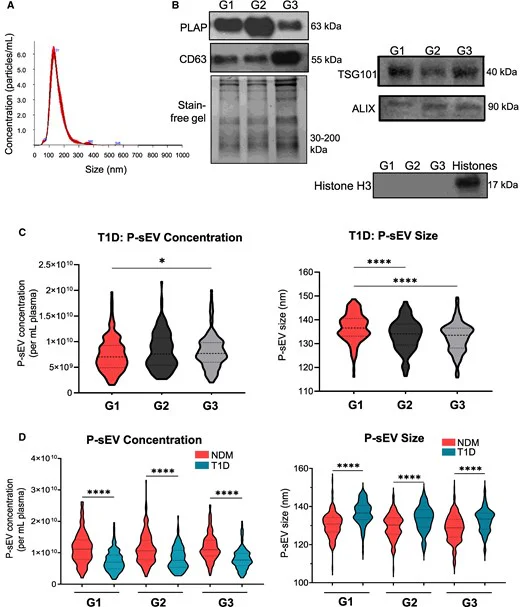
Altered Physical Characteristics of Placental sEVs in T1D: P-sEVs isolated from T1D pregnancies demonstrated increased average vesicle size and reduced overall abundance compared to normoglycemic controls. These physical changes may indicate alterations in placental vesicle biogenesis and secretion linked to diabetic metabolic stress.
Divergent Gestational Lipidomic Trajectories: Careful longitudinal profiling of lipid species in P-sEVs revealed significant differences between T1D and control pregnancies. The magnitude, direction, and timing of changes in key lipid classes involved in membrane remodeling (e.g., phospholipids) and bioactive signaling lipids varied markedly. This disruption suggests impaired metabolic adaptation mechanisms within the placenta during diabetic pregnancy.
Lipid Biomarkers Correlate with Fetal Hyperinsulinemia: Certain lipid species within P-sEVs discriminated pregnancies with high versus low cord blood C-peptide levels with strong accuracy (area under the curve, 0.85). This finding highlights a potential role for P-sEV lipid profiling as a minimally invasive biomarker to assess fetal metabolic state, particularly fetal pancreatic insulin secretion, which has implications for predicting neonatal hypoglycemia risk and future metabolic health.
Expert Commentary
The innovative use of placenta-derived extracellular vesicles as molecular proxies to monitor placental metabolic status presents a significant advance in perinatal research. Lipidomics, by capturing dynamic shifts in metabolic pathways, offers a mechanistic understanding of placental dysfunction in T1D beyond traditional glucose-centric models. The strong association between specific placental lipid signatures and fetal insulin secretion supports the biological plausibility of disrupted lipid metabolism affecting in utero programming.
Study strengths include its prospective design, large sample size, and integration of advanced lipidomic and machine learning techniques. Nonetheless, limitations warrant discussion. The observational nature precludes causal inference, and potential confounders such as maternal diet or concurrent medications were not exhaustively controlled. Generalizability may be limited to the studied populations. Future studies should validate these lipid biomarkers in independent cohorts and explore whether therapeutic modulation of placental lipid pathways can improve fetal outcomes in T1D pregnancies.
Conclusion
This study provides compelling evidence that placental metabolic adaptation is substantially disrupted in pregnancies affected by type 1 diabetes, as revealed by multidimensional lipidomic analysis of circulating placenta-derived small extracellular vesicles. The altered lipid trajectories correlate with fetal hyperinsulinemia at birth, underscoring the clinical relevance of these molecular changes. P-sEV lipid profiling holds promise as a noninvasive biomarker platform to monitor placental health and fetal metabolic risk in diabetic pregnancies, offering opportunities for precision monitoring and intervention. Further research to translate these findings into clinical practice is warranted.
Funding and ClinicalTrials.gov Registration
This research was conducted within the Ontario Birth Study and CONCEPTT collaborations. Specific funding sources were not detailed in the publication. The CONCEPTT study is registered at ClinicalTrials.gov (NCT02035045).
References
1. Klemetti MM, Li J, Alahari S, et al. Lipidomes of placenta-derived extracellular vesicles reveal disrupted metabolic adaptation in type 1 diabetes. J Clin Endocrinol Metab. 2026 Oct 30;PMID: 42961822.
2. Feig DS, Hwee J, Shah BR, et al. Continuous Glucose Monitoring in Pregnant Women with Type 1 Diabetes (CONCEPTT): A Multicenter Randomized Controlled Trial. Lancet. 2017;389(10085):2334-2345.
3. Salomon C, Torres MJ, Johnson MR. Placental Extracellular Vesicles and Fetal Programming in Gestational Diabetes Mellitus: Current Insights and Future Directions. Mol Aspects Med. 2022;81:101005.
4. Quek CYJ, Salomon C, Kobayashi M, et al. Lipidomic Profiling of Extracellular Vesicles from Human Placenta in Gestational Diabetes. Diabetologia. 2021;64(11):2477-2486.
Specialty calculators
For clinical reference; use professional judgment.