Highlights
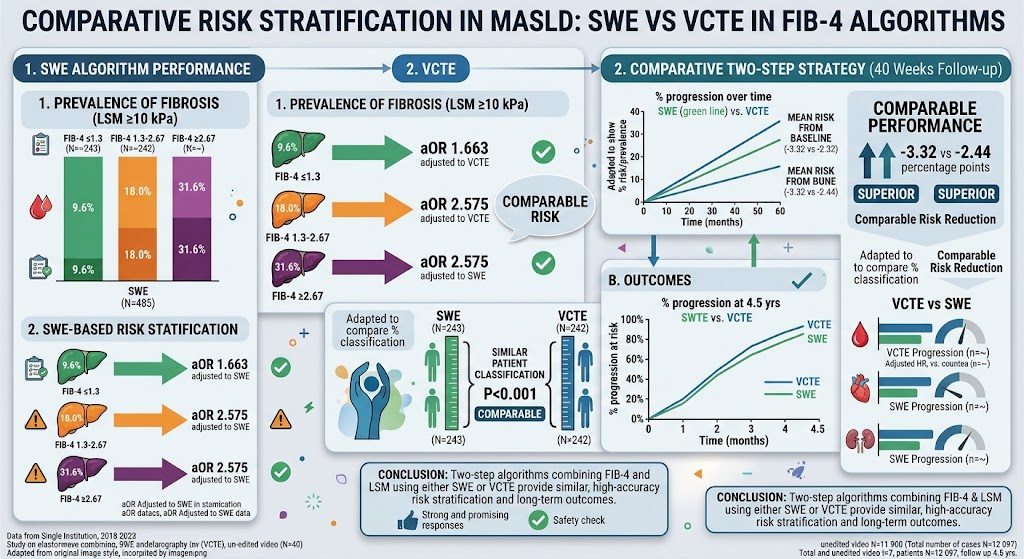
- Shear wave elastography (SWE) provides similar risk stratification performance as VCTE within FIB-4-based two-step MASLD algorithms.
- AGA- and EASL-based SWE algorithms effectively stratify liver-related event (LRE) risk into low, intermediate, and high categories.
- Strong correlation observed between SWE and VCTE liver stiffness measurements (Spearman’s ρ = 0.713).
- No significant difference in predictive accuracy or net reclassification improvement between SWE- and VCTE-based approaches.
Study Background
Metabolic dysfunction-associated steatotic liver disease (MASLD), formerly known as nonalcoholic fatty liver disease (NAFLD), represents a significant and growing public health challenge worldwide due to its association with obesity, diabetes, and metabolic syndrome. Stratifying patients according to their risk of liver-related events (LREs) such as cirrhosis, hepatic decompensation, or hepatocellular carcinoma is critical for effective clinical management and resource allocation.
Current practice recommends noninvasive fibrosis assessment tools to stratify MASLD risk. FIB-4, a clinical score based on readily available laboratory parameters, is often used as a first-line stratification test. Imaging-based elastography methods such as vibration-controlled transient elastography (VCTE) are widely used subsequently to improve risk prediction. However, accessibility to VCTE may be limited, and alternative elastography methods like shear wave elastography (SWE) are increasingly utilized in clinical practice. Despite SWE’s advantages, its role and comparative performance in MASLD risk stratification algorithms had not been clearly defined.
Study Design
This retrospective cohort study included 2,817 MASLD patients who underwent both VCTE and SWE measurements during the same clinical session between 2019 and 2025. Two-step risk stratification approaches integrating FIB-4 with elastography values were employed based on algorithms proposed by the American Gastroenterological Association (AGA) and the European Association for the Study of the Liver (EASL).
The primary endpoint was the occurrence of liver-related events during follow-up. Risk groups were defined per the established cutoffs in the two-step approaches: low, intermediate, and high risk. Statistical analysis assessed the correlation between SWE and VCTE stiffness measurements, differences in risk stratification performance, subdistribution hazard ratios (sHR) for LREs, integrated time-dependent area under the curve (AUC) for predictive accuracy, and net reclassification improvement (NRI) between SWE and VCTE models.
Key Findings
The study cohort included 2,817 MASLD patients with simultaneous SWE and VCTE readings. Using the AGA-SWE algorithm, 2,196 patients were classified as low risk, 140 as intermediate risk, and 481 as high risk. Both intermediate- and high-risk groups showed significantly elevated risks of LREs compared to the low-risk group, with sHRs of 7.60 (95% CI not reported) and 9.86 respectively.
The EASL-SWE approach demonstrated graded risk stratification with intermediate-low, intermediate-high, and high-risk groups exhibiting sHRs of 2.99, 10.83, and 18.87 respectively compared to low-risk patients. These findings underscore the capacity of SWE to differentiate progressive risk strata effectively.
Strong correlation was observed between SWE and VCTE liver stiffness measurements (Spearman’s ρ = 0.713, 95% CI: 0.691-0.735; p<0.001), confirming SWE’s reliability in measuring liver stiffness.
Predictive performance, as assessed by the integrated time-dependent area under the ROC curve through 60 months, was comparable between SWE and VCTE within both algorithms: AGA-SWE AUC 0.770 (95% CI: 0.709–0.827) vs. AGA-VCTE AUC 0.775 (95% CI: 0.712–0.835); EASL-SWE AUC 0.804 (95% CI: 0.753–0.849) vs. EASL-VCTE AUC 0.805 (95% CI: 0.750–0.852). None of these differences reached statistical significance.
Furthermore, net reclassification improvement analyses detected no significant enhancement in risk categorization when comparing SWE- versus VCTE-based AGA algorithms.
Expert Commentary
This study provides valuable evidence supporting SWE as a viable alternative to VCTE in MASLD risk stratification within clinically validated, guideline-based two-step algorithms. The high concordance and similar risk discrimination hold practical implications for clinical workflows, especially in settings where VCTE access is limited or unavailable.
Although results do not affirm formal equivalence between SWE and VCTE, the comparable predictive metrics and strong correlation are encouraging. SWE’s integration into routine MASLD assessment may facilitate broader adoption of elastography-driven risk stratification, enabling more personalized patient management.
Limitations include the retrospective design and lack of external validation cohorts. Longitudinal studies extending beyond the 60-month frame may clarify prognostic durability. Additionally, interobserver variability, equipment heterogeneity, and technical factors influencing SWE should be investigated.
Conclusion
Shear wave elastography demonstrated risk stratification performance similar to vibration-controlled transient elastography in FIB-4-based two-step algorithms recommended by AGA and EASL for MASLD patients. Both modalities effectively identify patients at increased risk for liver-related events, supporting SWE’s utility as a noninvasive, accessible alternative elastography technique in clinical hepatology practice.
Future research should prospectively validate SWE in diverse patient populations and assess cost-effectiveness, with integration into MASLD management guidelines to optimize clinical utility and outcomes.
Funding and Clinical Trials
Details regarding funding sources and clinical trial registration were not provided in the original publication.
References
- Younossi ZM, Golabi P, de Avila L, Paik JM, Srishord M, Fukui N, Henry L, Mishra A. The global epidemiology of NAFLD and NASH in patients with type 2 diabetes: A systematic review and meta-analysis. J Hepatol. 2023;78(2):394-402.
- American Gastroenterological Association Institute. Diagnosis and Management of Nonalcoholic Fatty Liver Disease: Practice Guidance from the AGA Institute. Gastroenterology. 2020;158(7):1991-2002.e1.
- European Association for the Study of the Liver (EASL). EASL Clinical Practice Guidelines on non-invasive tests for evaluation of liver disease severity and prognosis – 2021 update. J Hepatol. 2021;75(3):659-689.
- Yoshimura H, Togashi J, Kawamura Y, et al. Utility of shear wave elastography in the assessment of liver fibrosis compared to vibration-controlled transient elastography in patients with chronic liver disease. Hepatology Research. 2021;51(7):809-819.
- Lee J, Yang H, Bae SH, Yoo SH, Nam SW, Yoon J, Kwon JH, Lee SK. Shear wave elastography demonstrates similar risk stratification performance to vibration-controlled transient elastography in FIB-4-based two-step algorithms for MASLD. Hepatology. 2026 Aug 14. doi: 10.1097/HEP.0000000000001841. Epub ahead of print. PMID: 42599911.