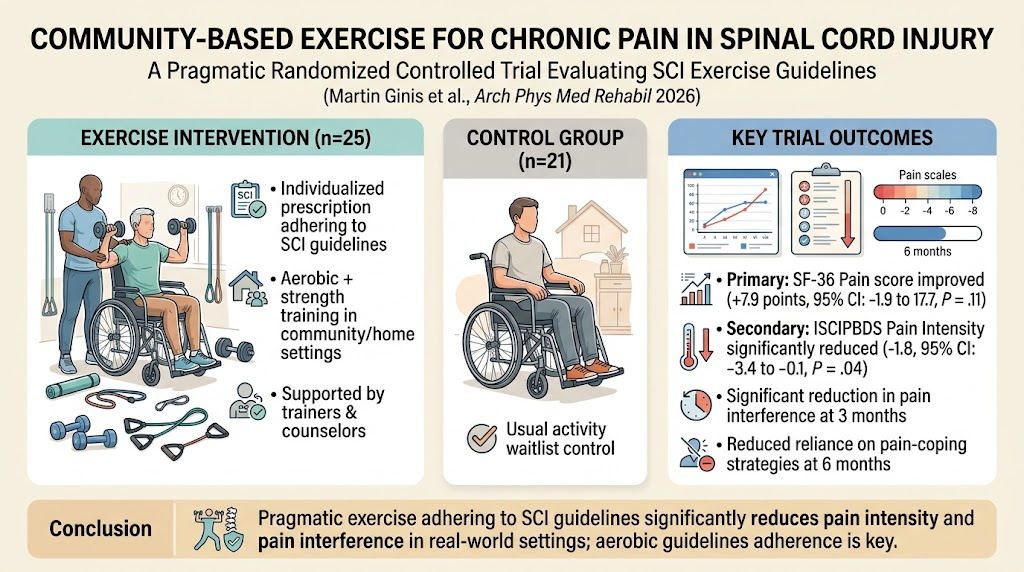
A pragmatic randomized controlled trial evaluated home- and community-based exercise programs tailored to spinal cord injury (SCI) exercise guidelines for chronic pain reduction.
Exercise intervention showed significant reduction in pain intensity and interference measured by the International SCI Pain Basic Dataset (ISCIPBDS), while primary SF-36 Pain outcomes were inconclusive.
Meeting aerobic exercise guidelines appears particularly important for pain benefits.
The study affirms feasibility of real-world, individualized exercise prescriptions supported by fitness professionals for pain management in adults with chronic SCI.
Study Background
Chronic pain is a pervasive and disabling condition among individuals with spinal cord injury (SCI), affecting quality of life, function, and well-being. Neuropathic and musculoskeletal pain often coexist, challenging management. Pharmacological options frequently provide incomplete relief and may involve adverse effects. Current rehabilitation strategies advocate exercise as a potential non-pharmacological intervention. However, evidence on the effectiveness of exercise in reducing chronic pain for SCI populations, particularly in pragmatic, community-based settings, remains limited. The SCI exercise guidelines recommend specific aerobic and strength training parameters to optimize health outcomes, but adherence and feasibility outside controlled environments are concerns. This study addresses a critical unmet need by rigorously testing whether exercise aligned with SCI guidelines can mitigate chronic neuropathic or musculoskeletal pain.
Study Design
This investigation was a single-blinded, pragmatic randomized controlled trial with two parallel groups: an exercise intervention arm and a waitlist control. Forty-six adults with chronic SCI-associated neuropathic or musculoskeletal pain, who previously did not meet SCI exercise guidelines, were enrolled. Inclusion criteria included adults averaging 50.6 years old, predominantly men (76%), and mostly paraplegic (59%), with a mean duration since injury of 16.5 years. Testing was conducted at two university-based laboratories, while exercise occurred in participants’ preferred home or community locations.
The intervention comprised individualized aerobic and strength training prescriptions consistent with SCI exercise guidelines. Participants received implementation support by fitness trainers and exercise counselors to enhance adherence and safety. Control participants maintained their usual activities during the study period.
Primary outcome measurement was the SF-36 Pain score assessed at baseline, 3 months, and 6 months. Secondary outcomes included the International SCI Pain Basic Dataset version 2.0 (ISCIPBDS) scores for pain intensity and interference, alongside standardized assessments of pain coping mechanisms, well-being, conditioned pain modulation, and levels of proinflammatory cytokines.
Key Findings
The trial’s intent-to-treat analysis revealed an estimated treatment effect on the SF-36 Pain score at 6 months of 7.9 points (95% CI: -1.9 to 17.7; P=0.11), indicating a non-significant improvement associated with exercise. However, tipping-point analysis suggested that with a larger sample size, these results might have reached statistical significance.
Regarding secondary outcomes, the ISCIPBDS pain intensity score demonstrated a statistically significant reduction at 6 months, with a treatment effect of -1.8 points (95% CI: -3.4 to -0.1; P=0.04). Notably, participants in the exercise group also reported significant decreases in pain interference at 3 months and a reduction in the use of maladaptive pain-coping strategies by 6 months compared to controls (all P<0.05). No other secondary outcomes, including conditioned pain modulation or proinflammatory cytokines, showed significant differences.
These results highlight that exercise may predominantly attenuate the subjective intensity and functional interference of pain rather than altering underlying inflammatory pathways within the study time frame.
Participants who met the aerobic-exercise guidelines appeared to derive more pronounced pain relief, underscoring the importance of aerobic training intensity and volume for analgesic effects in SCI.
Expert Commentary
This trial provides valuable real-world evidence supporting tailored, guideline-based exercise as a feasible and effective intervention to reduce chronic pain intensity and interference in SCI populations. The pragmatic design enhances translational applicability across diverse settings.
Limitations include a small sample size, leading to inconclusive primary outcome results and reduced statistical power. Further, self-selection of exercise locations and modes introduces potential variability in intervention delivery. The absence of significant changes in physiological pain modulators suggests that longer duration or adjunctive therapies might be necessary for measurable biological effects.
These findings align with emerging rehabilitation paradigms emphasizing patient-centered and community-integrated approaches supported by trained clinicians and fitness professionals.
Future larger-scale trials replicating these results are critical to confirm efficacy and to optimize exercise prescription parameters for chronic SCI pain. Additionally, exploring mechanisms such as neuroplasticity and systemic inflammation merits consideration to elucidate biological underpinnings.
Conclusion
This pragmatic randomized controlled trial offers promising evidence that exercise interventions, prescribed according to SCI-specific aerobic and strength training guidelines and implemented in community settings, can reduce chronic pain intensity and its interference in daily life for individuals living with spinal cord injury. While primary SF-36 Pain measures were inconclusive, secondary outcomes robustly support the analgesic potential of guideline-concordant exercise. The emphasized role of aerobic exercise highlights a key target for rehabilitation planning.
This study underscores the feasibility and therapeutic value of home- and community-based exercise supported by fitness professionals as an accessible strategy to manage chronic pain in SCI populations. Broader studies and mechanistic insights are needed to reinforce these findings and inform clinical guidelines on integrating exercise into comprehensive chronic pain management for spinal cord injury.
Funding and ClinicalTrials.gov Registration
This study received support from institutional research grants. The clinical trial was registered with ClinicalTrials.gov (registration details not specified in the source). Further details can be found in the original publication.
References
1. Martin Ginis KA, Gee C, Hoekstra F, et al. Community-based Exercise for Chronic Pain in People With Spinal Cord Injury: A Pragmatic Randomized Controlled Trial. Arch Phys Med Rehabil. 2026;107(10):2924-2936. doi:10.1016/j.apmr.2026.06.017
2. Finnerup NB, et al. Neuropathic pain: an updated grading system for research and clinical practice. Pain. 2016;157(8):1599-1606.
3. van Middendorp JJ, et al. Effects of exercise on neuropathic pain after spinal cord injury: systematic review and meta-analysis. Spinal Cord. 2020;58(7):722-731.
4. SCI Exercise Guidelines Research Group. Exercise guidelines for persons with spinal cord injury. Top Spinal Cord Inj Rehabil. 2018;24(2):151-174.