Highlight
This study examines outcomes at a minimum five-year follow-up for patients undergoing combined endoscopic repair of the gluteus medius/minimus tendons along with arthroscopic hip labral repair compared to isolated labral repair. Key highlights include significant improvement in patient-reported outcomes (PROs) in both groups, no significant differences in PROs or rates of clinically meaningful improvement, and comparable reoperation-free survival between groups, despite greater baseline abductor tendon pathology in the combined repair cohort.Study Background
Hip joint pathologies often present a complex clinical scenario when accompanied by both intra-articular issues, such as acetabular labral tears, and extra-articular soft tissue abnormalities, including tears of the gluteus medius and minimus tendons. The acetabular labrum plays a critical role in hip joint stability and congruence, and its tear is a common cause of hip pain and dysfunction. Concurrently, gluteal tendon tears, particularly involving the medius and minimus muscles, contribute to lateral hip pain and gait disturbances. Advances in minimally invasive arthroscopic and endoscopic surgical techniques have enabled the simultaneous management of these coexisting pathologies in a single procedural setting. While previous studies have reported favorable short- to long-term outcomes for combined repairs, there remains a paucity of data examining mid-term outcomes and how they compare to isolated labral repair, especially with appropriate adjustment for confounders such as age, sex, and body mass index (BMI).Study Design
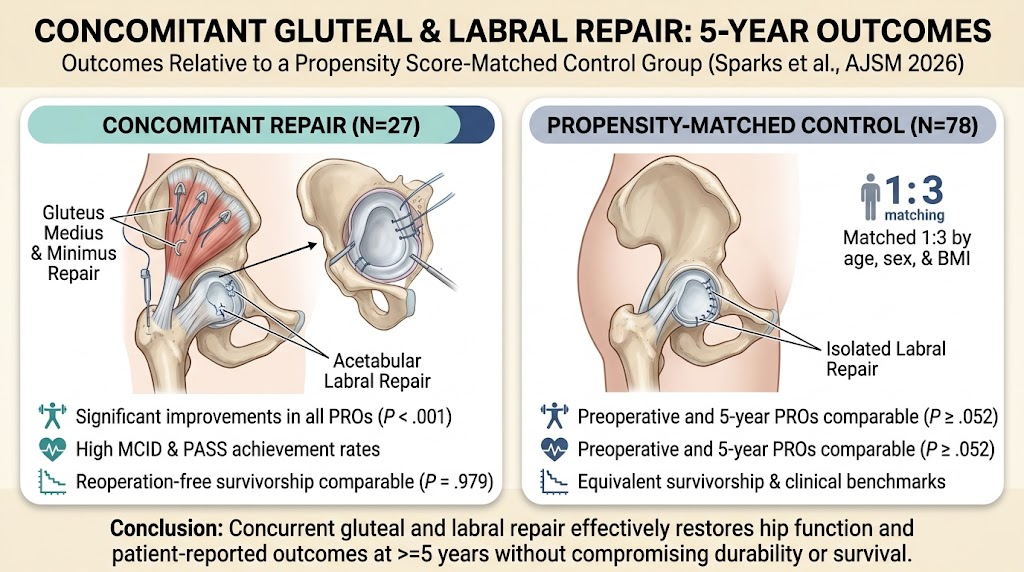
This retrospective cohort study included patients who underwent concomitant endoscopic repair of the gluteus medius and/or minimus tendons and arthroscopic labral repair between January 2012 and November 2019, with a minimum follow-up duration of five years. A propensity score matching technique was employed to match 27 patients in the combined repair group with 78 patients who underwent isolated labral repair, balanced on age, sex, and BMI to minimize bias. Patient-reported outcomes assessed included the Hip Outcome Score-Activities of Daily Living (HOS-ADL), Hip Outcome Score-Sports Subscale (HOS-SS), modified Harris Hip Score (mHHS), 12-item International Hip Outcome Tool (iHOT-12), and visual analog scales (VAS) for pain and satisfaction. Outcomes were recorded preoperatively and at the ≥5-year postoperative mark. The study evaluated the achievement of minimal clinically important differences (MCID) and patient acceptable symptom states (PASS) for each PRO measure. Additionally, reoperation-free survival analyses were performed.Key Findings
Both patient groups demonstrated significant improvement in all measured PROs from baseline to minimum five-year follow-up (P < .001 for all). There were no statistically significant differences between the groups in any PRO measures before surgery or at the five-year evaluation (preoperative P≥ .184; postoperative P≥ .052). The rates of achieving MCID and PASS for individual PRO instruments did not differ significantly between groups (MCID P≥ .513; PASS P≥ .063). When considering any single PRO measure, no significant differences in MCID or PASS achievement were observed at follow-up (MCID P = .673; PASS P = .408). Furthermore, Kaplan-Meier survival analyses showed comparable reoperation-free survival between patients receiving combined gluteal and labral repair and those undergoing isolated labral repair (P = .979). This finding is notable considering the combined group initially exhibited a greater burden of abductor tendon pathology.Expert Commentary
The findings support that the endoscopic repair of gluteus medius and minimus tendon tears when performed concomitantly with arthroscopic labral repair can effectively restore hip function and ameliorate pain to levels comparable with isolated labral repair even in the mid-term postoperative period. This synergy likely relates to addressing both the intra-articular and extra-articular sources of hip pain and dysfunction, which often coexist. By utilizing propensity score matching, the study robustly adjusted for confounding demographic variables, increasing the validity of comparisons. However, limitations include the retrospective design, relatively small sample size for the combined repair group, and lack of randomized allocation. Also, imaging or biomechanical assessments to objectively verify tendon healing or labral integrity were not reported, which would provide additional mechanistic insights. These results align with contemporary literature advocating for comprehensive evaluation and surgical management of concomitant hip pathologies to optimize patient outcomes. Further prospective, larger-scale studies with standardized imaging and function assessments could help delineate the long-term durability and cost-effectiveness of combined repair strategies.Conclusion
At a minimum of five years following surgery, patients undergoing concomitant endoscopic gluteus medius and/or minimus tendon repair with arthroscopic labral repair achieve significant, sustained improvements in hip function and pain relief. Despite a greater initial burden of abductor abnormalities in this group, their outcomes and reoperation rates are comparable to those undergoing isolated labral repair. This evidence supports the clinical benefit and durability of addressing multiple hip pathologies in a single surgical session, emphasizing the importance of appropriate surgical management of abductor tendon pathology in conjunction with labral repair for optimal patient-reported outcomes.Funding and Clinical Trials
No specific funding sources were reported for this study. The clinical trial registration status was not indicated.References
- Sparks CA, Brinkman JC, Monty TL, Nho SJ. Labral Repair With Concomitant Endoscopic Gluteus Medius and/or Minimus Repair: Outcomes at a Minimum 5-Year Follow-up Relative to a Propensity Score-Matched Control Group. Am J Sports Med. 2026 Sep 15;54(12):2907-2918. PMID: 42745409.