Highlights
- Continuous glucose monitoring (CGM) time above 140 mg/dL (TA140) closely matches OGTT 2-hour glucose in predicting progression to stage 3 type 1 diabetes (T1D).
- CGM offers practical and patient-friendly monitoring, enabling earlier and repeated assessment of metabolic deterioration in early-stage T1D.
- Key demographic and clinical factors—including young age, male sex, and HbA1c ≥ 5.7%—augment predictive models incorporating CGM and OGTT data.
- Defined TA140 thresholds offer objective criteria for staging early T1D and guiding clinical risk stratification and intervention timing.
Background
Type 1 diabetes mellitus (T1D) is a chronic autoimmune disease characterized by progressive destruction of pancreatic beta cells, leading to insulin deficiency. Early detection and staging of T1D, before symptomatic onset (stage 3), is critical for personalized disease monitoring, clinical trial enrollment, and timely intervention. Traditionally, oral glucose tolerance testing (OGTT) has served as the metabolic gold standard for assessing glucose intolerance and progression risk; however, OGTT is resource-intensive, episodic, and inconvenient for patients.
Continuous glucose monitoring (CGM) technology, providing real-time, dynamic glucose data, has transformed glycemic management in established diabetes but is increasingly explored for early-stage disease prediction and monitoring. The objective measurement of CGM time above specific glycemic thresholds, such as 140 mg/dL (TA140), holds promise as a minimally invasive biomarker for beta cell dysfunction and disease progression risk.
This review synthesizes key findings from the largest combined prospective cohort of early-stage T1D individuals, comparing the predictive performance of CGM-derived TA140 against OGTT parameters and HbA1c, to inform clinical practice and future research directions.
Key Content
Study Design and Cohort Characteristics
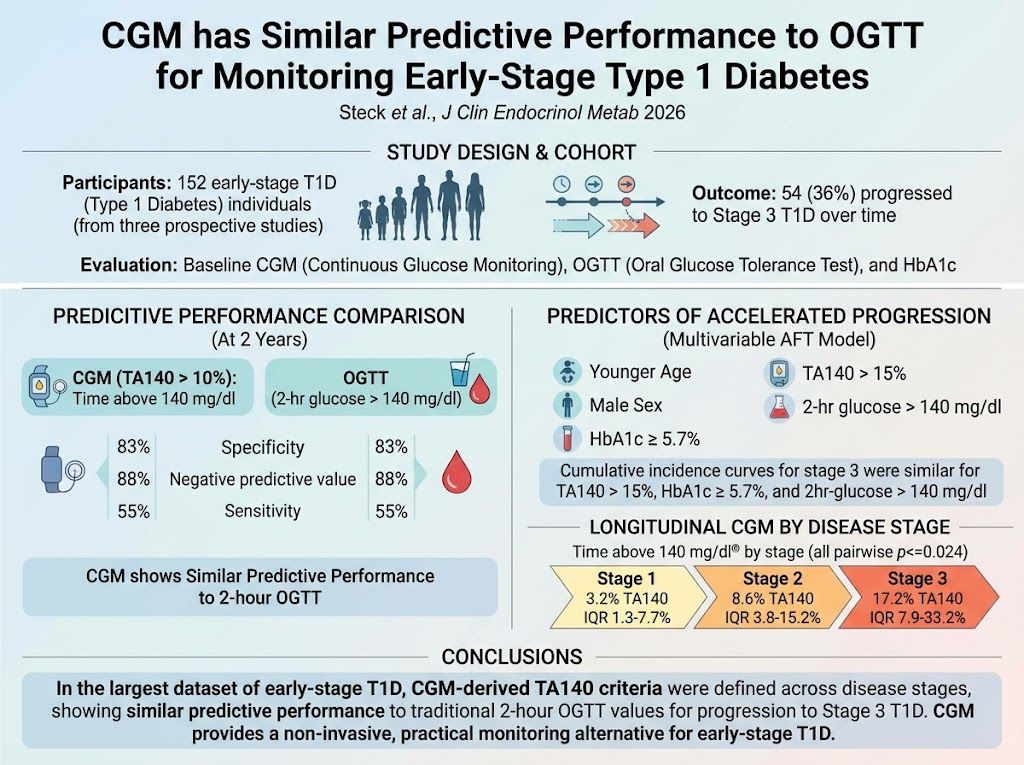
The analyzed cohort amalgamated data from three longitudinal prospective studies involving 152 individuals with early-stage T1D. Baseline assessments included CGM recordings, OGTT, and HbA1c measurements. Over a median follow-up (up to 5 years), 54 participants (36%) progressed to clinical diabetes (stage 3), enabling robust evaluation of progression predictors.
Comparative Predictive Performance of CGM and OGTT
ROC analyses revealed that CGM metric TA140 >10% time above 140 mg/dL and OGTT 2-hour glucose >140 mg/dL yielded identical specificity (83%), negative predictive value (88%), and sensitivity (55%) at the 2-year mark for predicting progression to stage 3. Importantly, other CGM metrics also significantly predicted progression at 5 years (p ≤ 0.008).
OGTT parameters including 2-hour glucose, glucose area under the curve (AUC_glucose), and C-peptide measures (AUC and peak) significantly associated with progression (p ≤ 0.021). These results underscore that CGM-derived glycemic exposure metrics provide parallel discriminatory ability to the traditional OGTT.
Multivariable Risk Modeling and Clinical Variables
Using accelerated failure time modeling, younger age, male sex, baseline HbA1c ≥5.7%, TA140 >15%, and 2-hour OGTT glucose >140 mg/dL emerged as independent and strong predictors for expedited progression to stage 3.
Kaplan-Meier analyses of cumulative progression incidence demonstrated overlapping risk curves for TA140 >15%, elevated HbA1c, and 2-hour glucose thresholds, further supporting CGM’s clinical utility.
Longitudinal CGM Profiles Across T1D Stages
Data from 406 longitudinal CGM monitors delineated a stepwise increase in median TA140 according to disease stage: 3.2% in stage 1, 8.6% in stage 2, and 17.2% in stage 3 participants, with significant pairwise differences (p ≤ 0.024). This gradation supports TA140 as a biomarker reflecting progressive beta cell dysfunction and metabolic decompensation.
Contextualizing within the Literature
Previous studies have established OGTT and autoantibody profiles as critical markers for T1D staging. Recent smaller cohorts hinted at CGM’s potential for earlier and more granular glycemic trajectory assessment. This comprehensive analysis substantiates CGM-derived TA140 as a practical surrogate marker comparable in predictive power to OGTT glucose thresholds, with added advantages of real-time monitoring and lower patient burden.
Expert Commentary
From a clinical perspective, the equivalency in predictive performance between CGM TA140 and OGTT 2-hour glucose suggests a paradigm shift is feasible in T1D early-stage monitoring. CGM affords frequent, non-invasive glycemic profiling that could replace or complement OGTT, a cumbersome test with variability in clinical utility.
The inclusion of demographic factors such as age and sex in multivariate models aligns with known epidemiologic influences on T1D progression rates, emphasizing the need to integrate clinical context with metabolic biomarkers.
Mechanistically, elevated TA140 reflects sustained postprandial and basal hyperglycemia indicative of declining beta cell reserve. The biological plausibility reinforces TA140 as not only correlative but potentially predictive of immunopathological disease acceleration.
However, challenges remain. CGM standardization across devices, optimal TA140 cutoffs for various populations, and validation in diverse demographic groups require further investigation. Also, while CGM data are abundant, analytic standardization is essential to ensure reproducibility and clinical interpretability.
Guideline bodies, including the American Diabetes Association, currently emphasize OGTT and autoantibody assessments for staging but may update recommendations as evidence accumulates supporting CGM’s role.
Conclusion
This largest combined prospective cohort to date demonstrates that CGM-derived time above 140 mg/dL is a robust predictor of progression to clinical type 1 diabetes in early-stage individuals, exhibiting performance equivalent to conventional OGTT metrics. The defined TA140 thresholds stratify early disease stages effectively, offering a practical, less invasive monitoring alternative.
Adoption of CGM-based biomarkers could facilitate earlier identification of at-risk individuals, personalized monitoring, and more timely intervention, ultimately improving clinical outcomes. Future research should validate findings across broader populations, refine CGM analytic standards, and assess impacts on clinical decision-making.
References
- Steck AK, Dong F, Pyle L, Vigers T, Wilson DM, Simmons KM, Rewers MJ, Frohnert BI. CGM has Similar Predictive Performance to OGTT for Monitoring Early-Stage Type 1 Diabetes. J Clin Endocrinol Metab. 2026 Oct 7;PMID: 42839276.
- DiMeglio LA, Evans-Molina C, Oram RA. Type 1 diabetes. Lancet. 2018 Mar 3;391(10138):2449-62. PMID: 29396267.
- Bingley PJ. Clinical applications of diabetes antibody testing. J Clin Endocrinol Metab. 2010 Jan;95(1):25-33. PMID: 19729587.
- Tack CJ, et al. Continuous glucose monitoring: A modern tool in diabetes management and research. Endocrinol Metab Clin North Am. 2019 Sep;48(3):841-854. PMID: 31320389.
- Oram RA, et al. Progression of beta cell dysfunction in type 1 diabetes: Implications for clinical trial design. Diabetes. 2017 Apr;66(4):820-826. PMID: 28223440.