Introduction and Context
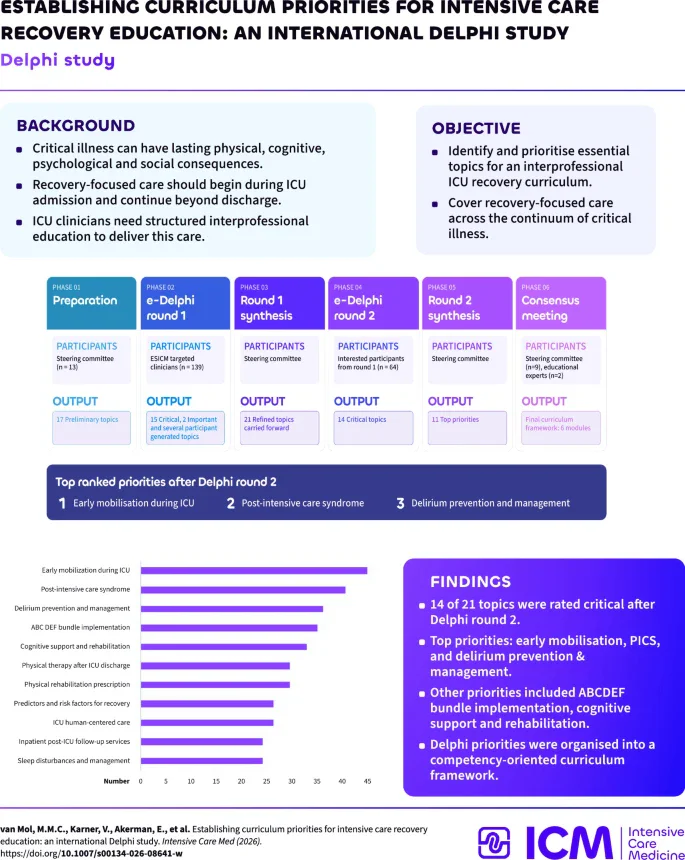
The landscape of intensive care has moved beyond mere survival. Increasingly, clinicians acknowledge that many patients who survive critical illness face persistent physical, cognitive and psychological problems grouped as post‑intensive care syndrome (PICS). Delivering recovery-oriented care across the continuum—from the ICU through hospital discharge and into the community—requires structured training so interprofessional teams can recognise risk, deliver evidence-based interventions, and coordinate follow-up. To address this training gap, van Mol and colleagues conducted an international, interprofessional e-Delphi study (endorsed by the European Society of Intensive Care Medicine) to identify and prioritise curriculum topics for ICU recovery education (van Mol et al., 2026). This article summarises the consensus, places it in the context of existing evidence and guidelines, and outlines practical implications for clinicians, educators and health systems.Why this consensus matters now
– Growing survivorship after critical illness has exposed persistent morbidity (physical weakness, cognitive impairment, mental health problems) that affects quality of life and resource use. – Several evidence-based approaches—early mobilisation, sedation minimisation, delirium prevention and ABCDEF bundle elements—improve outcomes but are inconsistently implemented across ICUs. – Educational frameworks tailored to multidisciplinary ICU teams are lacking or fragmentary; curriculum priorities need international, interprofessional consensus to guide standardized education, credentialing and quality improvement. The van Mol et al. Delphi therefore aimed to produce a prioritized, expert-informed list of curriculum topics and a set of learning modules to underpin future training programs in ICU recovery care (van Mol et al., 2026).New Guideline (Consensus) Highlights
Key messages from the Delphi consensus: – A focused set of high-priority topics was identified for an interprofessional ICU recovery curriculum. Top-ranked priorities included: early mobilisation during ICU admission; recognition and management of post‑intensive care syndrome (PICS); delirium prevention and management; practical implementation of the ABCDEF bundle; and cognitive support and rehabilitation. – Consensus criteria were prespecified: a topic reached agreement if ≥70% of participants rated it as critical (7–9 on a 9‑point Likert scale) and ≤15% rated it not important (1–3). – The process included two e-Delphi rounds followed by a structured consensus meeting; participant retention was moderate between rounds and final consensus agreement was reached by the expert panel. Why clinicians should care: the result is a prioritized, expert-endorsed framework that can be translated into modular curricula for clinicians (physicians, nurses, physiotherapists, occupational therapists, pharmacists, psychologists) to improve recovery-focused care across the continuum of critical illness.What changed or was newly emphasised
This Delphi study does not replace clinical practice guidelines; rather, it defines education priorities to implement known evidence-based practices. Key advances compared with the prior absence of a unified curriculum include: – Formal prioritisation of early mobilisation and cognitive rehabilitation alongside classical ICU topics such as sedation and delirium. – Explicit interprofessional emphasis—training topics were chosen to be relevant across professions rather than physician-focused alone. – Implementation and transition-of-care topics (e.g., ICU follow-up clinics, handover to rehabilitation services) were elevated as educational priorities—recognising that recovery begins in the ICU but extends beyond discharge.Topic-by-Topic Recommendations (Curriculum Modules)
The Delphi produced a final set of learning modules (summarised below). For each module, I list the core educational aims and the supporting evidence or guideline context. Module list (as prioritised by international experts): 1. Fundamentals of ICU recovery and post‑intensive care syndrome (PICS) – Aims: Define PICS, prevalence, typical trajectories; screening and documentation. – Evidence: Foundational consensus on PICS (Needham et al., 2012) supports routine recognition and structured follow-up. 2. Delirium prevention, assessment and management – Aims: Train clinicians in validated delirium screening (e.g., CAM-ICU), nonpharmacologic prevention (sleep, sensory aids), and rational pharmacologic strategies. – Evidence: PADIS 2018 recommends routine delirium monitoring and multicomponent prevention (Barr et al., 2018). 3. Sedation, analgesia and the ABCDEF bundle – Aims: Implement light sedation strategies, daily awakening trials, and integrate ABCDEF bundle elements to minimise harm. – Evidence: The ABCDEF bundle is associated with better outcomes and reduced delirium; implementation studies show broad benefits (Pun et al., 2019). 4. Early mobilisation and functional rehabilitation in the ICU – Aims: Rationale, safety screening, activity progressions, and interprofessional roles for mobilisation from bed mobility to ambulation. – Evidence: Randomised data (Schweickert et al., 2009) demonstrate improved functional outcomes and reduced delirium with early PT/OT in mechanically ventilated patients. 5. Cognitive assessment and rehabilitation strategies – Aims: Screening for ICU-related cognitive impairment, brief bedside cognitive interventions, referral pathways for outpatient neurorehabilitation. – Evidence: Cognitive deficits are common and long-lasting after critical illness; evidence for structured cognitive rehabilitation is emerging and an educational priority. 6. Psychological care, PTSD prevention and family support – Aims: Screening for anxiety, depression and PTSD; strategies such as ICU diaries, early psychological input and family engagement. – Evidence: Psychological morbidity is a major component of PICS; evidence for ICU diaries and early psychosocial interventions is evolving and featured in education priorities. 7. Nutrition and metabolic considerations for recovery – Aims: Early nutrition principles, metabolic support to preserve muscle mass, integration with mobilisation plans. – Evidence: Nutrition interacts with rehabilitation efforts; education on timing and targets is essential for recovery-focused care. 8. Transitions of care and ICU follow-up services – Aims: Effective handover to ward and community care, structure and aims of ICU follow-up clinics, referral pathways for rehabilitation. – Evidence: ICU follow-up clinics are variably effective in trials but are central to coordinated recovery and are therefore an educational priority. 9. Special populations and equity considerations – Aims: Tailoring recovery care for older adults, patients with baseline cognitive impairment, and addressing disparities in access to rehabilitation. 10. Implementation science, quality improvement and interprofessional teamwork – Aims: Practical skills in local implementation, audit, change management and measuring recovery outcomes. – Evidence: Implementation barriers often limit uptake of evidence-based bundles; education should include QI methods to close the know‑do gap. Note: The Delphi consensus defined thresholds for “critical” priority; training programs can use these modules as the backbone for curricula targeted at bedside clinicians and rehabilitative specialists.Evidence and guideline context
– Early mobility: Randomised controlled trial evidence (Schweickert et al., 2009) and systematic reviews support early physiotherapy/OT to improve functional outcomes and reduce delirium in ventilated patients. – Sedation & delirium: PADIS 2018 guidelines recommend light sedation, sedation protocols, daily interruption and routine delirium assessment using validated tools (Barr et al., 2018). – ABCDEF bundle: Implementation studies and collaborative datasets link greater bundle adherence with reduced duration of mechanical ventilation, delirium and improved survival (Pun et al., 2019). – PICS & follow-up: Stakeholder statements recommend structured follow-up and coordination between ICU teams and rehabilitation/community services, though trial evidence for the effectiveness of follow-up clinics is mixed (Needham et al., 2012).Expert Commentary and Insights
Panel perspectives summarised from the Delphi meeting and related commentary: – Interprofessional education is essential: experts emphasised that rehabilitation and cognitive/psychological support cannot be delivered by a single profession; educational content must be relevant to nurses, PT/OTs, physicians, pharmacists and allied staff. – Implementation is the key barrier: experts repeatedly highlighted that curriculum adoption will succeed only when paired with organizational support—staffing, protocols, time and leadership for QI. – Evidence gaps remain: areas such as the optimal content and timing of cognitive rehabilitation, the specific benefits of ICU diaries, and the structure of follow-up clinics were flagged as priorities for future research. – Equity issues: experts raised concern that rehabilitation resources are unevenly distributed and curricula must include strategies for low‑resource settings. Controversies – ICU follow-up clinics: despite being a logical component of recovery pathways, randomised trials have shown mixed benefit; experts argued training should emphasise functional handover and local context-based follow-up models rather than one-size-fits-all clinics. – Pharmacologic interventions for delirium and PTSD prevention: evidence is limited; education should stress nonpharmacologic prevention and cautious, evidence-based medication use.Practical Implications for Clinical Practice
How units and educators can use the Delphi output: – Build modular curricula: adopt the Delphi modules as core components and tailor depth by profession (e.g., nurses focus on delirium screening and mobilisation safety checks; PT/OTs focus on progression and functional goals). – Pair education with implementation strategies: include QI tools, local protocols, and audit measures to track bundle adherence and recovery outcomes. – Measure outcomes: integrate metrics such as in‑ICU mobility milestones, delirium prevalence/duration, discharge functional status, and readmissions to assess curriculum impact. – Start small and scale: pilot curriculum modules on a single unit, measure feasibility and outcomes, then scale across the organisation with leadership support. Patient vignette (illustrative) John Mitchell, a 62-year-old man, spends 10 days in the ICU after severe pneumonia and hypoxic respiratory failure. With a recovery-focused curriculum in place, his care team screens for delirium using CAM-ICU daily, minimises sedation per PADIS recommendations, initiates coordinated early mobilisation supervised by PT/OT, documents cognitive baseline and uses a standard handover to the ICU follow-up service. At three months he has improved mobility with few symptoms of PTSD and clear outpatient rehabilitation plans—an outcome the Delphi curriculum is designed to increase across populations.Research needs and next steps
– Validation: evaluate whether education built on these modules improves clinician behaviour and patient‑centred outcomes in randomized or stepped-wedge trials. – Adaptation for low‑resource settings: create streamlined, pragmatic versions of modules for settings with limited PT/OT availability. – Interprofessional credentialing: consider competency frameworks and micro‑credentialing tied to modules to ensure consistent care delivery.References
– van Mol M, Karner V, Akerman E, van den Boogaard M, Brooks K, Meyer J, Rousseau AF, Rose L, Slack A, Stoppe C, van Zanten A, Schaller SJ, Eggmann S. Establishing curriculum priorities for intensive care recovery education: an international Delphi study. Intensive Care Med. 2026 Nov 2. PMID: 42970126. – Schweickert WD, Pohlman MC, Pohlman AS, et al. Early physical and occupational therapy in mechanically ventilated, critically ill patients: a randomised controlled trial. Lancet. 2009;373(9678):1874–1882. – Barr J, Fraser GL, Puntillo K, et al. Clinical practice guidelines for the management of pain, agitation/sedation, delirium, immobility, and sleep disruption in adult patients in the ICU (PADIS 2018). Crit Care Med. 2018;46(9):e825–e873. – Pun BT, Balas MC, Barnes-Daly MA, et al. Caring for critically ill patients with the ABCDEF bundle: results of the ICU Liberation Collaborative in over 15,000 adults. Crit Care Med. 2019;47(1):3–14. – Needham DM, Davidson J, Cohen H, et al. Improving long-term outcomes after discharge from intensive care unit: report from a stakeholders’ conference. Crit Care Med. 2012;40(2):502–509. (higher-detail references above are suggested reading for clinicians and educators designing or adopting recovery-focused curricula.)Bottom line
The international Delphi by van Mol et al. provides a pragmatic, expert-endorsed blueprint for ICU recovery education. By prioritising early mobilisation, delirium prevention, ABCDEF bundle implementation, PICS recognition and cognitive rehabilitation within an interprofessional curriculum, the consensus offers a practical roadmap. The next step is implementation: translating these modules into training programs, pairing them with quality improvement strategies, and studying whether education changes care and improves long‑term outcomes for ICU survivors.Specialty calculators
For clinical reference; use professional judgment.