Introduction
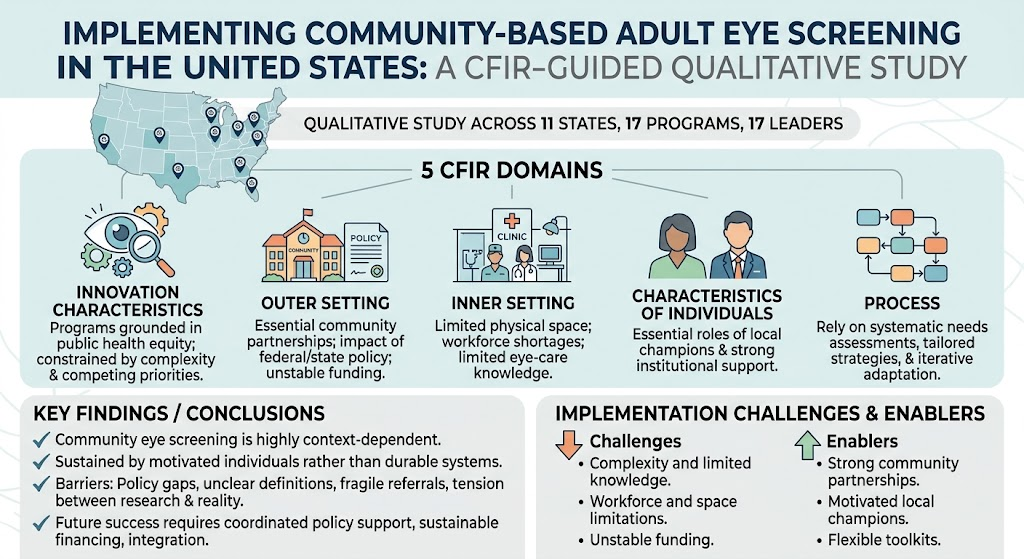
Preventable vision loss remains a significant public health concern in the United States. With conditions such as diabetic retinopathy, glaucoma, and age-related macular degeneration often progressing asymptomatically until advanced stages, early detection through systematic screening is critical to reducing morbidity and preserving vision. However, adult eye disease screening in community settings is often fragmented, inconsistently defined, and challenged by unstable funding and workforce limitations. To address these barriers and inform scalable, equitable screening efforts, Ramachandran et al. conducted a qualitative multi-site study guided by the Consolidated Framework for Implementation Research (CFIR) to elucidate determinants affecting the design, implementation, and sustainability of community-based adult eye screening programs across the U.S.
Background: Burden and Unmet Need
Vision impairment affects millions in the U.S., contributing to diminished quality of life, increased risk of falls and accidents, and substantial economic costs. Despite guidelines endorsing regular eye screening for high-risk populations, screening uptake remains low, particularly among underserved communities. Community-based screening programs have the potential to mitigate disparities by increasing accessibility outside traditional clinical settings. Yet, variability in program models, limited integration with healthcare systems, and a lack of consensus on best practices hinder widespread adoption and durability. Understanding context-specific implementation factors is essential to developing strategies that enhance reach, acceptability, and effectiveness.
Study Design
This study used a qualitative design employing semi-structured Zoom interviews conducted from May to August 2024. Seventeen U.S. eye care leaders representing 17 adult vision screening programs spanning eleven states participated. These programs varied widely in clinical settings (e.g., community health centers, mobile units), workforce composition (e.g., ophthalmic technicians, community health workers), and diagnostic modalities (e.g., visual acuity, retinal imaging). Interview transcripts were coded in NVivo following a CFIR-guided coding framework encompassing five domains: innovation characteristics, inner setting, outer setting, individual characteristics, and implementation process. Rigorous qualitative methods including double coding and consensus reconciliation ensured analytic reliability (inter-rater κ > 0.8).
Key Findings
The study identified twenty-two themes distributed across the five CFIR domains that elucidate how operational, organizational, and policy factors affect community eye screening initiatives.
Innovation Characteristics
Programs were underpinned by a strong public health equity ethos aiming to reduce vision disparities. However, many struggled with complexity due to multifaceted stakeholder priorities, diverse target populations, and balancing thorough diagnostic assessment with scalability. Ambiguity about “screening” definitions and appropriate threshold criteria for follow-up referral contributed to inconsistent practices.
Inner Setting
Organizational challenges included limited physical space to conduct screenings, pervasive shortfalls in trained eye-care personnel, and knowledge gaps among general staff regarding eye health. Many programs heavily relied on motivated “local champions” who navigated institutional constraints and secured leadership buy-in, underscoring the fragility of dependence on individual enthusiasm rather than systemic support.
Outer Setting
Community partnerships emerged as critical facilitators to program reach and trust-building. Federal and state policies greatly influenced program funding, yet financial support was often unstable and short-term. The external environment’s uncertainty impeded long-term planning and sustainability. Moreover, weak referral networks compromised continuity of care for patients identified with eye disease, limiting clinical impact.
Individual Characteristics
Key personnel characteristics such as commitment, leadership, adaptability, and clinical acumen were integral to implementation success. The presence of institutional champions alongside empowered team members fostered program resilience despite resource constraints.
Implementation Process
Effective programs regularly conducted systematic community needs assessments to tailor interventions. Iterative adaptation to feedback and local context was essential, balancing research protocol fidelity with pragmatic real-world feasibility. Structured processes and clear communication channels supported smoother integration within broader health infrastructures.
Expert Commentary
This study leverages the comprehensive CFIR framework to shed light on multifactorial determinants influencing a crucial yet underexplored facet of public health ophthalmology. The granular insights into operational complexity, workforce limitations, and policy-driven challenges provide actionable intelligence for stakeholders aiming to design sustainable screening programs. However, the qualitative approach and purposive sampling of eye care leaders may limit generalizability to smaller or differently structured programs. Moreover, patient perspectives and cost-effectiveness metrics warrant further exploration to complement implementation insights.
By emphasizing the importance of strong community partnerships and adaptable deployment strategies, these findings align with emerging frameworks promoting equity-driven, integrated eye care models. They also highlight an urgent need for coordinated policy action to standardize screening definitions, secure sustainable financing, and foster referral networks—all essential to closing existing care gaps.
Conclusion
Community-based adult eye screening programs in the U.S. face complex challenges spanning program design, institutional infrastructure, external policy environments, and human factors. This CFIR-guided qualitative study reveals persistent barriers such as fragmented definitions, unstable funding, and underdeveloped referral pathways that impede sustainable impact. Nonetheless, motivated individuals and strategic community partnerships can compensate for systemic gaps to some extent.
Future scaling efforts require deliberate policy coordination, stable financing mechanisms, integration within existing health systems, and flexible, evidence-based implementation toolkits tailored to local contexts. The CFIR framework offers a valuable tool to guide such endeavors, promoting sustainable, equity-focused approaches to prevent avoidable vision loss on a population scale.
Funding and Clinical Trials Registration
The original study does not report specific funding sources or clinical trial registrations. Further research and evaluation in this area should consider transparent disclosure of funding and registration details to enhance reproducibility and translation.
References
1. Ramachandran R, Bracy D, Doiphode A, Newman-Casey PA. Implementing Community-Based Adult Eye Screening in the United States: A CFIR-Guided Qualitative Study. Am J Ophthalmol. 2026 Jun 1;289:325-347. PMID: 42225246.
2. Institute of Medicine (US) Committee on Vision. The National Eye Health Education Program. Reducing Visual Impairment and Blindness: National Strategies. Washington, DC: National Academies Press; 2016.
3. Zhang X, et al. Screening for eye diseases in adults: a public health priority. JAMA Ophthalmol. 2020;138(6):677-684.
4. Damschroder LJ, et al. Fostering implementation of health services research findings into practice: a consolidated framework for advancing implementation science. Implement Sci. 2009;4:50.