Highlight
This extensive longitudinal study from the Veterans Analysis of Liver Disease cohort reveals that both heterozygous and homozygous carriers of the Z-allele in Alpha-1 antitrypsin deficiency (AATD) face increased risks of major adverse liver outcomes (MALO) compared to the wildtype Pi*MM genotype. Notably, Pi*ZZ homozygotes show the highest incidence and hazard ratios across all liver-related complications, including decompensation, hepatocellular carcinoma (HCC), liver transplantation, and liver-related mortality. Heterozygous genotypes (Pi*MZ and Pi*SZ) also confer elevated risk, though less pronounced, underscoring the clinical relevance of detecting these genotypes beyond classical cirrhosis diagnosis.
Study Background
Alpha-1 antitrypsin deficiency (AATD) is a genetic disorder primarily known for its impact on pulmonary function but also a significant contributor to liver disease. Caused by mutations in the SERPINA1 gene, AATD leads to accumulation of abnormal alpha-1 antitrypsin protein within hepatocytes, precipitating liver injury. The Z-allele variant is recognized for its pathogenicity, particularly in homozygous Pi*ZZ individuals, who have established risk for cirrhosis and hepatocellular carcinoma.
However, the liver-related risk spectrum in heterozygous genotypes (Pi*MZ and Pi*SZ) remains less clearly defined, limiting clinical guidance on surveillance and management. This study addresses a critical evidence gap by quantifying major adverse liver outcomes (MALO) across genotypes, informing the natural history, risk stratification, and potential monitoring strategies for patients with AATD.
Study Design
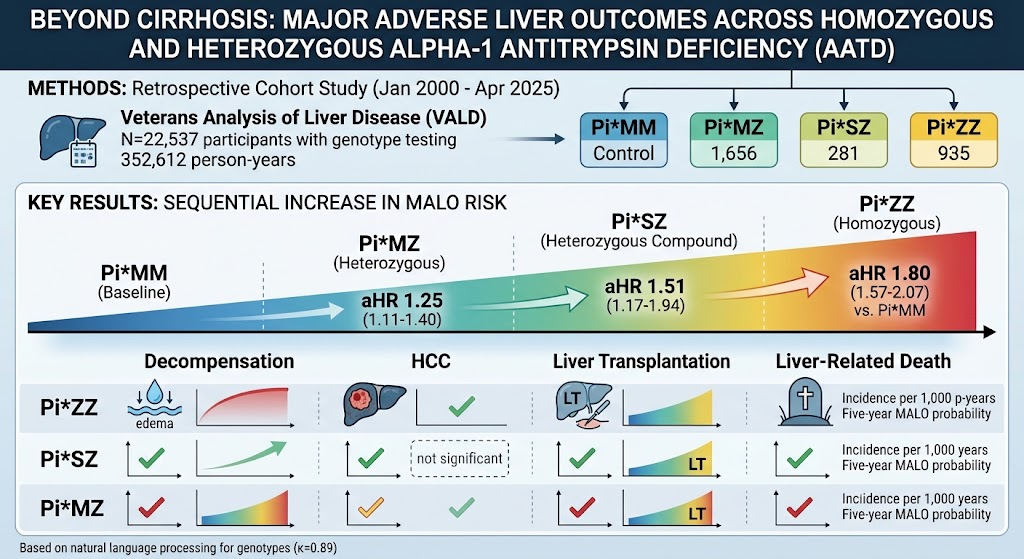
This retrospective cohort investigation utilized the Veterans Analysis of Liver Disease (VALID) database, covering January 2000 to April 2025, including 22,537 veterans with confirmed AATD genotype testing. The genotypes were Pi*MM (wildtype; n=19,665), Pi*MZ (heterozygous Z; n=1,656), Pi*SZ (heterozygous S and Z; n=281), and Pi*ZZ (homozygous Z; n=935).
Genotyping was conducted through a validated natural language processing tool with excellent concordance (κ=0.89) to ensure accurate classification. The primary outcome was the incidence of major adverse liver outcomes (MALO), encompassing clinical decompensation, hepatocellular carcinoma (HCC), liver transplantation (LT), and liver-related death (LRD). Multivariable Fine-Gray competing risk models adjusted for confounders were employed to estimate hazard ratios (HRs) for MALO.
Key Findings
During a median follow-up of 15.9 years encompassing 352,612 person-years, risk of MALO increased progressively with Z-allele burden:
- Pi*MZ heterozygotes displayed a 25% increased adjusted hazard of MALO compared to Pi*MM (aHR 1.25, 95% CI 1.11–1.40).
- Pi*SZ heterozygotes had a 51% increased hazard (aHR 1.51, 95% CI 1.17–1.94).
- Pi*ZZ homozygotes exhibited the highest hazard ratio of 1.80 (95% CI 1.57–2.07).
Incidence rates (per 1,000 person-years) for MALO also rose across genotypes: 11.3 for Pi*MM, 13.0 for Pi*MZ, 14.6 for Pi*SZ, and 19.2 for Pi*ZZ. Corresponding five-year probabilities of MALO were 3.5%, 5.5%, 5.3%, and 8.1% respectively, highlighting a clinically meaningful incremental risk.
Pi*ZZ was significantly associated with all individual MALO components, including decompensation, HCC, liver transplantation, and liver-related death. Pi*MZ and Pi*SZ were linked with increased risk of liver decompensation, transplantation, and mortality, but not hepatocellular carcinoma. Sensitivity analyses restricted to patients with metabolic dysfunction-associated steatotic liver disease (MASLD) confirmed the robustness of findings.
Expert Commentary
This study represents one of the largest genotype-phenotype assessments of AATD related liver outcomes, particularly illuminating the underappreciated risks in heterozygous Z-allele carriers. Historically, clinical focus has centered on Pi*ZZ individuals; however, the graded risk observed here advocates for broadening genotype screening and risk assessment in diverse clinical contexts, notably among veterans who may have overlapping liver disease etiologies.
The use of validated natural language processing to extract genotypes from clinical records is an innovative approach that enhances real-world applicability. Nonetheless, limitations of retrospective observational design exist, including potential residual confounding and predominance of a veteran population, which may affect generalizability. Further prospective studies could refine understanding of modifiers that influence progression and response to emerging therapies.
Conclusion
This national longitudinal cohort study delineates an increasing burden of major adverse liver outcomes across AATD genotypes, extending beyond the classical Pi*ZZ homozygous state to include heterozygous carriers. These findings underscore the critical need for early diagnosis, genotype-informed risk stratification, and heightened clinical surveillance to mitigate progressive liver disease morbidity and mortality among individuals with AATD.
The results are highly relevant for hepatologists, pulmonologists, and primary care providers managing patients with liver disease or unexplained liver dysfunction, prompting integration of AATD genotyping into diagnostic pathways and personalized management strategies for affected veterans and broader populations.
Funding and ClinicalTrials.gov
The study used resources from the Veterans Analysis of Liver Disease cohort. Specific funding sources or clinical trial registrations were not disclosed in the summary.
References
- Bastaich D, Dahman B, et al. Beyond cirrhosis: Major adverse liver outcomes across homozygous and heterozygous Alpha-1 antitrypsin deficiency associated liver disease. Hepatology (Baltimore). 2026 Aug 28. PMID: 42664383.
- Stoller JK, Aboussouan LS. Alpha1-antitrypsin deficiency. Lancet. 2005;365(9478):2225-36.
- Ferrarotti I, et al. Serum levels and genotype distribution of alpha1-antitrypsin in the general population. Thorax. 2012;67(8):669-74.