Proposed section structure
Title
ANAPC13 Mutations Emerge as a New Genetic Cause of Oocyte Maturation Arrest
Highlights
Brief bullets summarizing the main clinical and mechanistic findings.
Background
Clinical context of oocyte maturation arrest, unmet need in ART, and the APC/C pathway.
Study design
Human genetic cohort, mouse knock-in model, oocyte phenotyping, proteomics, mechanistic cell work, and exploratory rescue experiment.
Key findings
Detailed results with effect sizes and biological interpretation.
Expert commentary
Clinical significance, limitations, and translational implications.
Conclusion
Summary of takeaways and future directions.
References
Selected real-world literature.
Highlights
Three infertile women with recurrent oocyte maturation arrest were found to carry biallelic ANAPC13 variants, expanding the genetic architecture of female infertility.
A knock-in mouse model recapitulated the phenotype, strongly supporting causality rather than simple association.
The pathogenic mechanism appears to involve impaired APC/C function and abnormal subunit interaction during the metaphase I-to-anaphase I transition, while spindle assembly checkpoint dynamics were preserved.
Microinjection of Anapc13 mRNA partially rescued polar body extrusion, suggesting a plausible future precision-based therapeutic strategy.
Background
Oocyte maturation arrest is an important but often underrecognized cause of female infertility and repeated assisted reproductive treatment failure. In affected patients, retrieved oocytes fail to progress normally through meiosis, commonly arresting at the germinal vesicle, metaphase I, or metaphase II stage. This creates a profound clinical challenge because standard stimulation and fertilization protocols cannot overcome the underlying meiotic defect.
Genetic causes are increasingly recognized. Several genes involved in spindle dynamics, cell-cycle control, and meiosis-specific regulation have been implicated, but many patients remain without a molecular diagnosis. The anaphase-promoting complex or cyclosome (APC/C) is a multi-subunit E3 ubiquitin ligase that triggers orderly progression through cell division by promoting degradation of key regulatory proteins. In oocyte meiosis, APC/C is essential for the metaphase-to-anaphase transition and completion of maturation. Prior work has linked defects in APC/C subunits such as ANAPC8 and ANAPC12 to oocyte maturation arrest, but the contribution of ANAPC13 had not been established.
This study addresses a clinically meaningful gap: whether ANAPC13 is a bona fide infertility gene and whether its disruption can explain a definable subset of maturation arrest cases. Because this phenotype can lead to repeated failed cycles of in vitro fertilization or intracytoplasmic sperm injection, identifying a molecular cause is important not only for diagnosis but also for counseling, family planning, and future precision therapies.
Study design
This was a translational human-genetic and functional study. Patients diagnosed with oocyte maturation arrest based on morphological assessment during assisted reproductive treatment were recruited and underwent whole-exome sequencing. Two recurrent biallelic ANAPC13 variants were identified as the candidate pathogenic findings.
To test causality, the recurrent c.6C>A variant was engineered into a knock-in mouse model, referred to as Anapc13M/M, with wild-type Anapc13+/+ mice serving as controls. The investigators then assessed ovarian and oocyte phenotypes after superovulation and after in vitro maturation.
Mechanistic work included proteomic analysis of human oocytes, molecular interaction studies in cell lines with plasmid constructs, and evaluation of spindle assembly checkpoint dynamics. Finally, an exploratory rescue approach tested whether microinjection of Anapc13 mRNA could restore maturation in mutant oocytes.
This design is notable for combining human genetics, animal modeling, and mechanistic biology, which strengthens the causal inference beyond what a patient-only report could provide.
Key findings
The investigators identified two biallelic ANAPC13 mutations, NM_001242374.1: c.6C>A; p.D2E and c.71T>G; p.L24R, in three infertile females. All three patients had oocyte maturation arrest at metaphase I, consistent with a failure in the meiotic transition needed for polar body extrusion and completion of maturation. Although the cohort was small, the recurrence of ANAPC13 variants in unrelated affected individuals makes the association biologically compelling.
The mouse model provided the strongest support for pathogenicity. In Anapc13M/M females, the proportion of mature oocytes after superovulation was dramatically reduced compared with controls: 1.66% ± 3.34% versus 96.63% ± 3.40% in Anapc13+/+ mice, with p < 0.001. Similarly, in vitro maturation yielded only 0.83% ± 1.66% mature oocytes in mutants versus 70.30% ± 1.10% in wild-type mice, again with p < 0.001. These are not subtle differences; they indicate a near-complete block in meiotic progression.
Importantly, the investigators did not find evidence that the defect was due to altered spindle assembly checkpoint dynamics. That is clinically and mechanistically relevant because it points away from a checkpoint failure and toward a core APC/C dysfunction. In other words, the oocytes appear to be stalled because the machinery responsible for triggering the metaphase-to-anaphase transition is not functioning properly, rather than because the cell is incorrectly sensing spindle attachment.
Proteomic analysis and molecular experiments further suggested that mutant ANAPC13 disrupts the protein composition of oocytes during the metaphase I-to-anaphase I transition. The study indicates that APC/C dysfunction resulted from abnormal subunit interaction. This is a key mechanistic insight: ANAPC13 does not simply act as a passive structural element, but appears necessary for correct assembly or stability of the APC/C complex. When that interaction is altered, the downstream proteolytic cascade required for meiotic progression fails.
From a translational perspective, the rescue experiment is especially intriguing. Microinjection of Anapc13 mRNA partially restored the ability of mutant oocytes to extrude the first polar body, with rescue in 49.20% ± 3.60% of oocytes. While this is an exploratory preclinical finding and not directly transferable to routine care, it provides proof-of-concept that the phenotype may be modifiable. For a disorder once considered fixed, even partial rescue is an important signal.
Several points deserve emphasis when interpreting the results. First, the data establish a strong genotype-phenotype link because the same cellular phenotype was reproduced in a mouse model. Second, the findings connect human infertility to a defined cell-cycle pathway, which improves biological coherence. Third, the observed defect is highly specific to oocyte maturation, consistent with the selective vulnerability of meiotic cells to APC/C impairment.
At the same time, the study is limited by the small number of human cases. Three patients are enough to raise a highly credible genetic signal, especially with functional validation, but not enough to estimate prevalence or define phenotype heterogeneity. The report also does not yet establish whether carriers of other ANAPC13 variants have a milder phenotype, whether heterozygous relatives have any reproductive impact, or how broadly the findings generalize across populations.
Another practical limitation is that the rescue strategy remains experimental. Microinjection of mRNA is technically feasible in an embryo laboratory, but its safety, durability, and clinical utility in human oocytes are unknown. Any future therapeutic use would require extensive validation, including assessment of developmental competence after rescue, off-target effects, and ethical considerations in germline manipulation.
Expert commentary
This study is important because it expands the list of APC/C-related genes implicated in female infertility and reinforces the concept that meiotic arrest is often a disease of the cell-cycle machinery itself. For reproductive endocrinologists and embryologists, the findings may improve diagnostic thinking in patients with repeated failure to obtain mature oocytes despite appropriate stimulation and laboratory handling.
From a genetics standpoint, ANAPC13 should now be considered a candidate gene in the evaluation of unexplained oocyte maturation arrest, particularly in patients with repeated metaphase I arrest. The work also exemplifies why functional validation is essential in reproductive genetics: a variant found by sequencing becomes clinically meaningful only when paired with cellular and in vivo evidence.
For clinicians, the immediate implication is not a change in treatment guidelines, but a shift toward more precise counseling. A molecular diagnosis can reduce uncertainty, inform prognosis, and support discussion of options such as repeated ART attempts, donor oocytes, or enrollment in research protocols. In the future, rescue strategies tailored to the causal gene could become part of a precision reproductive medicine framework.
Conclusion
Biallelic ANAPC13 mutations are now supported as a cause of female infertility characterized by oocyte maturation arrest, with convincing evidence from human cases, a knock-in mouse model, mechanistic assays, and partial mRNA rescue. The study highlights APC/C dysfunction as a critical mechanism in meiotic failure and opens the door to genetic diagnosis and eventually targeted intervention in a subset of patients with otherwise unexplained infertility.
Before this can translate into routine practice, larger cohorts are needed to define prevalence, variant spectrum, and reproductive outcomes. Still, this work marks a meaningful advance: it moves ANAPC13 from a biologically plausible candidate to a validated infertility gene.
References
1. Wang Y, Ding Z, Liu X, Liu X, Tan H, Zheng N, Yu K, Chen B, Wang F, Cao Y, Huang L, Sang Q, Zhu F. Biallelic mutations in ANAPC13 cause female infertility characterized by oocyte maturation arrest both in humans and mice. Am J Obstet Gynecol. 2026 Apr 15. PMID: 41997520.
2. World Health Organization. Infertility. Fact sheet and related reproductive health resources.
3. Nagaoka SI, Hassold TJ, Hunt PA. Human aneuploidy: mechanisms and new insights into an age-old problem. Nat Rev Genet. 2012;13(7):493-504.
4. Hoshii T, et al. APC/C regulation in meiosis and oocyte maturation. Relevant review literature in reproductive cell biology.
AI image prompt
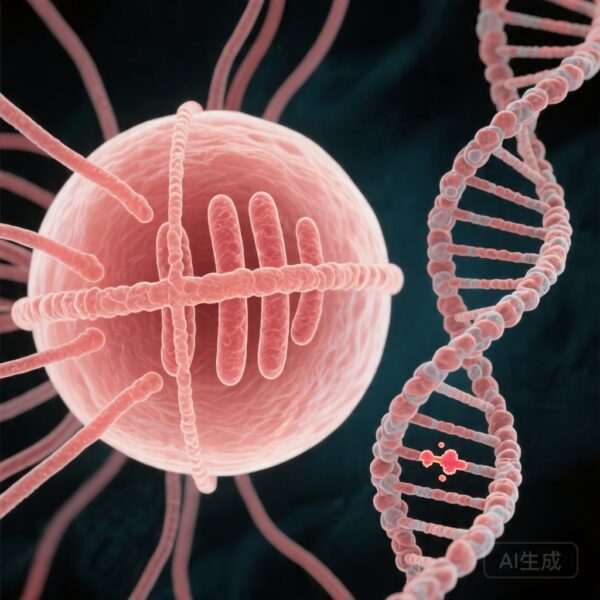
A high-resolution scientific medical illustration of an infertile woman’s oocyte arrested at metaphase I, with a visible APC/C protein complex and highlighted ANAPC13 gene mutation, alongside a subtle mouse knock-in model silhouette and laboratory microinjection scene, clean journal-cover style, blue and violet color palette, realistic cellular detail, modern reproductive genetics theme.