Introduction and Context
Acute‑on‑chronic liver failure (ACLF) is a syndrome of rapid clinical deterioration in patients with underlying chronic liver disease, characterized by acute hepatic decompensation, systemic inflammation, and failure of one or more organs (kidney, brain, circulation, lungs, coagulation). ACLF carries high short‑term mortality and frequently requires intensive care, organ support, and urgent consideration for liver transplantation. Multiple regional definitions and diagnostic systems have existed for ACLF for more than a decade — most prominently the EASL‑CLIF (European) construct derived from the CANONIC study, the APASL (Asia‑Pacific) criteria, and the NACSELD (North American) approach. Differences among these frameworks have hindered international research collaboration, obscured trial designs, and complicated patient selection for therapies and transplantation. The 2026 Acute‑on‑Chronic Liver Failure Multisociety Harmonisation Initiative (a collaboration among AASLD, EASL, APASL, ALEH, and SOLDA) publishes a global, evidence‑based consensus intended to unify definitions, diagnostic thresholds, grading, management priorities, and trial endpoints for ACLF. The document aims to be pragmatic and globally applicable to clinicians, researchers, regulators, and trialists (AASLD et al., Hepatology. 2026; PMID: 42960623). Why this consensus now? – Persistent heterogeneity in ACLF definitions limited cross‑study comparability and regulatory alignment for therapies. – New data on pathophysiology, organ‑support strategies, and outcomes (including transplant for high‑grade ACLF) have emerged. – A global coordinated framework was required to accelerate therapeutic development, standardize patient stratification, and improve clinical decision‑making across regions.New Guideline Highlights
Major themes and takeaways: – A single, harmonised global definition of ACLF that recognizes both cirrhotic and non‑cirrhotic chronic liver disease phenotypes where appropriate. – Standardized organ dysfunction and failure criteria, built on the CLIF‑organ‑failure logic but broadened for global applicability and to align with critical care definitions. – A three‑tier grading system (ACLF grade 1–3) focused on the number and severity of organ failures and linked to stratified management pathways and outcome expectations. – An explicit pathway: early recognition in hospital, rapid identification and treatment of precipitating events (infection, alcoholic hepatitis, variceal hemorrhage, drug‑induced liver injury), aggressive organ‑support where indicated, early candidacy assessment for liver transplant, and standardized measures for trial endpoints (e.g., 28‑ and 90‑day transplant‑free survival, organ‑support‑free days). – Guidance intended to be usable in low‑ and middle‑income settings while recognizing resource‑dependent adaptations. Key clinical headlines for practice: – Screen all hospitalized patients with acute decompensation of chronic liver disease for ACLF using the harmonised criteria. – Treat precipitating factors immediately; infection is the most common and modifiable precipitant. – Escalate care early: organ‑failure assessment should trigger ICU consultation, organ‑support planning, and parallel transplant evaluation when appropriate. – Use standardized endpoints in trials: 28‑day and 90‑day transplant‑free survival, organ‑support‑free days, and health‑related quality of life are recommended primary/secondary endpoints.Updated Recommendations and Key Changes
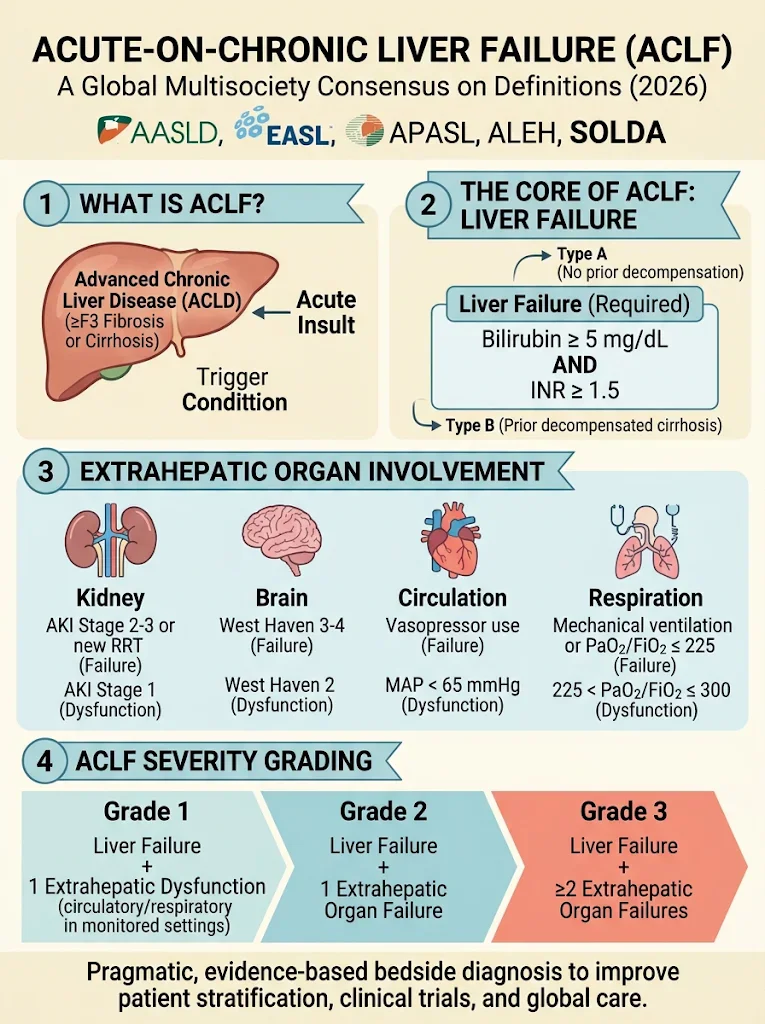
What changed from prior regional definitions? (Summary table) – Unified diagnostic scope: The consensus reconciles EASL‑CLIF (which centers on patients with cirrhosis and decompensation) with APASL (which includes non‑cirrhotic chronic liver disease) by endorsing a harmonised entry criterion that covers both groups but specifies subphenotypes. – Standardized organ failure thresholds: The CLIF‑SF (sequential organ scoring) approach remains influential, but the new guidance aligns organ failure criteria with contemporary critical care thresholds (e.g., use of vasoactive agents, oxygenation indices). – Grading harmonization: The three‑grade system corresponds to increasing number/severity of organ failures (ACLF‑1 — single organ failure or kidney dysfunction with other organ dysfunction; ACLF‑2 — two organ failures; ACLF‑3 — three or more organ failures). – Trial endpoints and regulatory alignment: The consensus prespecifies transplant‑free survival at 28 and 90 days and organ‑support‑free days as primary outcomes for phase II/III trials, aligning with regulatory expectations for life‑threatening syndromes. Evidence driving updates: – Large multicenter cohort analyses (including the European CANONIC cohort) established the relationship between number of failing organs and mortality. – Growing transplant literature demonstrates that selected patients with ACLF‑3 may have favorable outcomes post‑liver transplantation if selected early and managed aggressively. – Emerging data on the role of systemic inflammation and the identification of treatable precipitants informed a stronger emphasis on early infection control and comprehensive assessment.Topic‑by‑Topic Recommendations
Diagnostic criteria (harmonised core): – ACLF should be suspected in patients with known chronic liver disease (cirrhotic or non‑cirrhotic chronic liver disease) who present with acute hepatic decompensation (ascites, encephalopathy, jaundice, GI bleeding, or bacterial infection) plus organ dysfunction/failure. – Core baseline evaluation: complete blood count, coagulation profile (INR), creatinine, bilirubin, arterial blood gas/oxygenation, lactate, cultures, abdominal imaging as needed, and bedside organ‑failure scoring. Organ dysfunction and failure assessment: – Organ domains considered: liver (bilirubin), kidney (creatinine, requirement for renal replacement), brain (West Haven grade of encephalopathy), coagulation (INR/platelets), circulation (need for vasopressors), and respiration (PaO2/FiO2 or oxygen requirement). – Failure thresholds match those used in prior CLIF definitions but are explicitly aligned with critical‑care markers (e.g., need for vasopressor support designates circulatory failure). – ACLF grading: ACLF‑1 (1 organ failure OR kidney dysfunction plus another organ dysfunction), ACLF‑2 (two organ failures), ACLF‑3 (≥3 organ failures). Management strategies (by domain): – General principles: early recognition, treat precipitant, organ support, infection surveillance, and early transplant assessment. Strong recommendation (consensus): hospitals admitting acutely decompensated patients should implement an ACLF pathway with rapid assessment and escalation triggers. – Infection: aggressive early diagnosis and empiric broad‑spectrum antibiotics when infection suspected; adjust by cultures. Prophylactic antibiotics for GI bleeding as per existing guidelines. Strong recommendation based on observational evidence and risk reduction of mortality. – Kidney: manage with volume optimization, avoidance of nephrotoxins, and early consideration of vasoconstrictor therapy plus albumin when hepatorenal syndrome (HRS) is suspected. RRT (renal replacement therapy) should be used when indicated; decision should consider transplant candidacy. Moderate recommendation. – Hemodynamic/vasopressors: treat septic or vasodilatory shock per critical care principles; consider albumin infusion where indicated (e.g., SBP, large‑volume paracentesis). – Respiratory failure: early intubation and lung‑protective ventilation as needed; consider extracorporeal support only in centers with transplant capability and defined selection criteria. – Coagulation: correct clinically significant bleeding; routine correction of abnormal INR without bleeding is not recommended. – Specific precipitants: alcoholic hepatitis should be managed per alcoholic hepatitis evidence (e.g., evaluate for corticosteroids in selected patients), variceal hemorrhage per standard practice, and drug‑induced liver injury managed with withdrawal of the agent and supportive care. Liver transplantation and candidacy: – Early referral and parallel evaluation for transplant are strongly recommended for eligible patients with ACLF, including many with ACLF‑2 and ACLF‑3 if otherwise suitable. – Selection should weigh comorbidities, reversibility of extrahepatic organ failures, infection control, and psychosocial suitability. – The consensus endorses that ACLF‑3 is not an absolute contraindication to transplant in centers with experience, and in selected patients transplantation offers excellent survival benefits. Follow‑up and prognosis: – Short‑term prognosis is linked to ACLF grade: 28‑ and 90‑day mortality increase with ACLF grade. – Survivors require close outpatient follow‑up for liver disease management, secondary prevention of precipitating events, and consideration of elective transplantation listing when appropriate. Clinical trial design and endpoints: – Primary endpoints recommended: 28‑day transplant‑free survival or mortality for registration trials in life‑threatening interventions; 90‑day transplant‑free survival as an important secondary/confirmatory endpoint. – Additional endpoints: organ‑support‑free days, ICU length of stay, and health‑related quality of life. – Recommended stratification variables: ACLF grade, precipitant type (infection vs non‑infection), baseline liver disease type, and transplant candidacy. Special populations and resource settings: – Non‑cirrhotic chronic liver disease: APASL‑type presentations are included with explicit subphenotype labelling. – Low‑resource settings: the guidance provides pragmatic adaptations — prioritizing bedside measures, simplified infection screening, and referral thresholds — but emphasizes that outcomes depend on timely organ‑support and, where possible, transplant access.Expert Commentary and Insights
Consensus committee perspectives: – Harmonisation was deliberately pragmatic: rather than erasing regional differences, the guideline creates a ‘common language’ with defined subtypes so that local practice patterns and resources can be respected while enabling global research comparability. – The panel emphasized early infection control and organ‑support as the most impactful immediate actions and prioritized aligning trial endpoints with regulatory expectations. Areas of agreement: – The number and severity of organ failures strongly predict short‑term mortality. – Early transplant assessment can be lifesaving for selected patients, including some with ACLF‑3. – Standardized endpoints are required to accelerate therapeutic development. Areas of controversy and uncertainty: – The boundaries between severe decompensation without ACLF and early ACLF remain clinically challenging; validation of the harmonised criteria in diverse populations is a priority. – The optimal timing of transplant for ACLF‑3 — balancing recovery chances with the risks of persistent organ failure — requires further prospective data. – The role of emerging immune‑modulatory therapies, liver support devices, and precision biomarkers remains investigational and is an active area for phase II/III trials.Practical Implications
For the frontline clinician: – Implement the harmonised ACLF screening for all hospitalized patients with acute decompensation of chronic liver disease. – Adopt clear escalation triggers: any patient meeting ACLF‑2 or ACLF‑3 criteria should receive urgent critical care assessment and parallel transplant referral. – For infections, act early with cultures and empiric antibiotics; for suspected HRS, start vasoconstrictors and albumin promptly where appropriate. For hospital systems and trialists: – Develop local ACLF pathways linking hepatology, ICU, transplant services, and infectious disease to reduce time to organ‑support and to standardize data capture for research. – Use the consensus‑recommended endpoints and stratification variables when designing trials to improve cross‑study comparability and regulatory acceptance. Fictional vignette (illustrative): – John is a 54‑year‑old man with alcohol‑related cirrhosis who presents with increasing abdominal distension and confusion. Labs show bilirubin 9 mg/dL, creatinine 2.1 mg/dL, INR 2.0, and grade 2 hepatic encephalopathy. He is started on broad‑spectrum antibiotics for suspected infection, given albumin for suspected HRS, and transferred to the ICU when hypotension required norepinephrine. Under the harmonised 2026 criteria, John meets ACLF‑2 (two organ failures: kidney and brain/circulation) — prompting urgent transplant evaluation while continuing aggressive organ‑support. This pathway shortens decision time and aligns his care with recommended trial endpoints and prognostic expectations.References
– AASLD, EASL, APASL, ALEH, SOLDA. Acute‑on‑chronic liver failure: A global multisociety consensus on definitions. Hepatology (Baltimore, Md.). 2026 Oct 30. PMID: 42960623. (Primary consensus document) – EASL Clinical Practice Guideline: Management of decompensated cirrhosis. J Hepatol. 2018;69(2):406–460. (EASL guidance on decompensation and organ failures) – Moreau R, et al. Acute‑on‑chronic liver failure is a distinct syndrome that develops in patients with acute decompensation of cirrhosis: the CANONIC study. (Foundational cohort establishing organ‑failure prognosis; original CANONIC publication, 2013.) – Sarin SK, et al. Consensus recommendations of the Asian Pacific Association for the Study of the Liver (APASL) on ACLF (APASL ACLF work). Hepatol Int. 2014. (APASL regional definition and recommendations.) – Thursz MR, et al. Prednisolone and pentoxifylline in severe alcoholic hepatitis (STOPAH trial). N Engl J Med. 2015;372:1619–1628. (Relevant randomized evidence for alcoholic hepatitis management as a precipitant of ACLF.) Note: Readers should consult the full 2026 multisociety consensus (PMID: 42960623) for complete algorithm figures, graded recommendation tables, and detailed appendices with operational definitions and trial endpoint specifications.Conclusion
The 2026 multisociety ACLF consensus represents a major step toward harmonizing how clinicians and researchers define, stratify, and manage ACLF worldwide. By providing a common language for diagnosis, standardized organ‑failure criteria, graded severity, and regulatory‑aligned trial endpoints, the document aims to reduce variability in care, enable robust multicenter trials, and ultimately improve outcomes for patients with this high‑mortality syndrome. Clinical adoption will require local pathway development, ICU–hepatology integration, and prospective validation in diverse populations.Specialty calculators
For clinical reference; use professional judgment.